Alaska Current
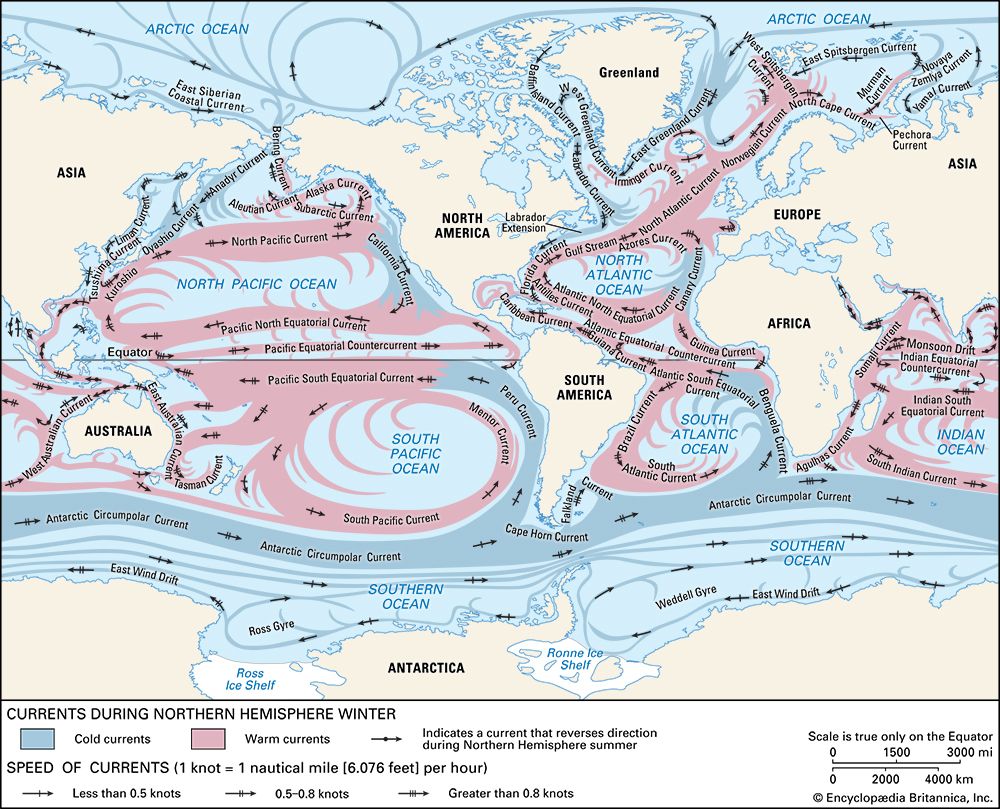
The Alaska Current is a surface oceanic current that functions as a branch of the West Wind Drift and forms a counterclockwise gyre within the Gulf of Alaska…
What is Alaska Current?
The Alaska Current is a surface oceanic current that functions as a branch of the West Wind Drift and forms a counterclockwise gyre within the Gulf of Alaska the Gulf of Alaska. It originates where the Aleutian Current approaches the North American coast and divides.1
Characterized by relatively warm Pacific waters—typically with temperatures above 39° F (4° C) and surface salinities below 32.6 parts per thousand—the current flows northward and westward along the southern Aleutian Islands. These waters eventually enter the Bering Sea, where their interaction with colder waters contributes to the formation of the Aleutian low, an atmospheric low-pressure center.23
The current is notable for its influence on the climate of Alaska’s western coasts, providing a tempering effect on the region’s temperatures. Flow velocities in its southern portion have been recorded as high as 1.7 knots.32
What is the Aleutian low and how does it influence weather?
The Aleutian low is a large, cyclonic atmospheric low-pressure center that typically persists over the Aleutian Islands region during the winter months. While it often shifts northward and nearly disappears during the summer, it remains a dominant feature of the Northern Hemisphere’s high-latitude pressure systems, alongside the Icelandic low.5
Influence on Weather and Climate
The Aleutian low plays a significant role in shaping regional weather patterns:
- Formation: It is partially driven by the interaction between relatively warm waters from the Alaska Current and the colder waters of the Bering Sea.2
- Air Mass Source: The region serves as a primary source for maritime polar air masses, which exert a major influence on the climate of the western United States.5
- Storm Activity: The system is associated with smaller, eastward-moving pressure centers that contribute to the variable and often stormy weather experienced across the North Pacific and Bering Sea coasts.52
How do ocean gyres circulate water around the globe?
Ocean gyres are vast, circular systems of ocean currents that spiral around a central point, playing a critical role in the global movement of water, heat, and nutrients. These systems are primarily driven by wind patterns and the Coriolis force, which deflects moving water due to Earth’s rotation.678
Mechanics of Circulation
- Wind-Driven Flow: Large-scale wind fields push the surface layer of the ocean. Because of the Coriolis force, this water is deflected—to the right in the Northern Hemisphere and to the left in the Southern Hemisphere—creating a clockwise or counterclockwise rotation, respectively.79
- Coriolis and Pressure: The interaction between the Coriolis force and horizontal pressure-gradient forces maintains these circular paths. In subtropical regions, this circulation creates subtropical gyres that ring high-pressure systems.69
- Westward Intensification: Due to the variation of the Coriolis force with latitude, these gyres are often “intensified” on their western sides, resulting in fast, jet-like currents such as the Gulf Stream or the Kuroshio current.10
These gyres are distinct from the slower, deeper thermohaline circulation, which is driven by density differences rather than wind.8
What is thermohaline circulation and why is it important?
Thermohaline circulation (THC), often referred to as the “great ocean conveyor belt,” is a global system of ocean currents driven by horizontal differences in temperature and salinity rather than wind.912
How It Works
The process is driven by density:
- Sinking: In polar regions, such as the North Atlantic and near Antarctica, surface water cools and becomes saltier due to ice formation and evaporation. This makes the water dense enough to sink to the seafloor.913
- Circulation: As this cold, dense water sinks, it spreads across the ocean basins, eventually upwelling to replace the surface water that moved toward the poles.914
- Speed: While wind-driven currents are vigorous and surface-level, thermohaline circulation is much slower—typically moving at about 1 centimeter per second—but it extends to the seafloor and envelops the entire global ocean.9
Why It Is Important
This circulation is vital for maintaining Earth’s equilibrium:
Sources
- Alaska Current — Encyclopædia Britannica
- Alaska - Climate of Alaska — Encyclopædia Britannica
- ocean current - Distribution of ocean currents — Encyclopædia Britannica
- Aleutian Current — Encyclopædia Britannica
- Aleutian low — Encyclopædia Britannica
- gyre — Encyclopædia Britannica
- ocean current - Coriolis effect — Encyclopædia Britannica
- ocean current - Causes of ocean currents — Encyclopædia Britannica
- thermohaline circulation — Encyclopædia Britannica
- Climate - The Gulf Stream — Encyclopædia Britannica
- subtropical gyre — Encyclopædia Britannica
- density current - Density currents originating from marginal seas — Encyclopædia Britannica
- Global warming - Ocean circulation changes — Encyclopædia Britannica
- convection — Encyclopædia Britannica
Published on · 3 min read