Aleutian Current
The Aleutian Current is a surface oceanic current that flows eastward between the Aleutian Islands and latitude 42° N. It is formed by a mixture of the…
What is Aleutian Current?
The Aleutian Current is a surface oceanic current that flows eastward between the Aleutian Islands and latitude 42° N. It is formed by a mixture of the Kuroshio (Japan Current) and the Oya Current.1
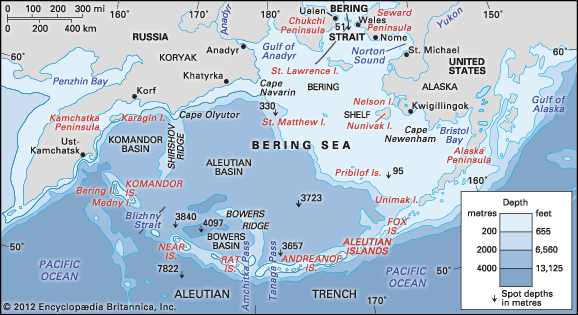
As this current approaches the North American coast, it divides into two primary branches: the Alaska Current and the California Current. Additionally, a branch of the Aleutian Current flows into the Bering Sea, where it contributes to the formation of a counterclockwise gyre. The interaction between warm oceanic waters entering the Bering Sea and the region’s cold waters is a significant factor in the development of the Aleutian low, an atmospheric low-pressure center that influences the climate of the surrounding areas.12
What is the Aleutian low and how does it influence weather?
The Aleutian low is a large, semi-permanent atmospheric low-pressure (cyclonic) center that typically forms over the Aleutian Islands region during the winter months. While it often shifts northward and nearly dissipates during the summer, its presence in winter is a defining feature of high-latitude meteorology in the Northern Hemisphere, similar to the Icelandic low.4
Influence on Weather
The Aleutian low significantly shapes regional climates through several mechanisms:
- Air Mass Source: It serves as a primary source region for maritime polar air masses, which exert a major influence on the climate of the western United States.4
- Oceanic Interaction: The system is reinforced by the mixing of relatively warm Pacific waters—carried by the Alaska Current—with the cold waters of the Bering Sea.2
- Storm Generation: The low-pressure center is associated with eastward-moving pressure systems that can bring severe weather, including high winds, blizzards, and coastal flooding, to the coasts of the Bering Sea and surrounding regions.42
How do ocean currents like the Aleutian Current affect marine life?
Ocean currents, including the Aleutian Current, play a vital role in shaping marine ecosystems and supporting biological productivity. These currents influence marine life through several key mechanisms:
- Nutrient Distribution: Currents are essential for transporting nutrients across vast distances and vertically between the seafloor and the surface. In regions of upwelling, such as those associated with the California Current, nutrient-rich deep waters are brought to the surface. This process fuels the rapid reproduction of phytoplankton and zooplankton, which in turn support abundant populations of fish and other marine animals.51
- Migration and Recruitment: Many species rely on currents to facilitate their life cycles. Fish often use currents to migrate between feeding and spawning grounds, or to transport larvae over long distances to suitable habitats. For instance, the Bering Sea benefits from the influx of Pacific waters, which contributes to its high biological productivity.346
- Habitat Regulation: Currents help determine the range of a species by moderating water temperatures and salinity. Changes in these conditions, such as those caused by global warming, can force species to migrate to new areas, potentially threatening existing habitats like those of polar bears and whales.7
What is the difference between a surface current and a deep-ocean current?
The primary difference between surface currents and deep-ocean currents lies in their driving forces and the depth at which they circulate.
Surface Currents
Surface currents are primarily driven by wind friction acting on the sea surface. This wind-driven circulation creates large, horizontal current cells known as gyres, which spiral around central points. These currents are most intense near the surface and generally diminish in speed and intensity with increasing depth. Typical surface speeds range from 5 to 50 cm per second, though some strong boundary currents can move much faster.111213
Deep-Ocean Currents
Deep-ocean circulation is dominated by thermohaline circulation, which is driven by variations in water density caused by differences in temperature and salinity. As surface water cools or increases in salinity (such as through ice formation), it becomes denser and sinks, replacing seawater at greater depths. These currents are inferred by tracking the distribution of seawater properties and density, as they move much more slowly than surface currents.121411
Sources
- Aleutian Current — Encyclopædia Britannica
- Alaska - Climate of Alaska — Encyclopædia Britannica
- Bering Sea and Strait - Hydrology — Encyclopædia Britannica
- Aleutian low — Encyclopædia Britannica
- clupeiform - Migration — Encyclopædia Britannica
- Alaska Current — Encyclopædia Britannica
- Marine ecosystem - Ocean currents — Encyclopædia Britannica
- How Do Ocean Currents Affect the Biosphere? — Encyclopædia Britannica
- California Current — Encyclopædia Britannica
- Marine ecosystem - Upwelling — Encyclopædia Britannica
- ocean current - Distribution of ocean currents — Encyclopædia Britannica
- Climate - Relationships to surface features — Encyclopædia Britannica
- seawater - Density of seawater and pressure — Encyclopædia Britannica
- ocean current — Encyclopædia Britannica
- ocean current - Pressure gradients — Encyclopædia Britannica
Published on · 3 min read