Altun Mountains
The Altun Mountains are a rugged range in northwestern China that branch off from the Kunlun Mountains. While the range is characterized by its complex…
What are some of the notable peaks or features within the Altun Mountain range?
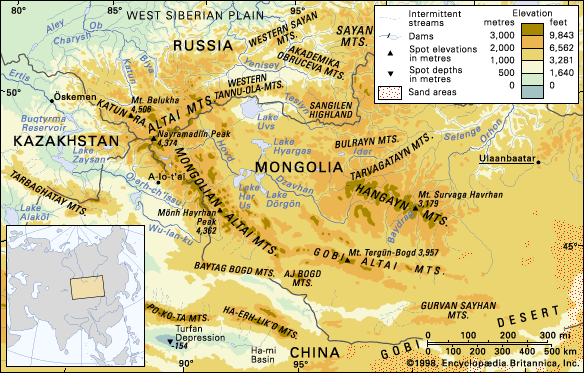
The Altun Mountains are a rugged range in northwestern China that branch off from the Kunlun Mountains. While the range is characterized by its complex topography, specific named peaks are limited in the available data:12
- Southwest Section: This area is the most rugged and complex part of the range, featuring peaks that exceed 20,000 feet (6,100 meters) and remain perpetually covered in snow.1
- Central Section: This portion is narrower and lower, with an average elevation of approximately 13,000 feet (4,000 meters).1
- Eastern Section: These peaks reach heights of 16,500 feet (5,000 meters) and structurally transition toward the Qilian Mountains.1
- Mount Muztag: The Altun Mountains branch off from the Arkatag Mountains at Mount Muztag (Muztagh), which stands at 25,338 feet (7,723 meters) and serves as the highest point in the Kunlun system.2
How do the Altun Mountains compare in height and extent to other mountain ranges in China?
The Altun Mountains serve as a significant, though secondary, mountain system in northwestern China. When compared to the country’s major ranges, their scale and elevation are distinct:
- Extent: The Altun range spans more than 400 miles (650 km), branching off from the Kunlun Mountains. While substantial, this is considerably shorter than the Kunlun system, which extends approximately 1,250 miles (2,000 km) across Central Asia.15
- Height: The range exhibits varied elevations. Its highest sections in the southwest exceed 20,000 feet (6,100 meters), placing them among the high-altitude regions of China, though they do not reach the extreme heights of the world’s tallest peaks, such as Mount Everest (29,035 feet).14
- Regional Context: Unlike the Plateau of Tibet, which averages over 13,000 feet and is considered the “roof of the world,” the Altun Mountains function primarily as a structural boundary between the Tarim Basin and the Qaidam Basin, rather than as a vast, elevated highland.14
What is the geological history of the Altun Mountains?
The geological history of the Altun Mountains is defined by significant tectonic activity, particularly during the Cenozoic Era (the past 65 million years). The range is fundamentally shaped by the Altyn Tagh Fault, an active strike-slip fault system that runs parallel to the mountains on their southern side.16
Key aspects of the range’s geological development include:
- Tectonic Displacement: The range has undergone a right-lateral displacement of at least 60 miles (100 km) due to the activity of the Altyn Tagh Fault.1
- Seismic Activity: The region remains geologically active, with frequent earthquakes associated with the fault system. This activity is a direct result of the ongoing convergence of the Indian and Arabian plates with the stable Asian continent, which has caused massive distortion across the region.67
- Structural Evolution: The Altun Mountains branch off from the Kunlun Mountains, which contain older folded structures and granitic rocks dating back approximately 250 million years. While the Altun range is a distinct structural boundary, its evolution is closely linked to the broader tectonic movements that formed the high mountain ranges and plateaus of Central Asia.167
Are there any significant natural resources found in the Altun Mountains?
The provided search results do not contain information regarding significant natural resources found specifically within the Altun Mountains. While the Altai Mountains are noted for commercially exploitable deposits of iron, gold, mercury, and other metals, this information does not apply to the Altun range.1
Sources
- Altun Mountains — Encyclopædia Britannica
- Kunlun Mountains - Physiography — Encyclopædia Britannica
- Altai Mountains - Geology — Encyclopædia Britannica
- Kunlun Mountains — Encyclopædia Britannica
- China - Relief of China — Encyclopædia Britannica
- Kunlun Mountains - Geology — Encyclopædia Britannica
- Kunlun Mountains - Study and exploration — Encyclopædia Britannica
- Asia - Chronological summary — Encyclopædia Britannica
Published on · 3 min read