Anchovy Pear
The anchovy pear (Grias cauliflora) is an evergreen tree belonging to the Lecythidaceae family, native to the West Indies.
What is anchovy pear?
The anchovy pear (Grias cauliflora) is an evergreen tree belonging to the Lecythidaceae family, native to the West Indies.1
Growing up to 15 meters (50 feet) tall, the tree features long, glossy, spear-shaped leaves and fragrant yellow flowers. It is primarily cultivated for its edible fruit, which is russet brown, pear-shaped, and contains a single seed. The fruit is rich in vitamin C and is frequently consumed as a pickle, a culinary use that earned the plant its name due to its role as an hors d’oeuvre.12
How is the anchovy pear typically prepared as a pickle?
The provided information confirms that the anchovy pear (Grias cauliflora) is historically and commonly consumed as a pickle, which serves as an hors d’oeuvre. However, the available records do not contain specific culinary instructions or traditional recipes detailing the preparation process for pickling the fruit.
What other plants belong to the Lecythidaceae family?
The Lecythidaceae family, commonly known as the Brazil nut family, comprises approximately 25 genera and 350 species of pantropical evergreen trees. Beyond the Brazil nut tree (Bertholletia excelsa), the family includes several notable trees valued for their fruits, seeds, or ornamental qualities:3
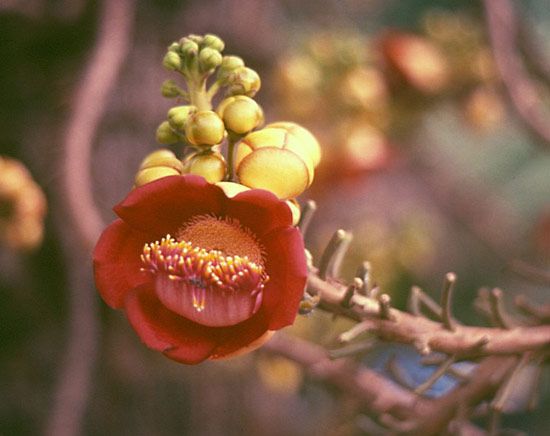
- Cannonball tree (Couroupita guianensis): A tropical tree known for its large, spherical, woody fruits.4
- Anchovy pear (Grias cauliflora): A tree native to the West Indies that produces edible, pear-shaped fruit.4
- Monkey pot (Lecythis species): A genus of large South American trees characterized by woody, capsular fruits.45
- Barringtonia: An Old World group containing about 73 species found from eastern Africa to the Pacific.3
- Eschweilera: A large Neotropical genus containing approximately 100 species.3
- Gustavia: A Neotropical genus comprising about 40 species.3
- Scytopetalum tieghemii: A species valued for its decay-resistant wood, used in parts of Africa for construction.3
What are some other unique fruits native to the West Indies?
The West Indies are home to a variety of unique and flavorful fruits, many of which have become staples in tropical cuisine. Here are some notable examples:
- Star apple (Chrysophyllum cainito): Named for the star-shaped pattern of its core, this fruit is roughly the size and shape of an apple. It features a firm, smooth skin and sweet, tasty flesh that can range in color from white to purple.
- Soursop (Annona muricata): A large, spiny, green-skinned fruit with fibrous, white flesh. Its flavor is often described as a combination of strawberry, pineapple, and citrus. It is frequently used to make refreshing drinks, custards, and ice creams.
- West Indian bullock’s-heart (Annona reticulata): A heart-shaped fruit that ripens to a yellow-brown color. When ripe, its cream-colored pulp becomes sweet and aromatic, often compared to the consistency of chilled ice cream.
- Mammee (Mammea americana): Also known as the tropical apricot, this fruit has a thick, leathery, russet-colored rind and juicy yellow or reddish flesh.
- Biriba (Rollinia mucosa): A large tree native to the West Indies that produces a delicious fruit similar to the soursop, though it features softer, blunter spines.
Sources
- anchovy pear — Encyclopædia Britannica
- anchovy pear — Merriam-Webster
- Brazil nut — Encyclopædia Britannica
- Lecythidaceae — Merriam-Webster
- Lecythis — Merriam-Webster
- Ericales - Lecythidaceae — Encyclopædia Britannica
- star apple — Encyclopædia Britannica
- Soursop — Encyclopædia Britannica
- mammee — Merriam-Webster
- Magnoliales - Fruit — Encyclopædia Britannica
- Caribbean Sea - Resources — Encyclopædia Britannica
Published on · 2 min read