Cannonball Tree
The term "cannonball tree" most commonly refers to Couroupita guianensis, a tall, soft-wooded tree in the family Lecythidaceae native to northeastern South…
What is cannonball tree?
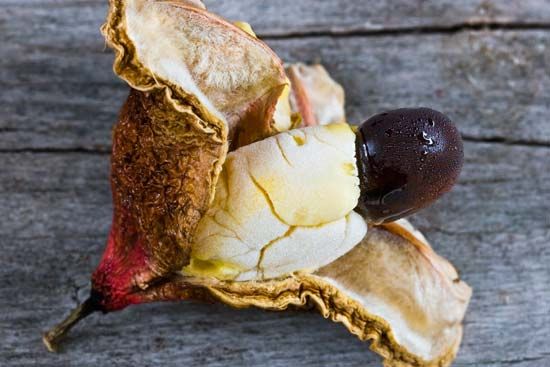
The term “cannonball tree” most commonly refers to Couroupita guianensis, a tall, soft-wooded tree in the family Lecythidaceae native to northeastern South America. It is named for its large, spherical woody fruit, which can reach 20 cm (8 inches) in diameter and resembles a rusty cannonball.12
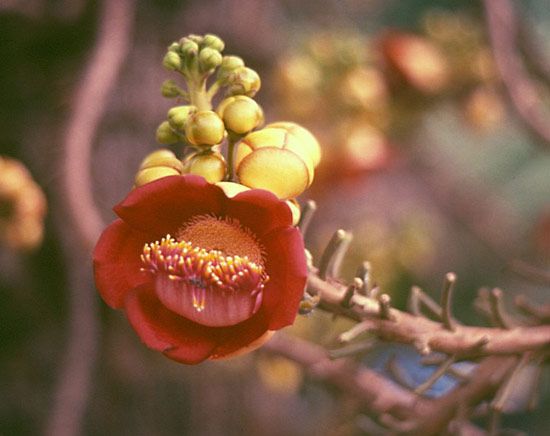
The tree is characterized by showy, fragrant flowers that grow directly from the trunk in long racemes. While the fruit contains a pulp with many seeds, its hard, woody shell is often used locally to craft utensils. Additionally, the name is sometimes applied to Xylocarpus granatum, an East Indian tree in the Meliaceae family that also produces a hard, woody fruit and provides useful timber.12
How do the flowers of the cannonball tree grow directly from the trunk?
The cannonball tree (Couroupita guianensis) exhibits a botanical phenomenon known as cauliflory. This term describes plants that produce their flowers and fruit directly from the main trunk or older, woody branches rather than from new growth or the tips of twigs.1
In the case of the cannonball tree, these showy, fragrant flowers emerge along long, woody racemes that sprout straight from the trunk. This adaptation is common among many tropical trees, as it allows for the development of large, heavy fruits—like the tree’s namesake “cannonballs”—that might otherwise be too cumbersome to be supported by thinner, younger branches. It is important to note that this process is entirely distinct from the development of the vegetable known as cauliflower, which is a cultivated variety of cabbage that forms an edible, immature inflorescence.314
What are some other unique fruits found in tropical rainforests?
Tropical rainforests are home to an incredible diversity of unique fruits, many of which possess distinct flavors, textures, and biological characteristics. Here are several notable examples:
- Durian: Often called the “king of fruits” in Southeast Asia, this large, spiny fruit is famous for its intense, pungent odor—which has led to it being banned from some public transportation—and its rich, custard-like pulp.567
- Mangosteen: Native to Southeast Asia, this fruit features a thick, deep-red rind protecting segments of snow-white, tangy-sweet flesh that is highly prized for its delicate texture.86
- Cupuaçu: A relative of cacao found in the Amazon, this “superfruit” is known for its creamy white pulp, which offers a unique flavor profile often described as a blend of chocolate and pineapple.6
- Ice Cream Bean: This South American tree produces giant bean pods that can reach up to one meter in length; the seeds are surrounded by a juicy, sweet pulp that tastes remarkably like vanilla ice cream.6
- Miracle Fruit: Native to West Africa, this small red drupe contains a glycoprotein called miraculin. When consumed, it temporarily binds to taste buds, causing sour or acidic foods to be perceived as sweet.9
- Jackfruit: Recognized as the largest tree-borne fruit, it can weigh up to 36 kg (80 pounds). Its flavor is often described as a combination of apple, pineapple, mango, and banana.6
- Salak: Also known as “snake fruit” due to its scaly, reddish-brown skin, this palm-grown fruit contains lobes that are sweet, acidic, and reminiscent of pineapple.6
How do animals interact with the hard fruit of the cannonball tree?
The provided search results do not contain information regarding how animals interact with the fruit of the cannonball tree. While the fruit is known to be large, spherical, and pulpy with a hard woody shell, the specific ecological interactions between local fauna and the fruit are not detailed in the available documentation.
Sources
- cannonball tree — Encyclopædia Britannica
- cannonball tree — Merriam-Webster
- cauliflorous — Merriam-Webster
- Cauliflower — Encyclopædia Britannica
- miracle fruit — Encyclopædia Britannica
- mangosteen — Encyclopædia Britannica
- durian — Encyclopædia Britannica
- Magnoliales - Fruit — Encyclopædia Britannica
- 8 Fruits to Try Before You Die — Encyclopædia Britannica
- durian — Merriam-Webster
- South America - Tropical and subtropical rainforests — Encyclopædia Britannica
Published on · 3 min read