Are Civet Cats and Genet Cats the Same Animals?
Although they share a similar appearance and belong to the same family, civet cats and genet cats are not the same animals. In fact, both names are…
Are civet cats and genet cats the same animals?
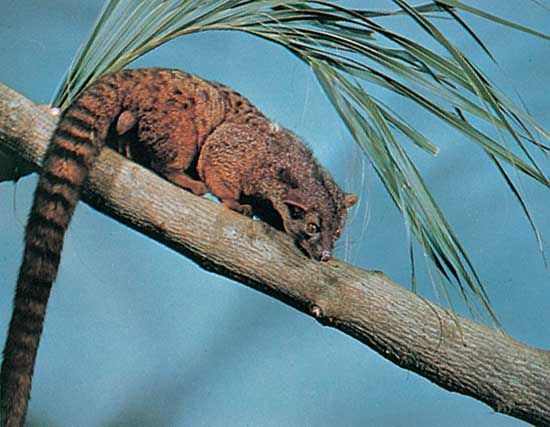
Although they share a similar appearance and belong to the same family, civet cats and genet cats are not the same animals. In fact, both names are misnomers, as these creatures are members of the Viverridae family and are not true cats.1
While both are slender-bodied, long-tailed, and short-legged, they differ in several key ways:
- Classification: Civets comprise 15 to 20 species across 10 to 12 genera, whereas all 14 species of genets belong to a single genus, Genetta.12
- Physical Build: Civets are generally larger and stockier with coarser fur. Genets are more slender and elongated.1
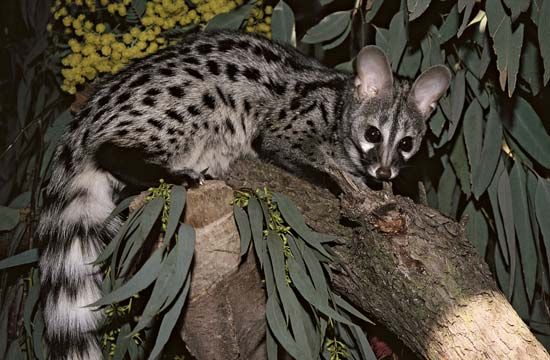
- Markings: Civets often feature a dorsal stripe that extends into the tail, which typically ends in a solid dark color. Genets have a dorsal stripe that stops at the base of the tail, and their tails are prominently banded to the very tip.1
- Behavior: Genets are known for being agile and are the only viverrids capable of standing on their hind legs.1
What other animals belong to the Viverridae family?
The Viverridae family consists of 35 species of small, secretive Old World mammals. While civets, genets, and linsangs are the most well-known members, the family includes a diverse range of animals categorized into six subfamilies.42
Key members of the Viverridae family include:
- Binturong: Also known as the bearcat, this arboreal mammal is the only member of the genus Arctictis.42
- Fossa: A cat-like carnivore native to Madagascar, belonging to the genus Cryptoprocta.42
- Palm Civets: Various species such as the masked palm civet (Paguma larvata), golden palm civet (Paradoxurus zeylonensis), and the African palm civet (Nandinia binotata).2
- Linsangs: Small, slender carnivores including the spotted linsang and the African linsang.42
- Specialized Species: This includes unique animals like the otter civet (Cynogale bennettii), the aquatic genet (Osbornictis piscivora), and the falanouc (Eupleres goudotii).2
These animals are primarily found in forests and dense vegetation, relying on scent glands for communication and exhibiting a wide variety of dietary habits ranging from strictly carnivorous to frugivorous.2
How do civets and genets differ from true cats?
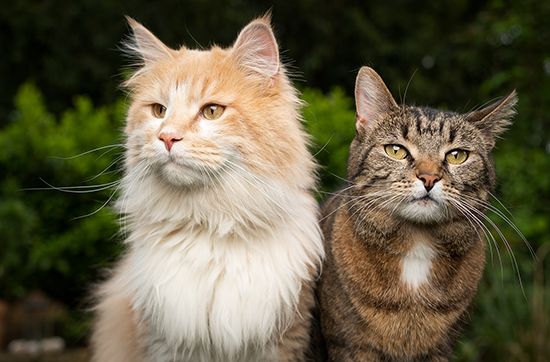
While civets and genets are often referred to as “cats” due to their appearance, they are not true cats. Both animals belong to the family Viverridae, and the use of “cat” in their common names is a misnomer.1
Although they share the same suborder as cats—Feliformia—viverrids differ from true cats in several distinct anatomical ways:
- Snout and Legs: Viverrids possess longer, more tapered snouts and shorter legs compared to the typical feline build.12
- Toes: While cats generally have four toes on their hind feet, viverrids typically have five.1
- Body Structure: Viverrids are characterized by a more elongated, slender body structure than most true cats.12
These animals are secretive, small-toothed mammals native to the Old World, whereas true cats belong to the family Felidae. While they may exhibit some cat-like behaviors, such as being agile climbers, their evolutionary path and physical characteristics set them apart from the feline family.12
What is the purpose of the scent glands in viverrids?
In the family Viverridae, scent glands play a vital role in communication and social interaction. Most viverrids possess anal scent glands that open into a pouch under the tail, where they store a greasy, musklike secretion.62
The primary purpose of these secretions is scent marking, which allows these animals to establish and advertise their territories. By depositing this material, individuals can communicate their presence to others of their species. While the secretions of many species are described as strong or disagreeable, those of the African civet are notably musky and pleasant, a quality that has led to their historical use in the perfume industry.726
Because viverrids are generally small, secretive, and often nocturnal, they rely heavily on these chemical cues to navigate their environment and interact with others. While the exact mechanisms of how they perceive these markers are still being studied, it is suspected that the vomeronasal organ (Jacobson organ) plays a significant role in processing these complex chemical signals.76
Sources
- Are civet cats and genet cats the same animals? — Encyclopædia Britannica
- viverrid — Encyclopædia Britannica
- civet — Encyclopædia Britannica
- list of viverrids — Encyclopædia Britannica
- Viverridae — Merriam-Webster
- Chemoreception - Territorial behavior — Encyclopædia Britannica
- artiodactyl - Scent glands — Encyclopædia Britannica
- civet — Merriam-Webster
Published on · 3 min read