Viverrid
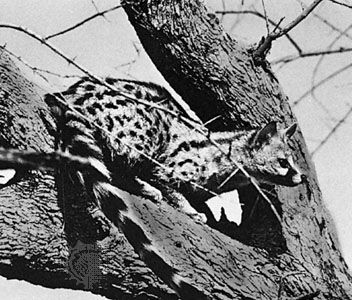
Viverrids (family Viverridae) are small mammals native to the Old World, a term historically used to refer to Africa, Asia, and Europe.
In what regions of the world are viverrids primarily found?
Viverrids (family Viverridae) are small mammals native to the Old World, a term historically used to refer to Africa, Asia, and Europe.12
Their distribution across these regions is diverse:
- Africa: Many species are found throughout the continent, including various genets and the African civet.2
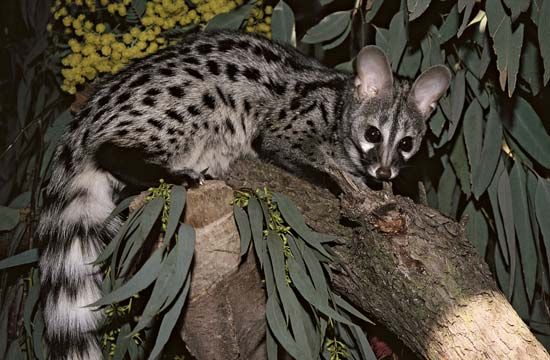
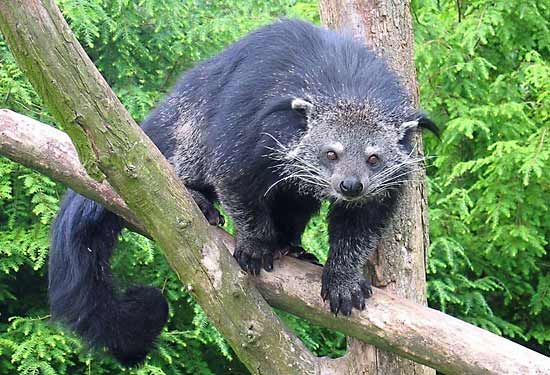
- Asia: Numerous species, such as palm civets, the binturong, and Oriental linsangs, are native to Asian forests and habitats.2
- Europe: The European genet is found in parts of Spain, Portugal, and France.2
- Madagascar: The island is home to unique species, including the fossa.2
Because they are often secretive and inhabit dense vegetation, many viverrids are poorly known, and some species are restricted to very small geographic areas or specific islands.2
What is the evolutionary history of viverrids, and how are they related to other carnivorous mammals?
The evolutionary history and classification of viverrids (family Viverridae) remain complex, as they are inferred from a limited fossil record and ongoing comparative studies of modern species.1
Evolutionary Relationships
Viverrids belong to the suborder Feloidea (or Aeluroidea), a group of terrestrial carnivores that also includes Felidae (cats) and Hyaenidae (hyenas). Within this superfamily, Viverridae and Hyaenidae are considered the most closely related, while the Felidae are viewed as the most divergent.1
Taxonomic classification is often in flux; for instance, the fossa of Madagascar is traditionally regarded as a viverrid but possesses characteristics of cats, leading some to alternatively place it within the Felidae or Herpestidae families. Because Viverridae contains diverse evolutionary lines, it is divided into six subfamilies, reflecting a significant amount of evolutionary divergence over time.14
Relation to Other Carnivores
The order Carnivora is broadly divided into two superfamilies:
- Canoidea: Includes families such as Canidae, Ursidae, Procyonidae, and Mustelidae. Some primitive mustelids show resemblances to primitive viverrids.1
- Feloidea: Includes Viverridae, Hyaenidae, and Felidae.1
While formal classification systems are often used for convenience, they aim to reflect these real evolutionary relationships, which are increasingly clarified through DNA analysis and genetic research.1
Are there any viverrids that are considered endangered, and what conservation efforts are in place to protect them?
Several species within the family Viverridae are currently facing the threat of extinction, as documented by the IUCN Red List of Threatened Species.7
Endangered Viverrids
- Malabar civet (Viverra civettina): Once widespread in the Western Ghats of India, this species is critically endangered and has not been sighted in the wild since the 1990s. Its decline is primarily attributed to the conversion of its forest habitat into agricultural land and retaliatory killings following attacks on livestock.78
- Sunda otter civet (Cynogale bennetti): Native to the Malay Peninsula, Sumatra, and Borneo, this semiaquatic species is also listed as being in danger of extinction.7
Conservation Context
While specific, large-scale recovery programs are not detailed in the provided records, the primary threats to these animals—habitat destruction and human-wildlife conflict—highlight the urgent need for forest preservation and the development of coexistence strategies between local agricultural communities and these rare carnivores.8
What are the main characteristics of viverrids that distinguish them from other carnivorous mammals?
Viverrids (family Viverridae) are a group of 35 species of small, secretive Old World mammals, including civets, genets, and linsangs. They are distinguished from other carnivorous mammals by several key physical and behavioral characteristics:
- Morphology: Most species possess slender bodies, elongated heads with tapered muzzles, and long tails. Their short legs typically end in four- or five-toed feet.
- Scent Communication: A defining feature for many is the presence of anal scent glands. In civets, these glands produce secretions stored in a pouch used for scent marking, which has historically been harvested for the perfume industry.
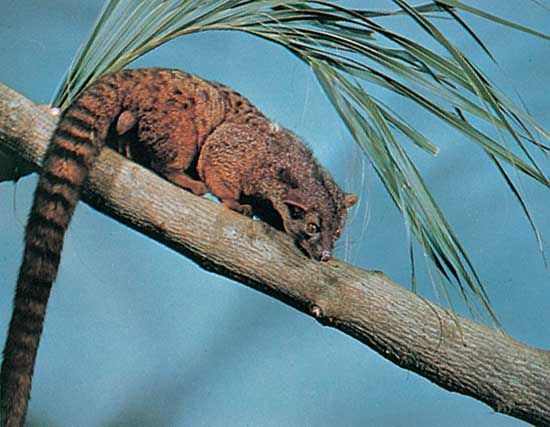
- Dietary Adaptability: While primarily carnivorous—feeding on small rodents, birds, reptiles, and insects—many species are omnivorous. For example, palm civets are largely frugivorous, a habit reflected in their flatter, broader molars compared to more strictly carnivorous members of the family.
- Habitat and Behavior: Viverrids are generally forest-dwelling and secretive. Many are adept climbers, with some species like the binturong and fossa spending most of their lives in trees, while others are semiaquatic.
Sources
- list of viverrids — Encyclopædia Britannica
- viverrid — Encyclopædia Britannica
- viverrid — Merriam-Webster
- carnivore - Critical appraisal — Encyclopædia Britannica
- Viverridae — Merriam-Webster
- linsang — Encyclopædia Britannica
- civet — Encyclopædia Britannica
- 10 Critically Endangered Animals of India - Malabar civet ( Viverra civettina ) — Encyclopædia Britannica
Published on · 3 min read