African Goliath Beetle
The African goliath beetle (Goliathus goliatus) is a large, strikingly colored scarab beetle native to the rainforests and savannas of equatorial Central and…
What is African goliath beetle?
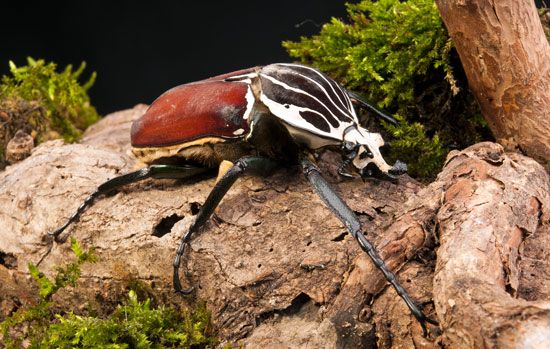
The African goliath beetle (Goliathus goliatus) is a large, strikingly colored scarab beetle native to the rainforests and savannas of equatorial Central and West Africa.1
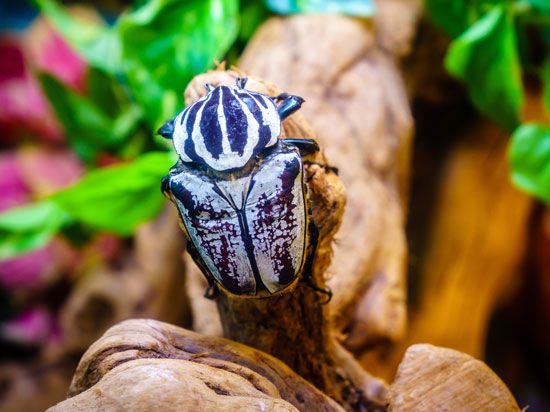
While the adult beetle is among the largest insects in the world, its larval form is particularly notable as one of the heaviest, reaching weights of 80–100 grams. Adults typically measure up to 110 mm in length and possess a stout, oval-shaped body with distinct color patterns, often featuring a white pronotum with bold black stripes.1
These beetles are omnivores that feed primarily on sap and fruit. Their conservation status remains unknown due to a lack of formal assessment, though they face threats from habitat loss, deforestation, and overharvesting for the black market trade.1
How does the metamorphosis process work for beetles?
Beetles undergo a process known as complete metamorphosis, which consists of four distinct developmental stages: egg, larva, pupa, and adult.23
- Egg: The life cycle begins when a female lays eggs, typically in soil or decaying organic matter.23
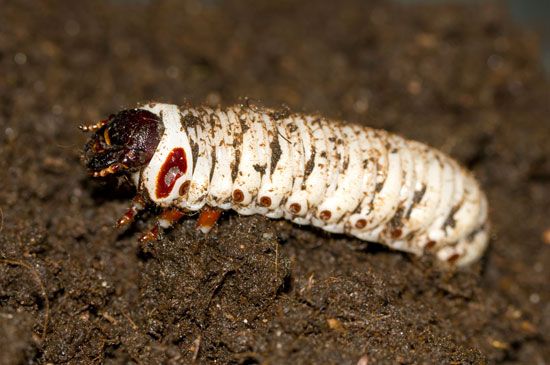
- Larva: Upon hatching, the larva feeds and grows. Because its skin (cuticle) does not stretch, the larva must undergo a process called molting, where it sheds its old skin to accommodate its increasing size. This typically occurs three to five times until the larva reaches maturity.2
- Pupa: After a nonfeeding prepupal stage, the insect enters the pupal stage. The pupa forms beneath the final larval skin. During this phase, the insect undergoes significant internal and external changes, developing adult characteristics such as wings and hardened structures. Many species construct a protective cell or cocoon of frass or other materials to shelter the pupa during this transformation.241
- Adult: Finally, the adult emerges from the pupal skin. Its skeleton hardens and gains color, marking the completion of the life cycle.21
What are some other examples of giant insects?
While most arthropods are small, several species have evolved to reach impressive sizes. Here are some notable examples of giant insects and related invertebrates:
- Atlas moth: Native to Southeast Asian rainforests, this moth is one of the largest in the world, with a wingspan reaching up to 25–30 cm (10–12 inches).567
- Giant wētā: Found on islands off the coast of New Zealand, these heavy, flightless relatives of crickets are classic examples of island gigantism, with some specimens weighing over 70 grams.57
- Walkingstick (Phryganistria chinensis): This insect is among the longest in the world, with a recorded specimen measuring 62.4 cm (about 2 feet) in length.5
- Rhinoceros beetle (Megasoma actaeon): While adults are large, the larvae of this species are particularly massive, sometimes exceeding 200 grams.5
- Queen Alexandra’s birdwing (Ornithoptera victoriae): This butterfly from the Solomon Islands features a wingspan that can exceed 30 cm (about 1 foot).5
Why is the larval stage of the goliath beetle so much heavier than the adult?
The larval stage of the African goliath beetle is significantly heavier than the adult because it serves as the primary period for growth and energy accumulation. During this stage, the larva—a massive, grub-like creature—feeds voraciously on decaying plant matter, dung, and decomposing animals to build the protein reserves necessary for its development.1
In contrast, the adult beetle does not grow in size once its outer skeleton has hardened. While the adult is still a large insect, its weight is limited by the physical constraints of its rigid exoskeleton. The larva, however, possesses a more flexible body that can accommodate substantial mass as it prepares for metamorphosis. Before pupating, the larva reaches its peak weight of 80–100 grams, whereas the adult typically weighs between 40–60 grams. This weight reduction occurs as the insect undergoes the transformative process of the pupal stage, during which it transitions into its final, fixed-size adult form.21
Sources
- African goliath beetle — Encyclopædia Britannica
- Coleoptera - General features — Encyclopædia Britannica
- Lepidoptera - Growth, molting, and metamorphosis — Encyclopædia Britannica
- Coleoptera - Pupae — Encyclopædia Britannica
- arthropod - Size range — Encyclopædia Britannica
- atlas moth — Encyclopædia Britannica
- Big Bugs and Colossal Crabs: 7 Invertebrates of Unusual Size — Encyclopædia Britannica
- heteropteran - Metamorphosis — Encyclopædia Britannica
- Dormancy - Diapause in insects — Encyclopædia Britannica
Published on · 3 min read