Banda Islands
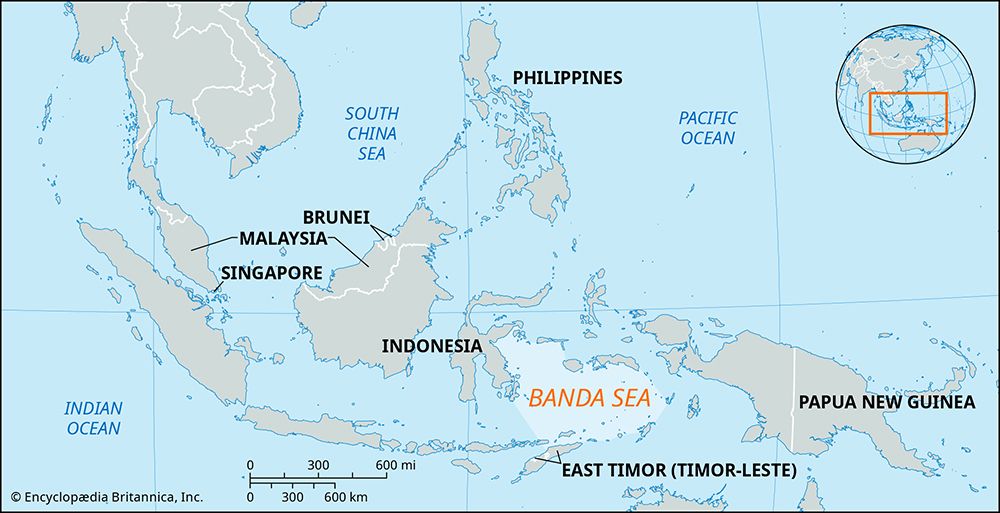
The Banda Islands are an archipelago consisting of nine islands located in the Banda Sea within the Maluku province of Indonesia.
What are the main islands that make up the Banda Islands archipelago?
The Banda Islands are an archipelago consisting of nine islands located in the Banda Sea within the Maluku province of Indonesia.
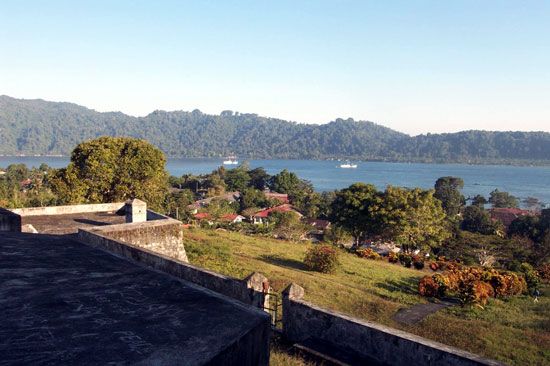
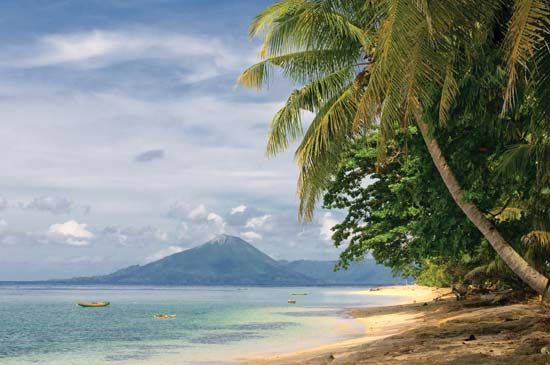
While the archipelago comprises nine islands in total, the primary islands mentioned include:
- Great Banda (Banda Besar): The largest island in the group, covering a significant portion of the total 17-square-mile land area.1
- Mount Api: An active volcanic island that reaches an elevation of 2,200 feet.1
- Bandanaira: An island that serves as the administrative and commercial hub, housing the capital and port city of the same name.1
The islands are historically significant for their role in the global nutmeg trade and their complex colonial history involving the Netherlands and Portugal.1
What is the historical importance of the Banda Islands in the spice trade?
The Banda Islands held immense historical importance as the world’s sole source of nutmeg for centuries, making them a focal point of intense colonial competition. Because the islands’ volcanic soil was uniquely suited for nutmeg production, European powers sought to establish total control over the trade to secure massive profits.12
Following their annexation by the Portuguese in 1512, the islands became a battleground between the Portuguese, the English, and the Netherlands. The Dutch East India Company eventually emerged as the dominant force, driven by a ruthless pursuit of monopoly. Under the leadership of Governor General Jan Pieterszoon Coen, the Dutch enforced their control through extreme violence; in 1621, they massacred thousands of the local inhabitants of Great Banda who resisted their commercial demands.123
This brutal consolidation of power allowed the Dutch to dominate the spice trade, effectively turning the region into a plantation-based economy worked by laborers brought from neighboring islands. The islands remained a key asset for the Dutch until they were finally restored to them by the Treaty of Paris in 1814.12
How did the Banda Islands play a role in the global nutmeg trade?
The Banda Islands were historically pivotal to the global spice trade because their volcanic soil provided the ideal environment for the cultivation of nutmeg, which is indigenous to the region.1
During the 17th century, the Dutch East India Company sought to establish a total commercial monopoly over this valuable commodity. To achieve this, the company restricted the production of nutmeg and mace exclusively to the Banda Islands. This strategy was enforced through a system of forced deliveries, where local cultivators were compelled to sell their produce to the company at set prices, effectively turning the islands into a plantation-based economy.41
The islands were a site of intense colonial rivalry, initially annexed by the Portuguese in 1512 before being contested by the English and the Netherlands. The Dutch eventually secured control, utilizing their superior military force to displace indigenous traders and consolidate their power over the archipelago’s export trade.14
How did Dutch colonization impact the Banda Islands and their native population?
Dutch colonization of the Banda Islands was characterized by a ruthless pursuit of a nutmeg monopoly, which resulted in the near-total destruction of the native population. Under the leadership of Jan Pieterszoon Coen, the Dutch East India Company enforced its commercial dominance through extreme violence.15
In 1621, when the inhabitants of Great Banda resisted Dutch demands, Coen ordered a massacre that killed approximately 2,500 people, while another 800 were forcibly transported to Batavia2. This systematic removal of the indigenous people fundamentally altered the islands’ demographics. To maintain the nutmeg plantations, the Dutch subsequently imported laborers from Java, Makassar, and other neighboring islands. Consequently, the modern population of the Banda Islands consists largely of the descendants of these imported laborers rather than the original inhabitants.2
This transition transformed the islands into a plantation-based economy, where the Dutch exerted total control over production and trade, effectively replacing traditional indigenous commercial patterns with a rigid, colonial monopoly.253
Sources
- Banda Islands — Encyclopædia Britannica
- Western colonialism - Eastern pursuits — Encyclopædia Britannica
- history of Indonesia - Expansion of European influence — Encyclopædia Britannica
- history of Indonesia - Growth and impact of the Dutch East India Company — Encyclopædia Britannica
- Jan Pieterszoon Coen — Encyclopædia Britannica
Published on · 3 min read