Barbet
Barbets are a diverse family of tropical birds known for their stout bills and often vibrant plumage. While many species feature greenish or brownish tones…
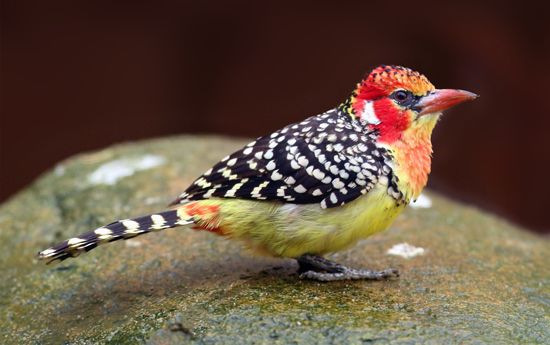
What are some of the most colorful or unique barbet species?
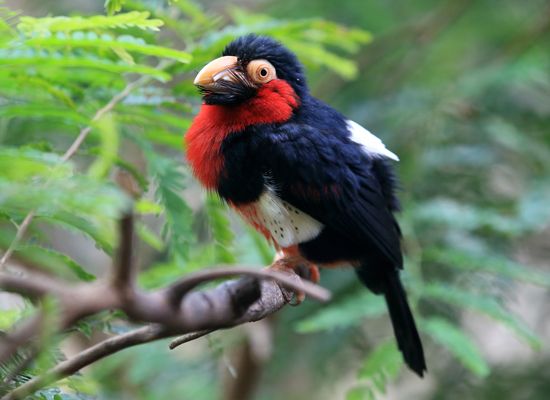
Barbets are a diverse family of tropical birds known for their stout bills and often vibrant plumage. While many species feature greenish or brownish tones, they are frequently accented with striking splashes of bright color.1
Some of the most notable species include:
- Crested Barbet (Trachyphonus vaillantii): Found in southern and eastern Africa, this large species is particularly unique for its bright red and yellow markings and a distinctive small crest of dusky feathers.2
- Coppersmith Barbet (Megalaima haemacephala): Native to Asia, this bird is well-known for its loud, ringing call, which is often described as metallic or rhythmic.1
- Tinkerbirds (genus Pogoniulus): These are the smallest members of the barbet family and are recognized for their repetitive, high-pitched vocalizations.1
These birds are generally nonmigratory and are known for their habit of nesting in holes excavated in rotting trees or termite mounds.1
In which regions of the world can barbets be found?
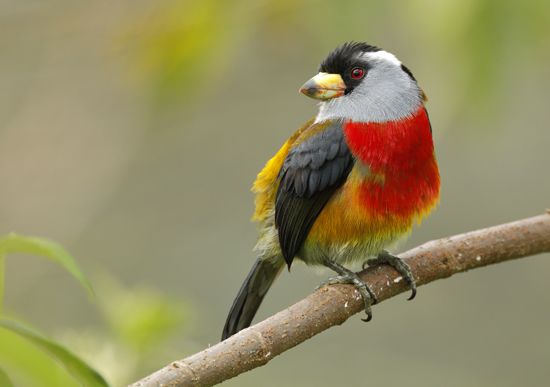
Barbets are found across several tropical regions of the world. Their distribution spans the following areas:
- The Americas: From Central America to northern South America.1
- Africa: Throughout sub-Saharan Africa.1
- Asia: Across Southeast Asia, extending eastward as far as Borneo and Bali.1
These birds are primarily arboreal and are known for being nonmigratory, typically residing in these tropical zones year-round.13
How do barbets build their nests and what are their breeding habits?
Barbets exhibit fascinating nesting and breeding behaviors, often characterized by their ability to excavate their own cavities despite lacking the specialized, chisel-tipped bills of woodpeckers.
Nesting Habits
- Excavation: Both sexes participate in digging nest holes, typically in dead, well-rotted trees. Because their bills are not specialized for wood-boring, this is a labor-intensive process. Occasionally, species may burrow into the ground or into termite nests.1
- Nest Structure: The cavity usually features a small, round entrance. Notably, barbets do not use any lining material inside the nest chamber, laying their eggs directly on the bare floor.1
- Reuse: The same cavity may be utilized for multiple nesting seasons. Additionally, some species excavate separate “dormitory” holes specifically for roosting at night.1
Breeding and Social Behavior
- Sociality: While many barbets nest in isolated pairs, there is a strong trend toward sociality. Some species, such as the plain-coloured barbets (Gymnobucco), nest colonially and can be quite aggressive, sometimes taking over entire trees.1
- Incubation and Care: A clutch typically consists of two to five white eggs. Both parents share incubation duties—which last 13 to 15 days or more—and both may spend the night in the nest. Adults are diligent about nest hygiene, actively removing excreta.1
- Development: The young develop slowly, often remaining in the nest for 30 days or more. Even after fledging, family groups may continue to roost together in a shared dormitory hole.1
What are the typical feeding habits and diet of barbets?
Barbets are primarily omnivorous birds that consume a varied diet consisting of insects, fruit, berries, flowers, and buds. Their feeding habits and dietary preferences can be summarized as follows:15
- Diverse Diet: While many species rely heavily on fruit and berries, they also frequently consume insects, lizards, and even birds’ eggs. Some species are known to supplement their diet with flowers and buds.15
- Foraging Techniques: Barbets are often observed sitting stolidly in treetops while waiting to feed. Some species, such as the African tinkerbirds, forage rapidly over tree bark, occasionally tapping with their beaks in a manner similar to piculets.15
- Specialized Adaptations: Certain barbets possess serrated or “toothed” edges on their bills, which are believed to assist them in tearing open fruit.5
- Ecological Role: As fruit-eating birds, barbets play a significant role in seed dispersal. They consume fruits and later excrete or regurgitate the hard, embryo-containing seeds undamaged, which helps distribute plant species across their tropical habitats.6
Sources
- barbet — Encyclopædia Britannica
- crested barbet — Merriam-Webster
- Capitonidae — Merriam-Webster
- piciform - Reproduction — Encyclopædia Britannica
- seed - Dispersal by birds — Encyclopædia Britannica
- piciform - Distribution and ecology — Encyclopædia Britannica
Published on · 3 min read