Barnacle Goose
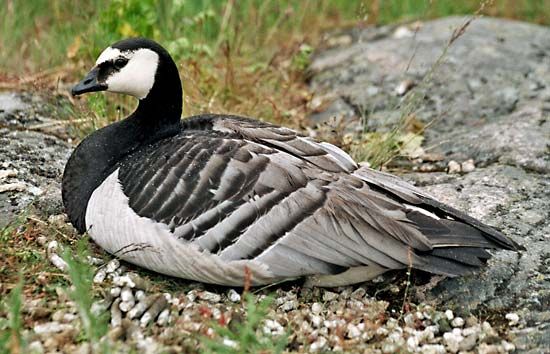
The barnacle goose (Branta leucopsis) is a water bird belonging to the family Anatidae. It is a small goose characterized by a dark back, a white face, and a…
What is Barnacle goose?
The barnacle goose (Branta leucopsis) is a water bird belonging to the family Anatidae. It is a small goose characterized by a dark back, a white face, and a black neck and bib. These birds breed in the Arctic and winter in the northern British Isles and along the coasts of Denmark, Germany, and the Netherlands.123
During the European Middle Ages, a curious myth emerged suggesting that these geese hatched from barnacles. Because of this belief, the birds were classified as “fish” and were permitted to be eaten on Fridays. Similarly, the brant was historically referred to as a “barnacle” in Ireland for the same reason. Like other geese, the barnacle goose is a migratory species that travels in flocks, often utilizing V-formations to conserve energy during flight.124
Why did people in the Middle Ages believe these geese hatched from barnacles?
The medieval belief that barnacle geese hatched from barnacles arose primarily because the birds were migratory and their breeding grounds in the high Arctic were unknown to Europeans at the time. Because the geese were never observed breeding locally, people sought an explanation for their sudden appearance each autumn.1
This myth was reinforced by the observation of pedunculate barnacles, specifically the Lepas species, which often washed ashore on driftwood after autumn gales. To the medieval observer, the feathery, tentacle-like feeding appendages (cirri) of these barnacles resembled the downy feathers of a young bird. Consequently, people concluded that the barnacles were the embryonic stage of the geese, which were thought to grow out of wood steeped in seawater or even from trees.15
Because the geese were believed to originate from shellfish rather than from land-based flesh, they were classified as “fish” by some, allowing them to be consumed on religious fasting days when meat was prohibited. The Swedish botanist Carolus Linnaeus later acknowledged this myth by naming the genus Lepas and using species names that translate to “goose-bearing”.61
How do geese use V-formations to conserve energy during migration?
Geese travel in V-formations during migration to conserve energy by taking advantage of air currents, known as vortices, that are created by the wing tips of the birds flying in front of them.2
By positioning themselves in this formation, the birds following the leader can benefit from the aerodynamic lift generated by the preceding geese. This behavior is a form of cooperative flight, where members of the flock often take turns leading the formation before dropping back to fly in the wake of others, allowing them to reduce the physical effort required for long-distance travel.4
What are the main differences between ‘gray geese’ and ‘black geese’?
The primary distinction between “gray geese” and “black geese” lies in their biological classification within the family Anatidae. These terms refer to two distinct genera of waterfowl:
- Gray Geese (Anser): This genus comprises what are considered the “typical” geese. They are characterized by large, strongly serrated bills, relatively simple plumage patterns, and comparatively short necks. Modern domestic geese are largely descended from species within this group, specifically the greylag and the swan goose.27
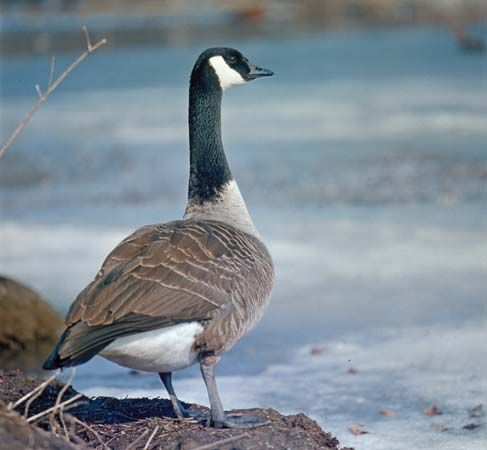
- Black Geese (Branta): This genus includes species such as the Canada goose, the barnacle goose, the brant, and the nene.2
While both groups share general characteristics—such as being large, heavy-bodied birds that pair for life and travel in V-formations—they are taxonomically separated into these two primary genera.2
Sources
- Barnacle goose — Encyclopædia Britannica
- Goose — Encyclopædia Britannica
- barnacle goose — Merriam-Webster
- Migration - Modes of migration — Encyclopædia Britannica
- cirripede - Importance to humans — Encyclopædia Britannica
- tree goose — Merriam-Webster
- Anser — Merriam-Webster
- White-fronted goose — Encyclopædia Britannica
Published on · 3 min read