Barylambda
Barylambda is an extinct genus of aberrant, herbivorous mammals that lived in North America during the late Paleocene Epoch, approximately 58.7 to 55.8…
What is Barylambda?
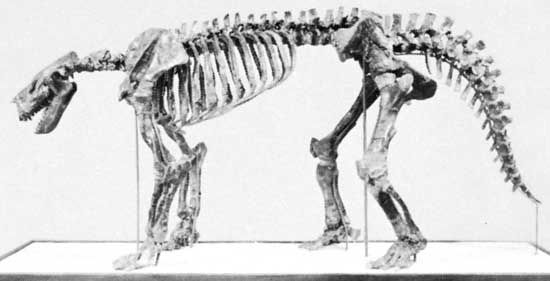
Barylambda is an extinct genus of aberrant, herbivorous mammals that lived in North America during the late Paleocene Epoch, approximately 58.7 to 55.8 million years ago.1
As one of the largest animals of its time, Barylambda reached lengths of about 2.5 metres (8 feet) and possessed a notably massive body with thick, powerful legs. It featured a small, short skull and broad feet with five digits. A distinctive anatomical feature was its very thick tail, which likely served as a support, enabling the animal to raise itself on its hind legs—a trait sometimes compared to the posture of kangaroos. Additionally, it retained clavicles, which is considered a primitive characteristic among hoofed mammals. It is believed that this creature subsisted on soft, easily chewed vegetation.12
What are the characteristics of the order Pantodonta?
The order Pantodonta consists of a group of primitive ungulate mammals. These animals were small but widely distributed across North America, Europe, and Asia.4
The fossil record indicates that this order existed from the Paleocene Epoch through the Oligocene Epoch. While the provided search results confirm their classification as primitive ungulates, they do not offer further specific anatomical or behavioral characteristics for the order as a whole.4
What was the environment like during the Paleocene Epoch?
The Paleocene Epoch, spanning from 66 million to 56 million years ago, was a transformative period following the mass extinction that ended the Cretaceous Period.
Climate and Geography
The climate during the Paleocene, particularly in North America, was marked by a general warming trend with little to no frost, characterized by alternating wet and dry seasons. Late in the epoch, the world experienced the Paleocene-Eocene Thermal Maximum (PETM), a 100,000-year interval of intense global warming where temperatures rose by more than 5 °C (9 °F). Geographically, the continents continued to drift; notably, Australia began its separation from Antarctica toward the end of the epoch.589
Biological Environment
The absence of dinosaurs allowed for the rapid proliferation and adaptive radiation of mammals. This era saw the emergence of early primates, archaic ungulates, and primitive carnivores like creodonts. Marine life, which had suffered during the end-Cretaceous extinction, gradually recovered, with mollusks and plankton diversifying significantly by the Late Paleocene.510
How do scientists determine the diet of extinct mammals?
Scientists determine the diet of extinct mammals and other prehistoric animals by analyzing several lines of physical evidence:
- Dental Morphology: The shape and structure of teeth are primary indicators of diet. Sharp, high cusps suggest a diet of flesh or chitinous material, while low, rounded cusps (bunodont) are typical of omnivores. Herbivores often possess specialized cheek teeth for grinding, incisors for nipping, or a diastema (a gap in the tooth row).11
- Direct Evidence: Occasionally, researchers find fossilized remains of food within the stomach region of a skeleton, such as pine needles found in a hadrosaur or lizard bones inside a Compsognathus.1213
- Coprolites: Fossilized feces provide direct evidence of what an animal consumed, such as crushed bone found in the droppings of a tyrannosaur.13
- Gastroliths: The presence of “stomach-stones” or gastroliths associated with a skeleton can indicate a digestive system adapted to pulverizing tough plant material.1214
- General Body Plan: Features such as claw strength, skull shape, and limb structure can reveal specialized feeding habits, such as myrmecophagy (ant-eating).11
Sources
- Barylambda — Encyclopædia Britannica
- Antoine-Louis Barye — Encyclopædia Britannica
- Barylambda — Merriam-Webster
- Pantodonta — Merriam-Webster
- Paleocene Epoch — Encyclopædia Britannica
- scorpion - Distinguishing taxonomic features — Encyclopædia Britannica
- primate - Paleocene — Encyclopædia Britannica
- Paleocene-Eocene Thermal Maximum — Encyclopædia Britannica
- Cenozoic Era - Cenozoic life — Encyclopædia Britannica
- Tertiary Period - Paleogeography — Encyclopædia Britannica
- mammal - Teeth — Encyclopædia Britannica
- dinosaur - The plant eaters — Encyclopædia Britannica
- geology - Paleontology — Encyclopædia Britannica
- dinosaur - The flesh eaters — Encyclopædia Britannica
- stomach — Encyclopædia Britannica
Published on · 2 min read