Basket-flower
The term "basket-flower" most commonly refers to Plectocephalus americanus (also known as Centaurea americana), an annual wildflower in the Asteraceae family…
What is Basket-flower?
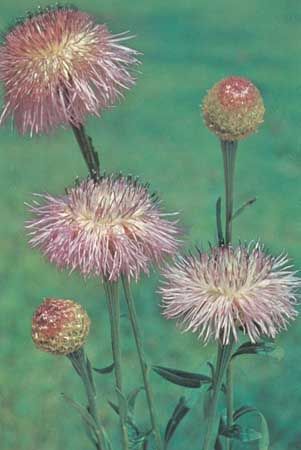
The term “basket-flower” most commonly refers to Plectocephalus americanus (also known as Centaurea americana), an annual wildflower in the Asteraceae family native to southwestern North America1.1
This plant grows up to 150 cm (5 feet) tall and features stout, branching stems with alternate leaves. It is often cultivated in gardens to attract butterflies and birds. Its appearance is similar to a spineless thistle, characterized by rose-colored, compact flower heads surrounded by fringed bracts that resemble a woven basket. The seeds are produced in achene fruits and are dispersed by the wind.2
Additionally, the name “basket flower” is sometimes used to describe the spider lily (Hymenocallis calathina), which produces umbels of flowers with linear segments.1
What are the characteristics of the Asteraceae family?
The Asteraceae family, commonly known as the aster, daisy, or composite family, is one of the largest angiosperm families, comprising over 1,620 genera and 25,000 species of herbaceous plants, shrubs, and trees distributed globally.34
Physical Characteristics
- Inflorescence: The most defining feature is the grouping of small flowers, or florets, into compact heads that resemble a single flower. These heads are typically subtended by an involucre of bracts.56
- Flower Types: Heads may contain tubular disk flowers, strap-shaped ray flowers, or ligulate flowers, depending on the species.6
- Fruit: The family produces a one-seeded fruit called an achene, which often features a modified calyx known as the pappus—a ring of hairs, scales, or bristles that aids in seed dispersal.56
- Leaves: Leaves are simple or compound and arranged in opposite, alternate, or whorled patterns along the stem.5
Pollination and Reproduction
Members of the family utilize a specialized plunger pollination mechanism, where the style pushes pollen out of the anther tube to be collected by insects. While primarily insect-pollinated, some species are wind-pollinated or reproduce via apomixis.7
Economic Importance
The family is highly significant for ornamental gardening, food crops like lettuce and artichokes, and the production of cooking oils from sunflower and safflower seeds.8
How do fringed bracts help a plant?
Bracts are modified, often small, leaflike structures positioned beneath a flower or inflorescence. While they are not directly involved in sexual reproduction, they serve several critical functions for a plant:910
- Protection: Bracts often enclose and protect developing flower buds before they open.11
- Pollinator Attraction: In some species, bracts are brightly colored and showy, mimicking petals to attract pollinators.911
- Defense via Extrafloral Nectaries: Some plants, such as the aspen sunflower, bear extrafloral nectaries on their involucral bracts. These glands secrete nectar that attracts ants, which in turn defend the plant by preying on insects that might otherwise damage the seeds or other plant tissues.12
- Mutualistic Relationships: By facilitating these interactions with insects, bracts help establish mutualistic relationships that can protect the plant from herbivores and competitors for resources like light and minerals.12
What is the difference between an annual and a perennial plant?
The primary difference between annual and perennial plants lies in the duration of their life cycles.
- Annuals: These plants complete their entire life cycle—from germination to seed production and death—within a single growing season. The only part of an annual that survives from one season to the next is the dormant seed. Common examples include many cereal grains, lettuce, and garden flowers like marigolds.14
- Perennials: These plants persist for several years, typically regrowing from a perennating part that survives from one season to the next. While their aboveground portions may die back in autumn, especially in cold climates, they survive through underground structures like bulbs, rhizomes, or tubers. All trees and shrubs are perennials, as are many herbaceous plants such as chrysanthemums and asparagus.1516
It is worth noting that some plants, such as tomatoes, are technically tender perennials but are often grown as annuals in many climates due to their inability to survive cold winters.14
Sources
- Basket-flower — Encyclopædia Britannica
- basket flower — Merriam-Webster
- Asteraceae — Encyclopædia Britannica
- Asteraceae - Physical characteristics — Encyclopædia Britannica
- list of plants in the family Asteraceae — Encyclopædia Britannica
- Asteraceae - Flowers — Encyclopædia Britannica
- Asteraceae - Pollination — Encyclopædia Britannica
- Asteraceae - Economic importance — Encyclopædia Britannica
- Bract — Encyclopædia Britannica
- Nectary — Encyclopædia Britannica
- bract — Merriam-Webster
- Angiosperm - General features — Encyclopædia Britannica
- Angiosperm - Mechanisms of dispersal — Encyclopædia Britannica
- Is That Plant 'Perennial' or 'Annual'? — Merriam-Webster
- Perennial — Encyclopædia Britannica
- Annual — Encyclopædia Britannica
Published on · 3 min read