Bat Fly
A bat fly is any insect belonging to the families Nycteribiidae and Streblidae within the order Diptera. These flies are specialized ectoparasites that live…
What is bat fly?
A bat fly is any insect belonging to the families Nycteribiidae and Streblidae within the order Diptera. These flies are specialized ectoparasites that live on bats.12
The two families exhibit distinct physical characteristics:
- Nycteribiidae: These are wingless, spiderlike insects featuring long legs and a small head that can fold back into a groove in the thorax when the insect is at rest.1
- Streblidae: These flies do not fold their heads back, and their wings may be present, vestigial, or entirely absent.1
A unique biological feature of these flies is that their larvae develop completely within the body of the mother.2
How do bat flies survive without wings?
Bat flies in the family Nycteribiidae and some species of Streblidae have evolved to be wingless, meaning they cannot fly to find new hosts. Instead, these insects survive as specialized ectoparasites that spend their entire active adult lives on the bodies of bats.21
Because they live permanently within the fur of their host, they do not require wings for dispersal in the same way free-living insects do. Their survival is supported by specific physical adaptations:
- Morphology: Wingless species, particularly those in the family Nycteribiidae, are often spiderlike with long legs, which allow them to move efficiently through the dense fur of a bat.2
- Reproductive Strategy: These flies exhibit a unique life cycle where they produce a single egg at a time that hatches internally. The larva is nourished within the mother’s body until it is fully mature, at which point it is expelled and immediately forms an immobile pupa.41
By remaining on the host, they ensure a constant supply of blood, which is their sole source of nutrition.1
What other types of parasites live on bats?
Beyond bat flies, bats serve as hosts to a variety of other external parasites that have adapted to live on their bodies or within their roosting environments. These include:
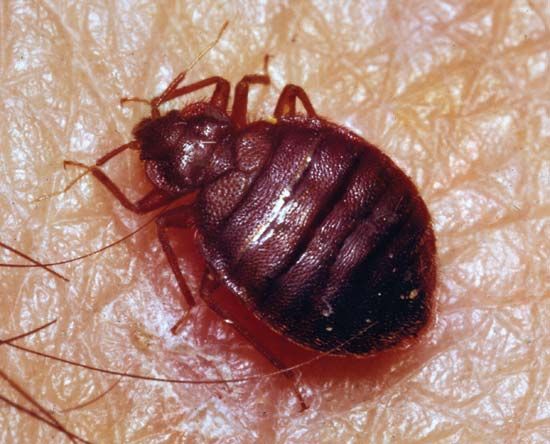
- Bat Bugs: Members of the family Polyctenidae, these are wingless, bloodsucking insects closely related to the bedbug. They are specialized ectoparasites found primarily in the fur of tropical bats and lack both eyes and wings.56
- Fleas: Various species of fleas are known to parasitize bats. These insects are often host-specific and are frequently found in the nests or roosts of colonial animals, where they can thrive on debris and host blood.78
- Ticks and Mites: Bats are frequently infested by a range of mites and ticks. Some species, such as those in the family Spinturnicidae, are highly specialized and may be found in specific areas of the bat’s body, such as the anal opening. Others, like certain Macronyssidae, can cause tissue damage to their hosts.3
- Lice: These wingless insects are also common parasites that reside within the fur of bats, feeding on skin secretions or blood.8
These parasites often exist as part of a complex community within bat roosts, alongside other insects like cave crickets and beetles that feed on guano and organic debris.8
How do bats groom themselves to remove parasites?
Bats are meticulous in their grooming habits, dedicating a significant portion of their time to maintaining their fur and cleaning their wing membranes to remove parasites and debris.10
Because bats typically hang upside down, they utilize a specific physical routine to reach all parts of their bodies:
- Combing: While hanging by one foot, a bat uses the claws of its other foot to comb through its fur.10
- Cleansing: They use their lips and tongue to moisten their claws and remove any combings or parasites trapped in the fur.10
- Wing Maintenance: Bats are particularly thorough when cleaning their wing membranes. They use their mouths to meticulously cleanse the skin, often applying oils secreted by dermal glands to condition the skin and waterproof their fur.1011
This behavior is essential for hygiene, as it helps manage the ectoparasites that naturally inhabit their roosts and fur.1012
Sources
- bat fly — Merriam-Webster
- bat fly — Encyclopædia Britannica
- bat - Importance to humans — Encyclopædia Britannica
- Diptera - General features — Encyclopædia Britannica
- bat bug — Encyclopædia Britannica
- bat bug — Merriam-Webster
- flea - Parasitism — Encyclopædia Britannica
- bat - Roosting — Encyclopædia Britannica
- acarid - Ecology — Encyclopædia Britannica
- bat - Maintenance behaviour — Encyclopædia Britannica
- Why do bats sleep upside down? — Encyclopædia Britannica
- bat - Anatomical specializations — Encyclopædia Britannica
- allogroom — Merriam-Webster
Published on · 3 min read