Bathurst Island
The Tiwi language, spoken by the Tiwi people of Melville and Bathurst islands, is classified as a member of the Australian language family. While some…
How does the Tiwi language differ from other Aboriginal languages in Australia?
The Tiwi language, spoken by the Tiwi people of Melville and Bathurst islands, is classified as a member of the Australian language family. While some sources may confuse the name with the unrelated Tiwa peoples of New Mexico, Tiwi is linguistically distinct as part of the Australian group.12
Regarding its relationship to other Australian Aboriginal languages, Tiwi is categorized within the non-Pama-Nyungan cluster, which is primarily distributed across northernmost Australia. Unlike the Pama-Nyungan group, which covers approximately 90 percent of the continent, the non-Pama-Nyungan languages—including Tiwi and Anindilyakwa—are part of a diverse set of subfamilies that scholars are increasingly investigating as a potential genetic entity. While these languages share fundamental characteristics of the Australian sound system and specific grammatical features like monosyllabic verb stems and case suffixes, they are differentiated from Pama-Nyungan languages by specific traits, such as personal pronoun structures.1
What traditional arts and crafts are practiced by the Tiwi people of Bathurst Island?
The Tiwi people of Bathurst and Melville islands are renowned for their distinctive artistic traditions, which are characterized by a rich history of three-dimensional wood sculpture and bold, symbolic painting.1
Key traditional arts and crafts include:
- Funerary Poles: The Tiwi are well known for creating tall, abstract wooden poles used as grave markers in elaborate funerary ceremonies. These poles are crafted by carving, removing, or leaving sections of a tree trunk in their original dimensions.14
- Painting: These poles, along with other ceremonial objects, are decorated with flat areas of color interspersed with bands of fine-line cross-hatching. This emphasis on color and geometric design is a hallmark of the northern Australian artistic tradition.1
- Bark Containers: In addition to grave posts, the Tiwi create bark containers that are boldly painted and used for offerings during mortuary rituals.1
These practices reflect the Tiwi people’s deep connection to their ancestral myths and their unique cultural identity within the northern Australian region.14
What is the history and culture of the Tiwi people who inhabit Bathurst Island?
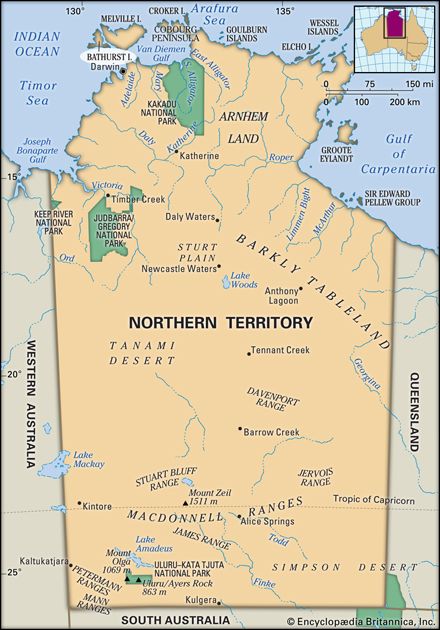
The Tiwi people have inhabited Bathurst Island and neighboring Melville Island for at least 7,000 years. Located in the Timor Sea near Darwin, these islands are collectively known as the Tiwi Islands.4
Historical Context
European contact began with sporadic sightings and landings, which were often met with hostility from the Tiwi. In 1818, the explorer Phillip Parker King surveyed the island and named it after the 3rd Earl Bathurst. By 1910, a Roman Catholic mission was established on Bathurst Island, and the islands were subsequently designated as Aboriginal reserves. During World War II, the island was the site of the first Japanese bombing attack on Australia.4
Governance and Modern Life
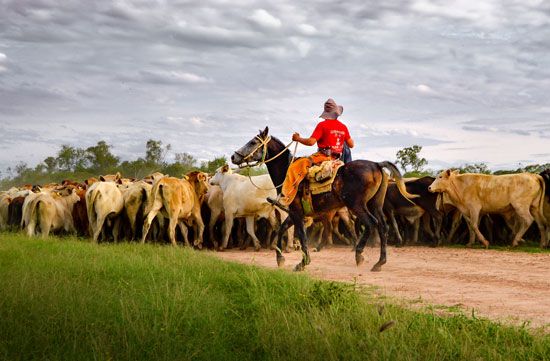
In 1978, ownership of the island was transferred to the Tiwi Land Council, a body of tribal representatives. Today, the islands are managed by the Tiwi Islands Local Government, with the settlement of Nguiu serving as the unofficial capital. The local economy has diversified to include cattle, crops, forestry, and aquaculture.4
What role did Bathurst Island play during World War II?
During World War II, Bathurst Island in the Northern Territory of Australia served as a significant site of conflict. In 1942, the island was the target of the first Japanese bombing attack against the Australian mainland.4
It is important to clarify that this historical event refers specifically to the Bathurst Island located in the Timor Sea, rather than the Bathurst Island situated in the Canadian Arctic, which is uninhabited and has no such military history.47
Sources
- Tiwi — Merriam-Webster
- Australian Aboriginal languages - Classification and distribution — Encyclopædia Britannica
- Tiwa — Merriam-Webster
- Bathurst Island — Encyclopædia Britannica
- Oceanic art and architecture - The north — Encyclopædia Britannica
- Australian Aboriginal peoples - Aesthetics — Encyclopædia Britannica
- Bathurst Island — Encyclopædia Britannica
Published on · 3 min read