Bark
Tree bark, defined as all tissues external to the vascular cambium, varies significantly across species due to the patterns of cork cambium development. The…
What are the different types of bark found in various tree species?
Tree bark, defined as all tissues external to the vascular cambium, varies significantly across species due to the patterns of cork cambium development. The outer layer, or rhytidome, consists of dead tissue that protects the plant from water loss, fire, and pests.12
Bark types are generally categorized by their appearance and texture:
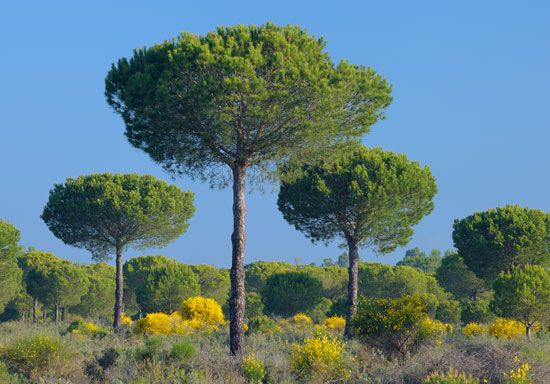
- Scaly Bark: Formed when cork tissues are laid down in a discontinuous, overlapping manner, as seen in pines and pear trees.1
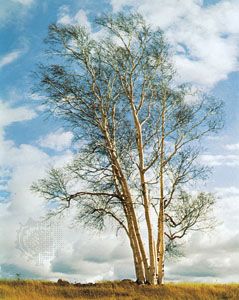
- Sheet-like Bark: Results from a continuous pattern of development, characteristic of paper birch and cherry trees.1
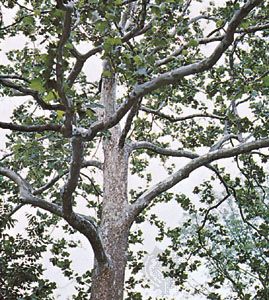
- Exfoliating and Patchy Bark: Seen in sycamores and lacebark pines, which shed layers to reveal different colors.1
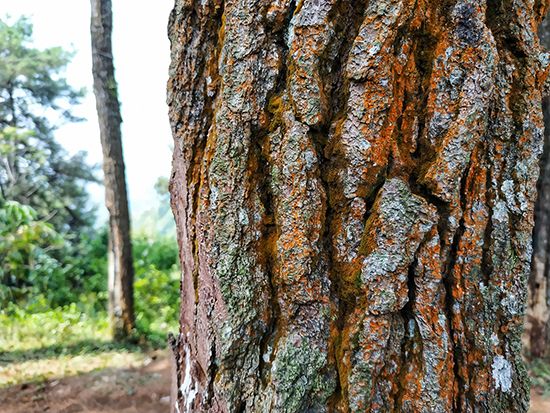
- Rugged or Fissured Bark: Common in many oaks, often featuring deep grooves.1
- Specialized Textures: These range from the smooth, copper-colored bark of the gumbo-limbo to the thick, spongy bark of the cajeput and the shinglelike covering of shagbark hickory.1
What is bark and what are its main components?
In woody plants, bark refers to all tissues located external to the vascular cambium. It serves as a vital protective layer that minimizes water loss, deters pests and fungi, and provides resistance against fire.21
Bark is composed of two primary regions:
- Inner Bark: This consists of secondary phloem, which is produced by the vascular cambium. Its innermost layer is responsible for transporting food from the leaves to the rest of the plant.21
- Outer Bark: This is primarily composed of dead tissue. It is produced by the cork cambium, which creates cork cells. These cells are lined with suberin, a fatty substance that makes the bark impermeable to water and gases.](https://www.britannica.com/science/suberin), a fatty substance that makes the bark impermeable to water and gases.21
When the outer bark contains both cork and old, dead phloem, it is referred to as rhytidome. Gas exchange between the inner tissues and the environment occurs through specialized spongy areas known as lenticels.21
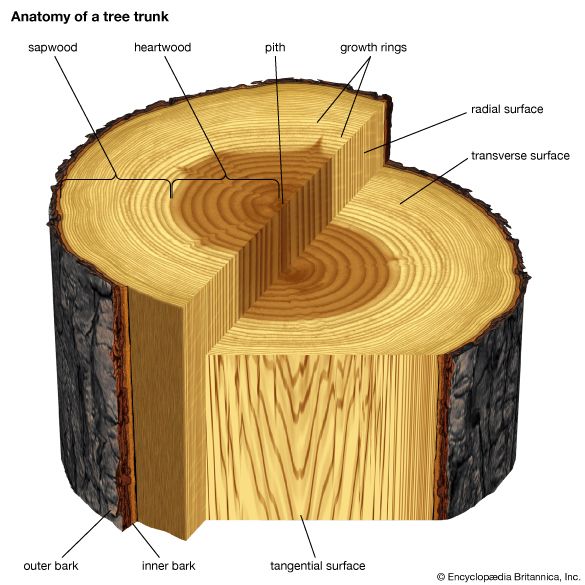
What are the layers of bark, and how do they develop as a tree grows?
Bark is defined as all tissues located external to the vascular cambium in woody plants. As a tree grows in girth, it develops two distinct regions of bark through secondary growth:214
The Two Regions of Bark
- Inner Bark: Composed of secondary phloem, this living tissue is produced by the vascular cambium. Its primary function is to transport food from the leaves to the rest of the plant.214
- Outer Bark: Consisting entirely of dead tissue, this layer is produced by the cork cambium. It serves as a protective barrier against water loss, fire, and pests. When this layer includes both cork and old, dead phloem, it is known as rhytidome.214
Development and Growth
As a tree increases in diameter, the original epidermis cannot expand and is eventually crushed and sloughed off. It is replaced by the periderm, which is formed by the cork cambium.14
Because the outer bark is composed of dead cells, it cannot accommodate the tree’s increasing circumference. Consequently, the tree continually sheds its outer layers. As the cork cambium ceases to function, a new one typically arises deeper within the secondary phloem, repeating the process of creating and displacing dead tissue throughout the growing season.14
How does the thickness of bark vary among different tree species?
Bark thickness varies significantly across tree species, ranging from thin, smooth coverings to massive, protective layers. While bark is generally thinner than the woody interior of a stem or root, its specific dimensions are determined by the species’ unique growth patterns and environmental adaptations.1
Some trees, such as the gumbo-limbo, are characterized by smooth, relatively thin bark. In contrast, other species have evolved to develop substantial, thick bark as a survival mechanism. For example, redwood and giant sequoia trees possess massive bark that provides high resistance to fire damage. Similarly, the cajeput tree is noted for its thick, soft, and spongy bark.5
The thickness and texture are primarily dictated by the activity of the cork cambium. In species where the cork cambium produces thick-walled cells, the resulting bark can be more robust. Furthermore, because the outer bark is composed of dead tissue that cannot expand, trees must continually shed or accumulate layers, leading to the rugged, fissured appearances seen in many oaks or the shinglelike covering of shagbark hickory.5
Sources
- Tree - Tree bark — Encyclopædia Britannica
- Bark — Encyclopædia Britannica
- rough-bark — Merriam-Webster
- Angiosperm - Dermal tissue — Encyclopædia Britannica
- wood - Macrostructure — Encyclopædia Britannica
Published on · 4 min read