Pentremites
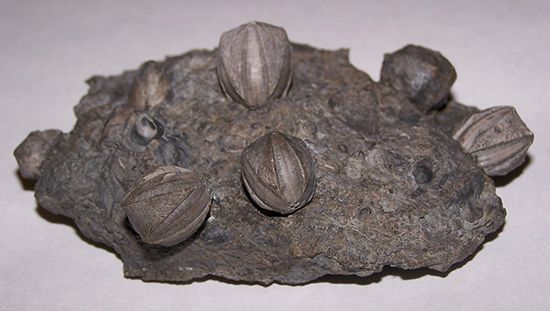
Pentremites is an extinct genus of stemmed, immobile echinoderms that lived during the Carboniferous Period, approximately 359 to 299 million years ago.…
What is Pentremites?
Pentremites is an extinct genus of stemmed, immobile echinoderms that lived during the Carboniferous Period, approximately 359 to 299 million years ago. These organisms are members of the class Blastoidea, a group of animals related to modern starfish and sea lilies.12
Characterized by an ovate or pear-shaped body, Pentremites featured five distinct ambulacral areas that resemble petals. As sedentary creatures, they were anchored to the seafloor by a stemlike column composed of circular plates.32
Because they are abundant and often well-preserved in the fossil record—particularly in the midcontinent region of North America—Pentremites serves as a valuable index fossil for correlating rock units. More than 80 species of this genus have been identified, primarily restricted to the Early Carboniferous epoch.12
What are index fossils and why are they important?
An index fossil is any plant or animal preserved in the rock record that serves as a diagnostic marker for a specific span of geologic time or a particular environment.5
To be considered a useful index fossil, a specimen should ideally possess the following characteristics:
- Short temporal range: The species existed for only a brief moment in geologic history, allowing for precise dating.56
- Wide geographic distribution: The organism was cosmopolitan, meaning it can be found across large areas, which helps in correlating separated rock outcrops.56
- Distinctive appearance: It is easily recognizable, reducing the risk of misidentification.56
- Abundance: The fossilized remains are common enough that discovery is highly probable.56
Index fossils are essential to stratigraphy because they provide the basis for defining boundaries in the geologic time scale and for the correlation of strata5. By applying the principle of faunal succession, geologists can determine the relative age of fossiliferous rocks based on the unique assemblages of life they contain.6
How do blastoids differ from modern starfish?
While blastoids and starfish are both members of the phylum Echinodermata, they differ significantly in their lifestyle and physical structure.
Key Differences
- Mobility and Attachment: Blastoids were sedentary organisms that remained anchored to the seafloor by a stemlike column composed of circular plates. In contrast, modern starfish (class Asteroidea) are unattached, free-moving animals that navigate using tube feet or spines located on their arms.27
- Body Structure: Blastoids were characterized by a highly regular structure consisting of 13 calcium carbonate plates arranged in three distinct circles. Starfish typically possess a star-shaped or pentagonal body with arms that contain prolongations of their internal organs, such as the alimentary system.27
- Skeletal Organization: The skeleton of a starfish is composed of calcareous plates and ossicles that are loosely united, providing the flexibility required for movement. Blastoids, however, possessed a rigid external framework that lacked the freedom of movement seen in starfish.72
What other types of animals lived during the Carboniferous Period?
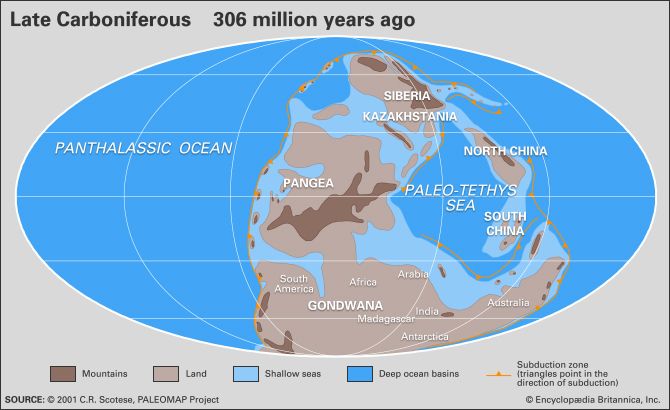
The Carboniferous Period (358.9 to 298.9 million years ago) hosted a diverse array of animal life across both marine and terrestrial environments.
Marine Invertebrates
Marine ecosystems were dominated by various invertebrates. Crinoids—stalked echinoderms—were so abundant that their remains became significant rock-forming materials. They were joined by other common groups, including bryozoans (moss animals) and brachiopods11. Additionally, blastoids, an extinct group of stalked echinoderms, were prominent members of these marine communities.910
Terrestrial Life
The Carboniferous is noted for the diversification of insects, which grew to impressive sizes, such as the giant ancestors of modern dragonflies (Protodonata) with wingspans reaching 70 cm. Other terrestrial arthropods included cockroaches, ancestral grasshoppers, crickets, and the first terrestrial scorpions.9
This period also marked the peak of amphibian development, featuring groups like the labyrinthodonts and the semiaquatic lepospondylians. Toward the end of the Pennsylvanian subperiod, the first reptiles emerged, such as the small captorhinid Hylonomus.91110
Sources
- Pentremites — Encyclopædia Britannica
- blastoid — Encyclopædia Britannica
- Pentremites — Merriam-Webster
- pentremitid — Merriam-Webster
- index fossil — Encyclopædia Britannica
- dating - Principles and techniques — Encyclopædia Britannica
- Asteroidea — Merriam-Webster
- Cryptoblastus — Encyclopædia Britannica
- A Journey Through Time Since the Precambrian - Carboniferous Period: 358.9 million to about 298.9 million years ago — Encyclopædia Britannica
- Carboniferous Period - Amphibians and early reptiles — Encyclopædia Britannica
- Carboniferous Period - Distinctive features — Encyclopædia Britannica
- Carboniferous Period - Paleoclimate — Encyclopædia Britannica
Published on · 3 min read