Bonanza Creek
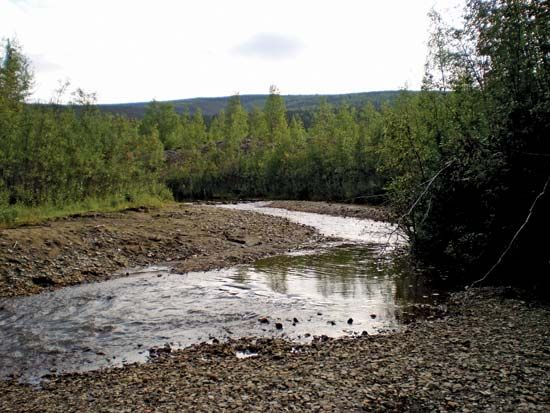
Bonanza Creek is a stream located in western Yukon, Canada. It rises near Dawson and flows approximately 20 miles (32 km) northwest until it reaches the…
What is Bonanza Creek?
Bonanza Creek is a stream located in western Yukon, Canada. It rises near Dawson and flows approximately 20 miles (32 km) northwest until it reaches the Klondike River.1
Originally known as Rabbit Creek, the waterway was renamed Bonanza Creek following the discovery of gold by George Washington Carmack on August 17, 1896. This significant find triggered the famous Klondike gold rush later that year.1
Who was George Washington Carmack?
George Washington Carmack was a prospector best known for his role in triggering the Klondike gold rush. On August 17, 1896, Carmack and his two Tagish partners—Skookum Jim Mason and his nephew, known as “Tagish Charlie”—discovered rich gold deposits in Bonanza Creek, a tributary of the Klondike River in the Yukon.12
The creek, which had previously been known as Rabbit Creek, was renamed Bonanza Creek to commemorate the significance of Carmack’s strike. This discovery led to a massive influx of prospectors to the region and the rapid growth of the nearby settlement of Dawson, which eventually reached a population of approximately 25,000 people during the height of the boom.12
What was life like during the Klondike Gold Rush?
Life during the Klondike gold rush was defined by extreme hardship, rapid migration, and the volatile boom-and-bust cycle of frontier mining. Following the 1896 discovery of gold in Bonanza Creek, tens of thousands of prospectors, or “stampeders,” flooded the region.23
The journey to the goldfields was perilous. Many seekers traveled through Skagway and Dyea, facing severe risks from malnutrition, hypothermia, and avalanches along the route. Upon arrival, the settlement of Dawson exploded in size, housing up to 30,000 people at its peak in 1898.34
This prosperity was short-lived. As easily accessible gold was exhausted, the population plummeted, and the industry shifted toward large-scale mechanical mining techniques. By 1900, many individual miners had departed, leaving behind a transformed landscape that eventually transitioned into a tourist destination and historic site.24
How did miners extract gold from the creek?
Miners extracted gold from the creeks using various placer mining techniques, which rely on the high density of gold to separate it from lighter soil and gravel.6
- Panning: The most basic method, where a miner swirls a mixture of water and gravel in a circular metal pan. The lighter material is washed over the sides, leaving behind the heavier gold and “black sands.”76
- Rocker (Cradle): An improvement over the pan, this device sifts larger quantities of ore. Gravel is shoveled onto a perforated plate while water is poured over it; the finer material falls onto an apron and across riffles, which trap the gold.6
- Sluicing: Miners used a sluice box—a long, inclined wooden trough with riffles along the bottom. As water and gravel flow through, the riffles create eddies that allow the heavy gold to settle and be trapped while lighter material is washed away.68
- Dredging: By the early 20th century, large-scale bucket-ladder dredging became the primary method, using a continuous chain of buckets to excavate and process large volumes of material.6
We could dive deeper into the transition from individual prospecting to the large-scale corporate mining operations that followed the initial rush.
Sources
- Bonanza Creek — Encyclopædia Britannica
- Yukon - The gold rush and territorial status — Encyclopædia Britannica
- Dawson — Encyclopædia Britannica
- Klondike gold rush — Encyclopædia Britannica
- Yukon River - People and economy — Encyclopædia Britannica
- panning — Encyclopædia Britannica
- Yukon River - History — Encyclopædia Britannica
- placer mining — Encyclopædia Britannica
- mining - Sluicing — Encyclopædia Britannica
Published on · 2 min read