Branco River
The Branco River is a significant waterway located in the state of Roraima in northern Brazil. It is formed near Boa Vista by the confluence of the Rio…
What is Branco River?
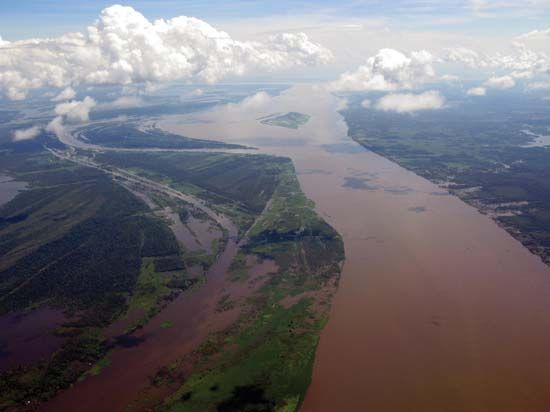
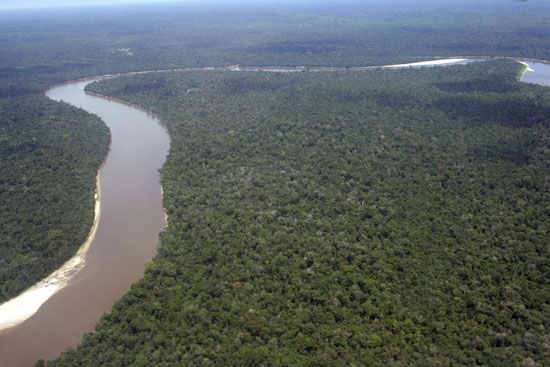
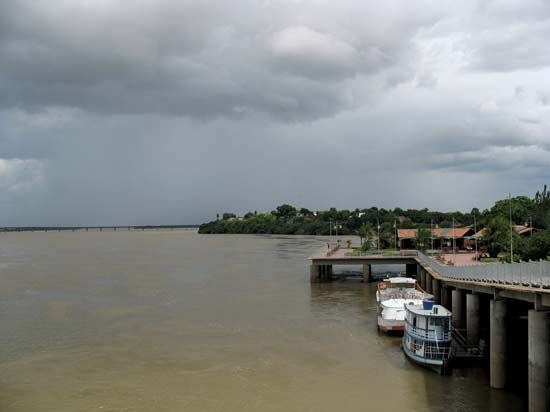
The Branco River is a significant waterway located in the state of Roraima in northern Brazil1. It is formed near Boa Vista by the confluence of the Rio Uraricoera, which originates in the Serra Parima near the Venezuela border, and the Rio Takutu, which flows from the Serra Pakaraima on the Guyana border.1
The river follows a south-southwesterly course for 482 miles (775 km) before joining the Negro River, a major tributary of the Amazon River. While the lower course is easily navigable, the upper reaches contain numerous rapids, and water levels can drop significantly during dry periods, complicating travel. The Branco is noted for its yellowish, silt-laden waters, which contrast sharply with the dark, organic-rich waters of the Negro River.12
How does the Negro River get its black color?
The Negro River derives its distinct jet-black color primarily from high levels of humic acids. These acids are produced by the decomposition of organic matter in the marginal swamps and forests through which the river flows.23
Additionally, the river’s appearance is influenced by its origin in nutrient-poor, sandy uplands. Because these areas lack significant mineral content, the river carries very little silt or dissolved solids, which allows the dark, tea-like color caused by the organic acids to remain clear and prominent. This creates a dramatic visual contrast when the Negro River meets the yellowish, silt-laden waters of the Branco River or the sediment-heavy waters of the Amazon River.23
What is the importance of the Amazon River basin?
The Amazon basin is of profound global importance due to its immense scale, ecological diversity, and role in regulating the Earth’s climate. As the world’s largest drainage basin, it accounts for approximately one-fifth of all freshwater runoff on the planet, serving as a critical component of the global hydrologic cycle.56
The basin’s significance is defined by several key factors:
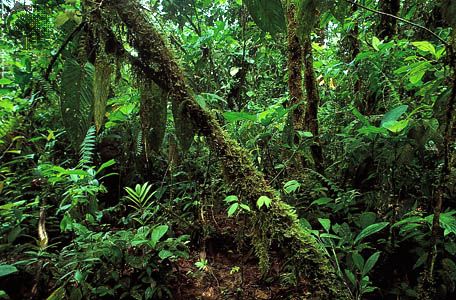
- Biological Diversity: It contains roughly 60 percent of the world’s rainforest and harbors 10 percent of the planet’s known species, including tens of thousands of plant species and millions of insects and invertebrates. It serves as a vital genetic repository for the future.576
- Climate Regulation: The Amazon Rainforest acts as an efficient absorber of carbon dioxide. Scientists emphasize that the forest functions as a control mechanism for the global climate, and its destruction could contribute to global warming through the release of stored carbon.7
- Water Resources: The basin is a primary source of water for millions of people. For instance, the Cerrado region within the basin provides water for 70–90 percent of the Brazilian population.5
- Indigenous Heritage: The region is home to many indigenous peoples who possess deep, traditional knowledge of the ecosystem’s resources, which is essential for both cultural preservation and potential pharmaceutical discoveries.7
What are the main differences between blackwater and whitewater rivers?
In the Amazon basin, rivers are often classified by their water composition and origin. The primary differences between blackwater and whitewater rivers are summarized below:
Blackwater Rivers
- Origin: These rivers typically rise in ancient, nutrient-poor crystalline highlands or sandy uplands.2
- Appearance: They are characterized by a clear, jet-black or tea-like color.32
- Composition: The dark color is caused by high levels of humic acids resulting from the decomposition of organic matter in marginal swamps and forests. They carry little to no silt or dissolved solids.32
- Examples: The Negro River, Jari River, and Tocantins-Araguaia.2
Whitewater Rivers
- Origin: These rivers originate in the geologically youthful and tectonically active Andes.2
- Appearance: They are turbid and yellowish due to heavy sediment loads.32
- Composition: Because they originate in active mountain ranges, they pick up significant amounts of silt and minerals, which account for their “whitewater” designation.2
- Examples: The Madeira River, Purus River, and Juruá River.2
When these distinct water types meet, they often create striking color boundaries that remain visible until turbulence eventually mixes them downstream.2
Sources
- Branco River — Encyclopædia Britannica
- Negro River — Encyclopædia Britannica
- Amazon River - Physiography of the river course — Encyclopædia Britannica
- River Blackwater — Encyclopædia Britannica
- Amazon basin — Encyclopædia Britannica
- Brazil - Rivers of Brazil — Encyclopædia Britannica
- Amazon River - Ecological concerns — Encyclopædia Britannica
- South America - Waterways — Encyclopædia Britannica
- Amazon River - Climate — Encyclopædia Britannica
- Amazon River — Encyclopædia Britannica
Published on · 3 min read