Bucket Orchid
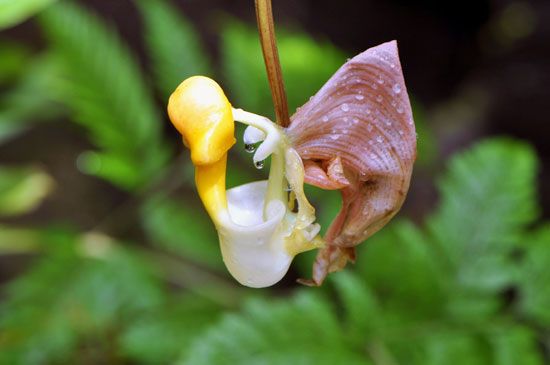
The bucket orchid (genus Coryanthes) is a group of approximately 42 species of epiphytic orchids in the Orchidaceae family, native to tropical regions of…
What is bucket orchid?
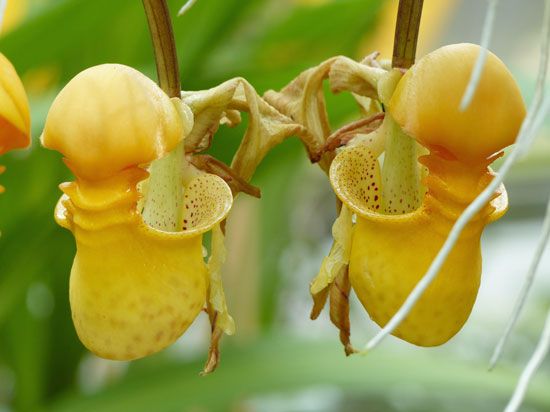
The bucket orchid (genus Coryanthes) is a group of approximately 42 species of epiphytic orchids in the Orchidaceae family, native to tropical regions of Mexico, Central America, South America, and Trinidad.1
These plants are renowned for a complex coevolutionary pollination mechanism involving male orchid bees. The flower features a specialized, bucket-shaped lip that collects an aromatic fluid secreted by the plant. Attracted by the flower’s strong scent, a male bee lands on the structure to collect the fluid. During this process, the bee often slips and falls into the fluid-filled bucket. Because the bucket’s walls are waxy and vertical, the bee must crawl through a narrow, spoutlike tunnel to escape. As it exits, the orchid attaches pollen packets (pollinia) to the bee, which are then deposited on the next bucket orchid the insect visits.12
What are euglossine bees and why are they attracted to orchids?
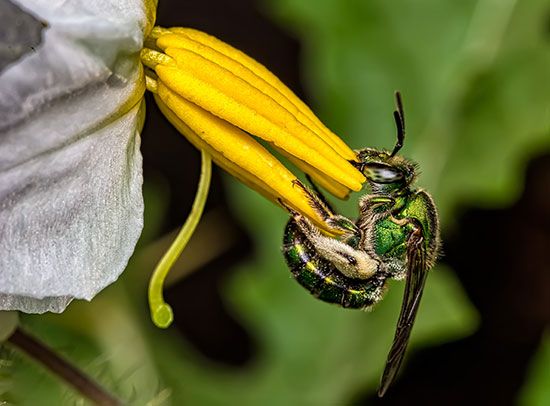
Euglossine bees, also known as orchid bees, are a group of brightly colored, metallic-hued bees native to New World tropical forests. They are vital to their rainforest ecosystem, serving as the primary pollinators for over 700 species of orchids.3
The attraction between these bees and orchids is unique because it does not involve food. Male euglossine bees visit these flowers specifically to collect fragrant chemical compounds, which they store in specialized structures on their hind legs. These scents are essential for mating; the male uses the gathered odors to signal to females that he is a successful forager and possesses the longevity required to collect a diverse array of chemical compounds. Because the bees are driven by these specific scents, scientists can even attract them in the wild using artificial chemical baits.3
While the bees do not consume the nectar or pollen of the orchids, their long tongues allow them to access deep, narrow floral structures that other insects cannot reach, facilitating the pollination process.3
How do other types of orchids attract their pollinators?
Orchids have evolved a remarkable array of strategies to ensure pollination, ranging from offering genuine rewards to employing sophisticated forms of deception.
Reward-Based Pollination
Many orchids attract pollinators, such as bees, by providing tangible rewards like nectar. These flowers typically feature bright colors, agreeable odors, and “nectar guides”—colored lines that direct the insect toward concealed nectaries. As the bee enters the flower to feed, it inadvertently brushes against the plant’s reproductive structures, causing pollen sacs (pollinia) to attach to its body for transport to the next blossom.4
Deceptive Strategies
Many orchids rely on deception rather than food rewards to attract pollinators:
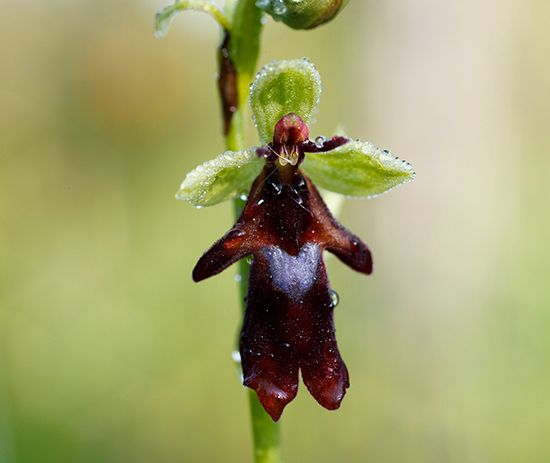
- Sexual Mimicry: Some orchids, such as those in the genus Ophrys, mimic female insects. The flower’s lip acts as a “dummy” female, attracting males that attempt to copulate with the flower. During these attempts, the insect picks up or deposits pollinia.2
- Pseudoantagonism: Certain Oncidium orchids simulate an enemy insect. When a male bee attacks the flower to defend its territory, it triggers the attachment of pollinia to its head.4
- Carrion and Fungal Mimicry: Fly-pollinated orchids often mimic the scent and appearance of decaying matter, dung, or fungi to attract flies. These flowers may feature dull, blotched colors and putrescent odors. Some use mechanical traps, such as hinged lips or tunnels, to force the fly to pass by the reproductive organs to escape.5
What is the difference between epiphytic and terrestrial plants?
The primary difference between epiphytic and terrestrial plants lies in their growth medium and how they obtain nutrients and water.
Epiphytic Plants
Epiphytes are plants that grow upon other plants or objects, such as tree branches or rocks, solely for physical support. They are not parasitic, meaning they do not derive nourishment from their host. Instead, they obtain water from rain and atmospheric vapor, often through specialized roots or leaves, and acquire nutrients from organic debris that collects in the canopy. Because they lack a direct connection to the ground, they are often called “air plants”.67
Terrestrial Plants
In contrast, terrestrial plants grow directly in the soil. They utilize their root systems to anchor themselves and to absorb water and essential minerals directly from the earth. While both types of plants share fundamental biological processes—such as photosynthesis to convert sunlight into energy—terrestrial plants are adapted to a ground-based existence, whereas epiphytes have evolved to thrive in elevated environments where they can access sunlight in dense forests.68
Sources
- bucket orchid — Encyclopædia Britannica
- orchid - Bee pollination — Encyclopædia Britannica
- euglossine bee — Encyclopædia Britannica
- mimicry - Orchids — Encyclopædia Britannica
- orchid - Fly pollination — Encyclopædia Britannica
- Epiphyte — Encyclopædia Britannica
- Did you know? — Merriam-Webster
- Plant - Definition of the kingdom — Encyclopædia Britannica
- Fern - Ecology — Encyclopædia Britannica
Published on · 3 min read