Serapias
Serapias is a genus of perennial terrestrial orchids belonging to the family Orchidaceae, comprising approximately 25 species native to the Mediterranean…
What is Serapias?
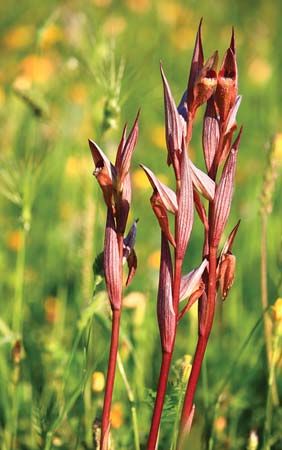
Serapias is a genus of perennial terrestrial orchids belonging to the family Orchidaceae, comprising approximately 25 species native to the Mediterranean region and the British Isles.1
These plants typically die back after flowering and feature two ovoid tubers and waxy, sheathing leaves. Their flowers are characterized by a helmetlike structure formed by the union of two sepals and one petal, often accompanied by a large bract. A defining feature is the long, triangular labellum (central flower lip), which often resembles a tongue and can be hairy.1
Notable species include:
- S. lingua (tongue orchid): Known for its reddish lip and lance-shaped leaves.1
- S. cordigera (heart-flowered serapias): Features purple flowers with blackish purple, tonguelike lips.1
- S. stenopetala: A pale yellow-flowered species endemic to Algeria and Tunisia, currently listed as critically endangered by the IUCN Red List of Threatened Species.1
What are some other examples of orchids that use deceptive pollination?
Many orchids employ deceptive strategies to ensure pollination without providing nectar rewards. While some mimic other nectar-producing flowers, others use more complex forms of manipulation:
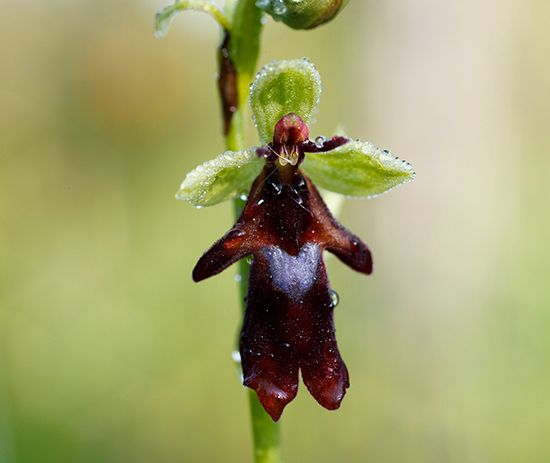
- Sexual Mimicry: Members of the genus Ophrys are famous for mimicking female insects. Their labellum acts as a “dummy” female, attracting male bees or wasps that attempt to copulate with the flower, thereby picking up or depositing pollen. A similar mechanism is found in the Australian orchid Cryptostylis leptochila, which attracts male ichneumon wasps.4
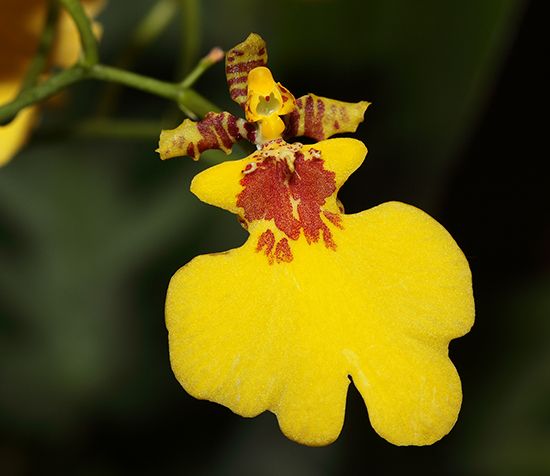
- Pseudoantagonism: The genus Oncidium uses a strategy where the flower simulates an enemy insect. Male Centris bees, attempting to drive the “intruder” from their territory, strike the flower and inadvertently collect pollinia on their heads.5
- Fragrance Collection: Orchids pollinated by male euglossine bees attract the insects with specific scents. The bees visit the flowers to collect these fragrances for their own use, and in the process, the orchid manipulates the bee to attach pollinia to its body.5
- Bucket Traps: The genus Coryanthes (bucket orchids) uses a sophisticated trap. Attracted by scent, bees fall into a water-filled bucket-shaped lip. The only escape route is a narrow tunnel that forces the bee to pass through the reproductive structures, ensuring the transfer of pollen.5
How do perennial orchids survive through the winter?
Perennial orchids, like many other herbaceous plants, survive the winter by entering a state of dormancy, which involves the dying back of their aerial parts—such as leaves and stems—while leaving protected organs at or below the soil surface.6
These underground structures serve as vital storage organs, allowing the plant to persist through unfavorable conditions. Common examples include:6
- Tubers: Specialized, thickened stems that store starch and enable overwintering. As seen in the genus Serapias, these structures allow the plant to die back after flowering and remain dormant until the next growing season.78
- Rhizomes: Prostrate stems that grow at or below the soil surface, providing a base from which new growth emerges.9
- Corms: Compact, starchy stem tissues that are often replaced annually.9
In addition to these natural adaptations, some orchids are grown in greenhouses where temperatures are regulated to protect them from frost, allowing them to thrive or even flower during the winter months.8
Why are some orchid species considered critically endangered?
Many orchid species are considered critically endangered due to a combination of human-driven environmental pressures that threaten their survival in the wild. The primary factors contributing to this status include:7
- Habitat Loss and Degradation: This is the most pervasive threat. The conversion of forests for commercial agriculture, logging, and infrastructure development destroys the specific environments—such as cloud forests—that many orchids require to thrive. Habitat fragmentation further isolates populations, hindering reproduction and reducing genetic diversity.11712
- Overexploitation and Poaching: Many orchids are highly valued as ornamental plants. They are frequently poached from their natural habitats to be sold in illegal wildlife markets, which directly depletes wild populations and makes them more vulnerable to extinction.1314
- Climate Change and Pollution: Global warming poses an existential threat by altering the delicate conditions orchids rely on. Furthermore, pollution and the introduction of invasive species can outcompete native orchids, limiting their success in their natural ranges.7
Because some orchids are restricted to very small geographic areas, such as a single mountain, even localized disturbances can push a species toward the brink of extinction.117
Sources
- Serapias — Encyclopædia Britannica
- Botanical Sex: 9 Alluring Adaptations — Encyclopædia Britannica
- Serapias — Merriam-Webster
- mimicry - Orchids — Encyclopædia Britannica
- orchid - Bee pollination — Encyclopædia Britannica
- gardening - Protecting plants — Encyclopædia Britannica
- orchid - Ecology — Encyclopædia Britannica
- Plant development - Seasonal adaptations — Encyclopædia Britannica
- Asparagales - Storage organs — Encyclopædia Britannica
- Tuber — Encyclopædia Britannica
- critically endangered species — Encyclopædia Britannica
- poaching — Encyclopædia Britannica
- The Orchid and the Fungus - Learn more — Encyclopædia Britannica
- conservation - Logging and collecting — Encyclopædia Britannica
- Deforestation - Effects — Encyclopædia Britannica
Published on · 3 min read