Euglossine Bee
Euglossine bees are highly specialized insects that play a vital role in the ecology of New World tropical forests. Their adaptations to these environments…
How are euglossine bees adapted to their tropical habitats?
Euglossine bees are highly specialized insects that play a vital role in the ecology of New World tropical forests. Their adaptations to these environments include:
- Morphological Specialization: Many species possess exceptionally long tongues, measuring up to 4 cm (1.6 inches), which allow them to access deep, narrow floral structures that other pollinators cannot reach.1
- Pollination Strategy: They are essential for the pollination of over 700 species of orchids. While females collect mud for nests, males exhibit a unique behavior of gathering fragrant chemicals from flowers into their hind legs. These scents serve as signals to females, indicating the male’s foraging success and longevity.1
- Ecological Versatility: These bees inhabit diverse forest layers, ranging from the understory to the canopy, where they visit lianas and emergent trees. Their presence is critical for the reproduction of various plants, including Brazil nuts, which rely almost exclusively on euglossines for pollination.1
What are the distinguishing characteristics of euglossine bees?
Euglossine bees, also known as orchid bees, are a tribe of bees (Euglossini) distinguished by several unique biological and behavioral traits:
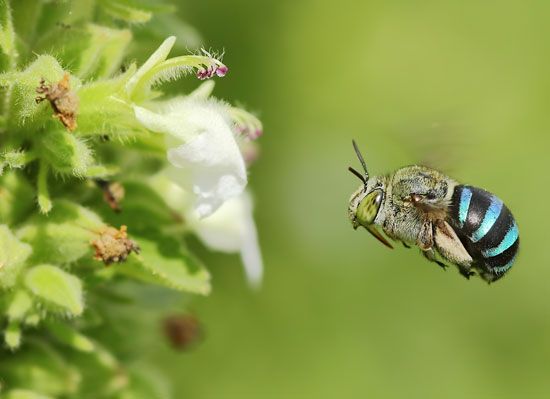
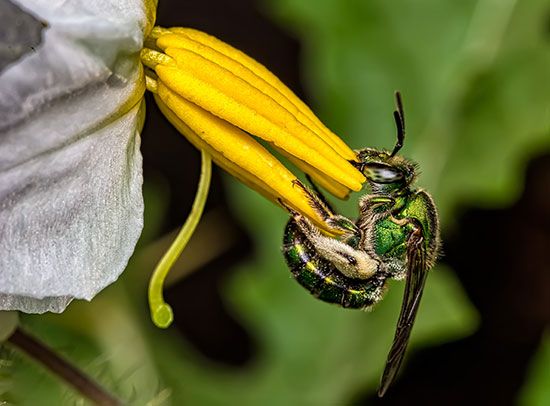
- Appearance: These bees are noted for their vibrant, metallic coloration, which includes shades of blue, green, and bronze.1
- Anatomy: A primary physical characteristic is their exceptionally long tongues, which can reach up to 4 cm (1.6 inches) in some species. This adaptation allows them to access deep, narrow floral structures that are inaccessible to other pollinators.1
- Male Pollination Behavior: Unlike most bees, male euglossines do not collect nectar or pollen from the flowers they visit. Instead, they gather fragrant chemicals from orchids, which they store in specialized brushes on their front feet and transfer to swollen segments on their hind legs. These scents serve as signals to females, indicating the male’s foraging success and longevity.12
- Social Structure: They do not have a queen and do not produce honey. Females typically live in small, solitary or communal mud nests, sometimes sharing space with mothers or sisters.13
How do scientists study and track euglossine bee populations?
Scientists study and track euglossine bees primarily by exploiting the unique behavioral traits of the males. Because male euglossine bees are strongly attracted to specific fragrant chemicals produced by various orchids, researchers can easily procure and observe these bees in almost any tropical American forest by setting out artificial attractant baits.1
These baits allow biologists to attract, capture, and record the presence of different species within a given area. This method is highly effective for scientific research and has significant applications in conservation studies, as it provides a reliable way to monitor population diversity and distribution across different forest layers, from the understory to the canopy. By analyzing which chemical compounds attract specific bees, scientists can gain deeper insights into the ecological relationships between these insects and the plants they pollinate.12
What are some of the most common species of euglossine bees?
The tribe Euglossini, commonly known as euglossine bees or orchid bees, comprises a large group of diverse species found throughout the Americas. While there are many distinct species within this group, they are often categorized by their genus rather than by individual common names for every species.
Approximately half of all known euglossine species belong to the genus Euglossa. These bees are widely studied for their ecological importance in tropical forests, where they serve as primary pollinators for more than 700 species of orchids1.15
Because euglossine bees are identified primarily by their scientific classification within the tribe Euglossini, researchers typically refer to them by their genus—such as Euglossa, Eulaema, Eufriesea, and Exaerete—rather than by specific common names. These bees are collectively recognized for their metallic coloration and specialized role in collecting fragrant chemical compounds from flowers to facilitate mating, a behavior that distinguishes them from other bee groups.15
Sources
- euglossine bee — Encyclopædia Britannica
- orchid - Bee pollination — Encyclopædia Britannica
- 8 Buzzworthy Types of Bees — Encyclopædia Britannica
- bucket orchid — Encyclopædia Britannica
- Euglena — Encyclopædia Britannica
- Asparagales - Pollination — Encyclopædia Britannica
Published on · 3 min read