Cacops
Cacops is an extinct genus of amphibian that lived during the Early Permian Period (approximately 299 million to 271 million years ago). Fossils of this…
What is Cacops?
Cacops is an extinct genus of amphibian that lived during the Early Permian Period (approximately 299 million to 271 million years ago). Fossils of this creature have been discovered in North America.1
Reaching a length of about 40 cm (16 inches), Cacops was well-adapted for terrestrial life, possessing strongly developed legs and limb girdles. Its skull was heavily constructed and featured an extremely large otic notch—the region housing the hearing mechanism—which was closed behind by a bony bar. Additionally, the animal featured a relatively small tail and thick bony armor on its back, which likely served as a defense against predators. Taxonomically, Cacops is associated with the Dissorophidae family, a group within the Temnospondyli subclass known for having strongly ossified vertebrae and, frequently, dorsal bony armor.12
What are the key features of the Permian Period?
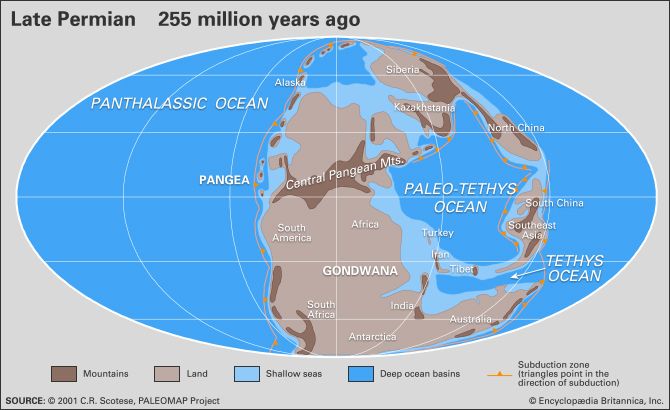
The Permian Period (298.9 million to 252.2 million years ago) was a transformative era characterized by significant geological, climatic, and biological shifts.3
Geography and Climate
- Supercontinent Formation: Most of Earth’s landmasses assembled into the supercontinent Pangea, which was surrounded by the massive Panthalassa ocean.34
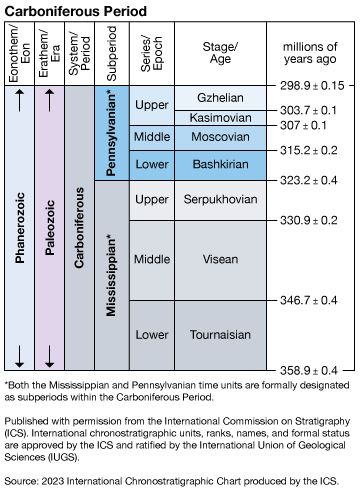
- Climatic Trends: The period began with widespread glaciation inherited from the Carboniferous Period3. Over time, the climate warmed significantly, leading to hot, arid conditions and the expansion of deserts in the Late Permian.53
- Environmental Drivers: Mountain-building events (orogenies) and the closure of seaways altered atmospheric and ocean circulation, while massive volcanism—specifically the Siberian traps—likely contributed to severe environmental stress at the end of the period.5
Life and Evolution
- Diversification: Early Permian warming encouraged the expansion of marine and terrestrial life. Plants evolved from marsh-dwelling ferns and lycophytes to drier-adapted coniferophytes.6
- Faunal Evolution: Insects diversified rapidly alongside plants. Crucially, several important reptile lineages appeared, including ancestors of the mammals.36
- Mass Extinction: The period concluded with the largest mass extinction in Earth’s history, where 90 percent or more of species perished due to extreme environmental changes, including rising temperatures and ocean oxygen depletion.357
How did early amphibians adapt to life on land?
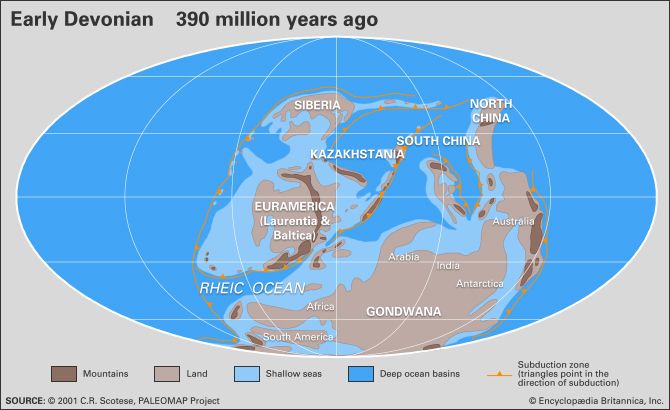
The transition of early vertebrates from aquatic environments to land was a complex process spanning over 80 million years, from the Early Devonian to the Early Pennsylvanian Epoch. This evolution involved significant anatomical and physiological modifications:8
- Locomotion and Skeletal Support: To counter the effects of gravity on land, early tetrapods developed stronger, more rigid vertebral columns with overlapping processes for vertical stability and lateral flexibility. Pelvic girdles became firmly anchored to the axial skeleton to support body weight and provide propulsion, while the pectoral girdle detached from the skull to allow for a flexible neck.8
- Respiration: Ancestral sarcopterygian fishes already possessed lungs for aerial breathing. Early tetrapods refined this by developing a muscle-driven buccal pump mechanism to move air into the lungs, a system that persists in modern amphibians.8
- Sensory and Feeding Adaptations: Feeding on land required increased head mobility and the development of a tongue for food manipulation. Sensory organs also shifted: the lateral-line system was lost, eyes adapted for vision in air, and nasal chambers evolved to separate olfactory intake from respiratory airflow.8
- Skin Protection: Through the development of keratinous tissues, the skin became more resistant to dehydration and physical abrasion from terrestrial particulates.8
What is the significance of bony armor in prehistoric animals?
Bony armor has served various critical roles throughout the evolutionary history of vertebrates, primarily functioning as a defense mechanism and a physiological tool.
Protective Function
In early fossil vertebrates, such as jawless ostracoderms, bony armor likely evolved as a defense against dominant arthropod predators. This protective strategy persisted in later lineages, particularly among animals with limited mobility. For instance, ankylosaurs utilized an extensive mosaic of interlocking plates to encase their bodies, while turtles developed a specialized carapace that allows them to withdraw vulnerable body parts.1112
Physiological and Evolutionary Significance
Beyond defense, bone played a vital role in the transition to land:
- Homeostasis: Bone serves as a reservoir for phosphate and calcium, which helped early vertebrates regulate their internal fluid composition, a necessary step for terrestrial life.13
- Structural Support: Once animals moved out of the buoyancy of water, the structural rigidity of bone provided the mechanical advantage required to support body weight on land.13
- Thermoregulation and Display: In some dinosaurs, such as Stegosaurus, bony plates may have functioned in thermoregulation, species recognition, or social display, though these functions remain subjects of scientific debate.14
Sources
- Cacops — Encyclopædia Britannica
- amphibian - Annotated classification — Encyclopædia Britannica
- A Journey Through Time Since the Precambrian - Permian Period: 298.9 million to 252.2 million years ago — Encyclopædia Britannica
- Permian Period - Marine and terrestrial life — Encyclopædia Britannica
- Permian Period - Paleoclimate — Encyclopædia Britannica
- Permian Period - The Permian environment — Encyclopædia Britannica
- Permian Period - Temperature crises — Encyclopædia Britannica
- amphibian - Common features — Encyclopædia Britannica
- amphibian — Encyclopædia Britannica
- amphibian - Evolution and classification — Encyclopædia Britannica
- bone - Evolutionary origin and significance — Encyclopædia Britannica
- dinosaur - Ankylosauria — Encyclopædia Britannica
- Avoidance behaviour - Protection reflexes, armour, and spines — Encyclopædia Britannica
- Stegosaurus — Encyclopædia Britannica
Published on · 3 min read