Australian Funnel-web Spider
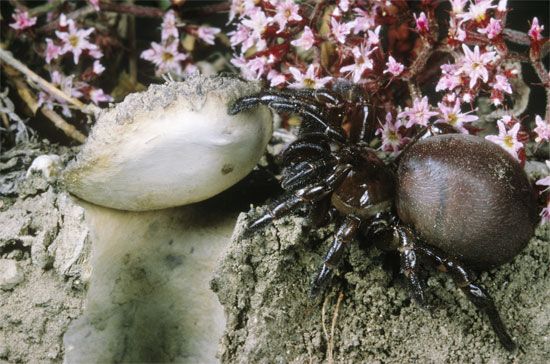
The Australian funnel-web spider (family Atracidae) comprises about 35 species of burrowing spiders native to southern and eastern Australia. They are named…
What is Australian funnel-web spider?
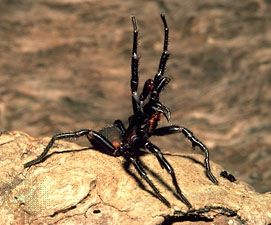
The Australian funnel-web spider (family Atracidae) comprises about 35 species of burrowing spiders native to southern and eastern Australia. They are named for their funnel-shaped webs, which lack the doors found in trap-door spiders. These medium-to-large, black or brown spiders are mygalomorphs, meaning their fangs move forward and down.12
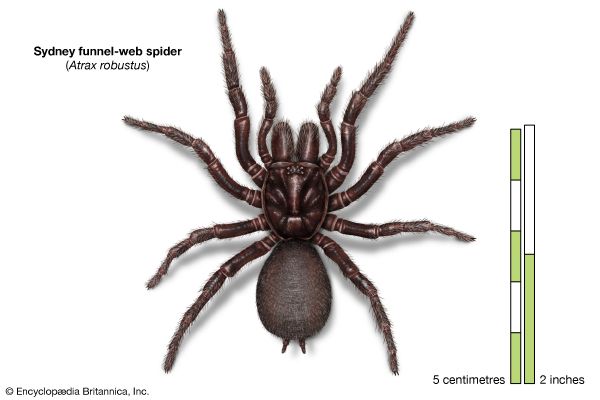
Several species are medically significant due to their potent venom. The Sydney funnel-web spider (Atrax robustus) and the northern tree-dwelling funnel-web spider (Hadronyche formidabilis) are particularly noted for their aggressive nature and toxic bites. Symptoms of a bite—which can include tachycardia, muscle spasms, and pulmonary edema—may appear within 15 to 20 minutes. Fortunately, an effective antivenom exists and is highly successful when administered promptly after a bite.12
How does antivenom work to treat a spider bite?
Antivenom, also known as antivenin, works by neutralizing the toxic components of a spider’s venom within the human body. It is a specialized form of antitoxin, which is an antibody capable of binding to and deactivating specific toxins.3
To produce this treatment, scientists inject small, repeated doses of a specific venom into an animal—most commonly a horse—to stimulate its immune system. As the animal develops a high concentration of antibodies against the venom, its blood is collected and processed into a concentrated preparation known as antiserum.3
When administered to a bite victim, these antibodies recognize and bind to the venom’s toxins, effectively neutralizing them before they can cause further harm. For highly venomous species like the Australian funnel-web spider, this treatment is life-saving, provided it is administered promptly after the bite occurs.321
What are some other venomous spiders found in Australia?
In addition to the various species of Australian funnel-web spiders, Australia is home to other venomous spiders that are medically significant to humans:
- Redback spider (Latrodectus hasselti): A species of black widow spider native to Australia, the female is distinguished by a prominent red or orange stripe on its abdomen. They are often found in dry, sheltered areas near human dwellings, such as sheds or under play equipment. While their bites cause intense pain, swelling, and systemic symptoms like nausea and vomiting, they are rarely lethal, and severe reactions can often be prevented with antivenom.4
- Funnel-web spiders (family Atracidae): Beyond the well-known Sydney funnel-web spider, the genus Hadronyche includes over 30 species. A notable example is the northern tree-dwelling funnel-web spider (H. formidabilis), which is found in Queensland and New South Wales and is considered medically significant due to its potent, fast-acting venom.12
How do mygalomorph spiders differ from other spider groups?
Mygalomorph spiders, which include tarantulas and trapdoor spiders, are distinguished from other spider groups—primarily the araneomorphs—by several key anatomical and physiological features.67
Primary Differences
- Jaw Movement: The most defining characteristic is the orientation of their chelicerae (jaws). Mygalomorphs are orthognath, meaning their fangs move vertically in a forward-and-down motion. In contrast, araneomorph spiders are labidognath, with fangs that move sideways and together.8
- Respiratory System: Mygalomorphs typically possess two pairs of book lungs, which are internal respiratory organs consisting of thin, blood-filled plates. Most araneomorphs have only a single pair of book lungs and rely additionally on tracheal tubes for gas exchange.6910
- Spinnerets: Mygalomorphs generally have fewer spinnerets, typically possessing only one or two pairs, whereas other groups may have more complex arrangements.6
Considered more primitive than their araneomorph counterparts, mygalomorphs are often large, nocturnal, and ground-dwelling, frequently constructing silk-lined burrows or chambers to capture prey.611
Sources
- Australian funnel-web spider — Encyclopædia Britannica
- 9 of the World’s Deadliest Spiders - Australian Funnel-web Spiders (family Atracidae) — Encyclopædia Britannica
- antitoxin — Encyclopædia Britannica
- redback — Encyclopædia Britannica
- How Deadly Are Australia’s Animals? — Encyclopædia Britannica
- Mygalomorphae — Merriam-Webster
- spider - Distinguishing taxonomic features — Encyclopædia Britannica
- mygalomorph — Merriam-Webster
- spider - Size range — Encyclopædia Britannica
- book lung — Encyclopædia Britannica
- list of arachnids — Encyclopædia Britannica
- arthropod - Respiratory system — Encyclopædia Britannica
- list of spiders — Encyclopædia Britannica
Published on · 3 min read