Camptosaurus
Camptosaurus was a large herbivorous dinosaur that subsisted on plant material during the Late Jurassic and Early Cretaceous periods.
What was the Camptosaurus’s diet, and how was it adapted for feeding?
Camptosaurus was a large herbivorous dinosaur that subsisted on plant material during the Late Jurassic and Early Cretaceous periods.1
Its anatomy was well-suited for foraging:
- Feeding Posture: While it possessed strong hind limbs for bipedal movement, its forelimbs were robust enough to support the animal on all fours, a posture it likely adopted while feeding.1
- Prehensile Hands: The hands were prehensile, allowing the dinosaur to grasp vegetation as it fed.1
- Mouth Structure: It featured a beaklike structure, likely covered by horny pads, which was effective for gathering plant material.1
- Dental Adaptations: Once inside the mouth, the vegetation was cut by long rows of broad, leaf-shaped cheek teeth housed within its low, long, and massive skull.1
Are there any interesting facts about Camptosaurus that make it unique among herbivorous dinosaurs?
Camptosaurus is often noted for its role as a generalized ornithopod, serving as a key evolutionary link between earlier forms and the more specialized iguanodontids and hadrosaurs.1
Several features distinguish it from its relatives:
- Wrist and Locomotion: It possessed the “blocky” wrist characteristic of iguanodontids, which allowed for four-legged progression, yet it retained the ability to move bipedally.1
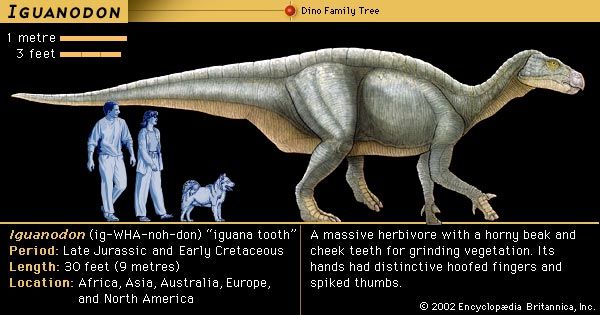
- Hand Anatomy: Unlike the iconic, large conelike thumb spike found in Iguanodon, the thumb of Camptosaurus was merely a small spur.1
- Claw Structure: Its claws were more normally curved and less hooflike than those seen in later, more specialized iguanodontids and hadrosaurs.1
- Skeletal Build: It lacked the deep dorsal spines that were common among many other iguanodontids, giving it a distinct profile.1
While it was a successful and widely distributed genus across western Europe and North America, its relatively unspecialized nature makes it a fascinating subject for understanding the transition toward the more derived duck-billed dinosaurs.12
How large was the Camptosaurus, and what were its distinguishing physical features?
Camptosaurus was a substantial herbivorous dinosaur that reached lengths of up to 6 meters (20 feet).1
Its physical appearance was defined by several key features:
- Body Structure: It possessed a low, long, and massive skull equipped with a beaklike structure for gathering plants and long rows of broad, leaf-shaped cheek teeth for processing food.1
- Limbs and Locomotion: The animal had powerful hind limbs for movement, paired with smaller but robust forelimbs that allowed it to transition to a four-legged stance, particularly while feeding.1
- Wrist and Hands: It featured the “blocky” wrist characteristic of iguanodontids, which supported its quadrupedal movement. Its hands were prehensile, though its thumb was only a small spur rather than the large, conelike spike seen in related species.1
- Distinctive Profile: Unlike many other iguanodontids, Camptosaurus lacked deep dorsal spines, and its claws were more curved and less hooflike than those of later, more specialized ornithopods.1
What other dinosaurs were closely related to Camptosaurus, and how did it fit into the dinosaur family tree?
Camptosaurus occupies a significant position within the dinosaur family tree as a member of the ornithopod group. It is classified as a fairly generalized iguanodontid, serving as an evolutionary bridge between earlier, less specialized ornithopods and the more derived, later-evolving groups.1
In terms of its relationships, Camptosaurus is closely linked to:
- Iguanodontids: It shares the characteristic “blocky” wrist structure found in this group, which allowed for quadrupedal movement, though it retained the ability to move bipedally.1
- Tenontosaurids: These are identified as close relatives within the broader ornithopod lineage.1
While Camptosaurus shares key anatomical traits with these groups, it remains distinct due to its more generalized features. For instance, it lacks the specialized, large conelike thumb spike seen in Iguanodon and does not possess the deep dorsal spines common to many other iguanodontids. Its claws also remain more curved and less hooflike than those of later, more specialized hadrosaurs, highlighting its role as a transitional form in the evolution of these herbivores.1
Sources
- Camptosaurus — Encyclopædia Britannica
- Camarasaurus — Encyclopædia Britannica
- Camptosaurus — Merriam-Webster
Published on · 3 min read