Cape Hatteras
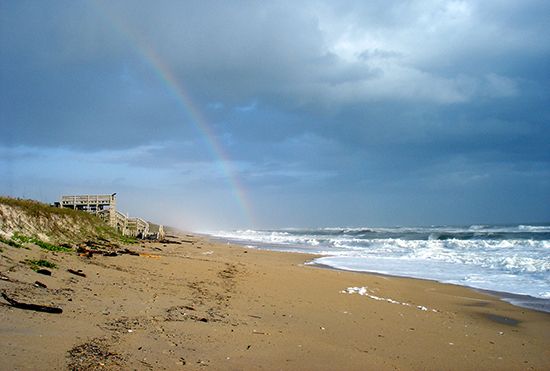
Cape Hatteras is a long, narrow, curved sandbar that forms a promontory on Hatteras Island, marking the southeasternmost point of the Outer Banks in North…
What is Cape Hatteras?
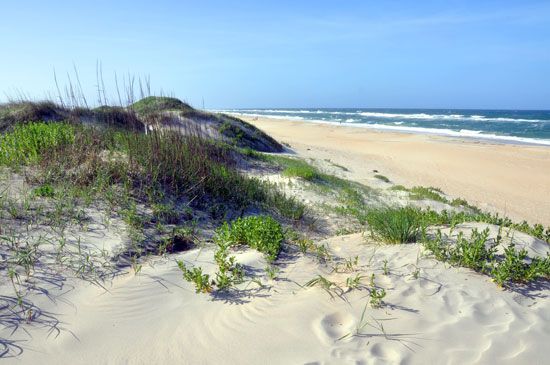
Cape Hatteras is a long, narrow, curved sandbar that forms a promontory on Hatteras Island, marking the southeasternmost point of the Outer Banks in North Carolina, U.S.1
The area is historically significant for its treacherous shallows in the Atlantic Ocean, specifically the Diamond Shoals, which have long posed a danger to maritime navigation. To assist mariners, a historic lighthouse was constructed at the site in 1870; standing 208 feet high, it remains the tallest masonry lighthouse in the country. Due to severe beach erosion, the entire structure was famously relocated 2,900 feet inland in 1999.12
Much of the cape is preserved within the Cape Hatteras National Seashore, which was the first national seashore established in the United States. This protected area spans 47 square miles across Bodie, Hatteras, and Ocracoke islands, offering a diverse landscape of beaches, salt marshes, and woodlands.12
Why is the area around Cape Hatteras known as the Graveyard of the Atlantic?
The area around Cape Hatteras is known as the “Graveyard of the Atlantic” primarily due to the treacherous shallows located in the Atlantic Ocean to the southeast of the cape.1
These dangerous waters, combined with the shifting sands of the Outer Banks, have historically posed a significant threat to maritime navigation. The region’s long history is replete with accounts of numerous shipwrecks, which have cemented its reputation as a perilous stretch of coastline for sailors throughout the centuries.2
How do barrier islands like the Outer Banks form and change over time?
Barrier islands like the Outer Banks are dynamic coastal features primarily formed by wave action in environments where the coastal slope is relatively flat. They typically develop when waves deposit sand and sediment along a coastline, building up an equilibrium profile that eventually rises above sea level. Wind further shapes these islands by creating dunes, while the area between the barrier and the mainland becomes a lagoon.456
These islands are in a constant state of change due to several factors:
- Sea Level Fluctuations: A slow rise in sea level can maintain the barrier, but if the rise is too rapid, the island may be drowned.75
- Storms and Catastrophic Events: Hurricanes and tsunamis can significantly alter the landscape in a short time by breaching barriers, creating washover channels, or causing severe erosion.8
- Sedimentation: Lagoons often fill with sediment from rivers and organic processes, which can eventually lead to the disappearance of the lagoonal environment.475
What was the significance of the Wright brothers’ flight at Kitty Hawk?
The flight at Kitty Hawk, North Carolina, on December 17, 1903, holds immense historical significance as the first time a heavier-than-air machine achieved powered and sustained flight under the complete control of a pilot.9
While earlier experimenters had focused on inherent stability, Wilbur and Orville Wright prioritized pilot control, utilizing their innovative “wing warping” system to manage the craft’s balance and direction. Their success was the culmination of years of rigorous scientific study, including wind-tunnel testing and glider experiments that allowed them to solve critical problems in aerodynamics and propulsion.109
On that day, the brothers completed four successful flights near the Kill Devil Hills, with the final flight covering 852 feet in 59 seconds. This achievement proved that controlled, powered flight was possible, laying the essential foundation for the development of the modern airplane and the future of aviation.11912
Sources
- Cape Hatteras — Encyclopædia Britannica
- Outer Banks — Encyclopædia Britannica
- Cape Hatteras National Seashore — Encyclopædia Britannica
- sandbar — Encyclopædia Britannica
- lagoon - Barrier bars and sediment sources — Encyclopædia Britannica
- lagoon - The effect of time — Encyclopædia Britannica
- lagoon - Waves , tides, and surf — Encyclopædia Britannica
- lagoon - Storms and catastrophic events — Encyclopædia Britannica
- History of Technology Timeline - 1903: Airplane — Encyclopædia Britannica
- Wright flyer of 1905 — Encyclopædia Britannica
- Wright brothers - Powered, sustained flight — Encyclopædia Britannica
- Wright brothers - Early glider experiments of the Wright brothers — Encyclopædia Britannica
- Kitty Hawk — Encyclopædia Britannica
Published on · 3 min read