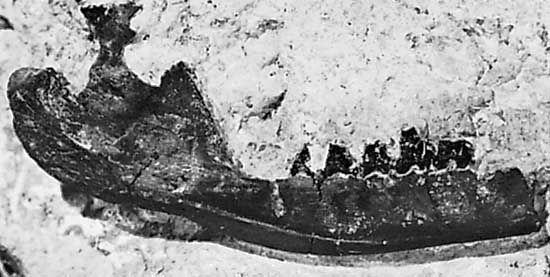
Castorocauda
The discovery of Castorocauda significantly reshaped our understanding of mammalian evolution during the Jurassic Period. Prior to its identification, it was…
How has our understanding of Castorocauda changed since its initial discovery?
The discovery of Castorocauda significantly reshaped our understanding of mammalian evolution during the Jurassic Period. Prior to its identification, it was often assumed that early mammals were primarily small, nocturnal insectivores. The finding of Castorocauda in China’s Jiulongshan Formation revealed that mammals had already achieved significant ecological diversity and specialization millions of years earlier than previously thought.1
Key insights from this discovery include:
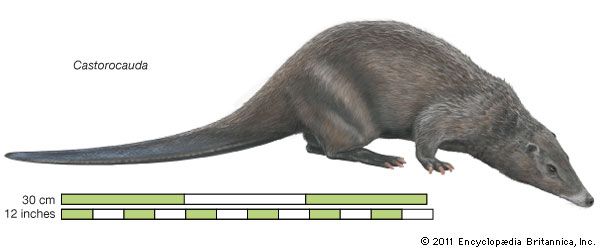
- Size and Specialization: Weighing up to 800 grams, it was the largest known Jurassic mammal, demonstrating that these creatures occupied niches beyond small-bodied roles.1
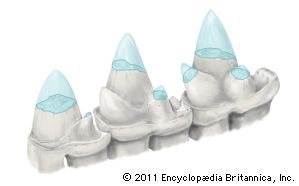
- Semiaquatic Adaptations: The presence of a broad, flat, scaly tail and specialized dentition for a fish-eating diet provided clear evidence of a semiaquatic lifestyle, alongside adaptations for digging.1
- Integumentary Evolution: The fossil preserved carbonized impressions of skin and hair, confirming that early mammals already possessed complex integument, including both an undercoat and guard hairs.1
This find highlights that mammals were a widespread, diverse group across both hemispheres during the Jurassic.1
What does the existence of Castorocauda tell us about mammal evolution during the Jurassic period?
The existence of Castorocauda has fundamentally challenged the traditional view that early mammals during the Jurassic Period were exclusively small, nocturnal, and insectivorous creatures.123
Key insights from Castorocauda regarding mammalian evolution include:
- Ecological Diversity: As the largest known Jurassic mammal, weighing between 500 and 800 grams, Castorocauda demonstrates that mammals occupied a wider range of ecological niches than previously assumed. Its specialized adaptations for a semiaquatic, fish-eating lifestyle and digging indicate that early mammals were already exploring diverse survival strategies.1
- Advanced Biological Traits: The discovery of well-preserved integument confirms that these early mammals possessed complex hair, including both an undercoat and guard hairs, similar to modern mammals.1
- Widespread Distribution: The presence of Castorocauda and other varied taxa, such as the insectivorous Ambondro and the generalist Haldanodon, reveals that mammals were a widespread and diverse group across both the Northern and Southern hemispheres early in their history.1
Ultimately, Castorocauda proves that while archosaurs dominated terrestrial ecosystems, mammals were far more biologically and ecologically sophisticated during the Jurassic than once believed.123
What other mammals lived during the same time period as Castorocauda?
During the Middle and Late Jurassic periods, Castorocauda lived alongside a variety of other early mammals that occupied diverse ecological niches. While these mammals were often overshadowed by the dominant dinosaurs of the time, they exhibited significant evolutionary specialization.14
Notable mammals that lived during the same era include:
- Ambondro: A small, insectivorous mammal that highlights the diversity of early mammalian diets.1
- Fruitafossor: A specialized mammal adapted for digging, demonstrating that early mammals were already developing distinct physical traits for specific environments.1
- Haldanodon: A member of the order Docodonta like Castorocauda, this possum-like generalist was known for its fossorial (burrowing) lifestyle.13
- Juramaia sinensis: A shrewlike mammal that emerged approximately 160 million years ago, representing the group of “true” mammals.5
These discoveries indicate that early mammals were a widespread group across both the Northern and Southern hemispheres, far more varied in form and function than the traditional view of small, nocturnal insectivores suggests.1
How does Castorocauda relate to modern mammals?
Castorocauda is not a direct ancestor of modern mammals, but its existence provides significant insights into the early evolutionary history of the mammal class. Although it is often described as “beaver-like” due to its physical adaptations, it belongs to the extinct order Docodonta and is not closely related to modern beavers, which are rodents that appeared much later in the fossil record.1
The relationship between Castorocauda and modern mammals is defined by shared biological traits rather than direct lineage:
- Integumentary Similarities: Like living mammals, Castorocauda possessed complex integument consisting of both an undercoat and guard hairs, demonstrating that these fundamental mammalian features were already well-developed by the Middle Jurassic.1
- Convergent Evolution: Castorocauda serves as a prime example of convergent evolution. Its broad, scaly tail and semiaquatic lifestyle mirror the adaptations seen in modern beavers and platypuses, despite the vast evolutionary distance between them.1
- Ecological Sophistication: Its discovery proves that early mammals were not merely small, nocturnal insectivores. By occupying specialized niches—such as swimming and digging—Castorocauda shows that the ecological diversity characteristic of modern mammals began much earlier than previously understood.1
Sources
- Castorocauda — Encyclopædia Britannica
- Jurassic Period - Vertebrates — Encyclopædia Britannica
- A Journey Through Time Since the Precambrian - Jurassic Period: 201.3 million to 145 million years ago — Encyclopædia Britannica
- mammal: Top Questions — Encyclopædia Britannica
- Jurassic Period - Marine life — Encyclopædia Britannica
- Docodon — Encyclopædia Britannica
- beaver — Encyclopædia Britannica
Published on · 3 min read