Ambondro
Ambondro is a genus of extinct, shrewlike mammals from the Middle Jurassic that provides critical insight into early mammalian evolution. It is the oldest…
How does Ambondro relate to other early mammal groups?
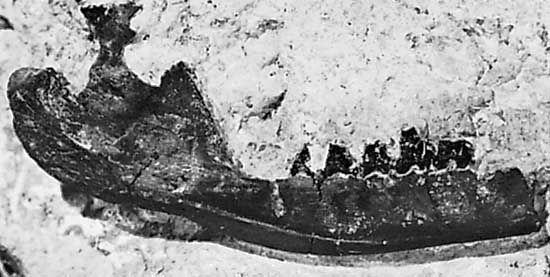
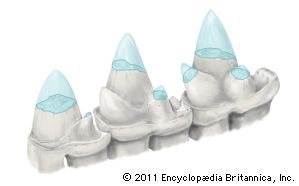
Ambondro is a genus of extinct, shrewlike mammals from the Middle Jurassic that provides critical insight into early mammalian evolution. It is the oldest known mammal to possess a complex tribosphenic dentition—a feature characterized by interlocking molar cusps and a basined heel used for crushing insects.1
This dental structure is significant because it is common to the ancestors of modern marsupial and placental mammals. However, because Ambondro predates the previously known appearance of this trait by 25 million years and exhibits distinct anatomical and geographic differences from later groups, researchers suggest that the tribosphenic-type dentition may have evolved independently more than once.1
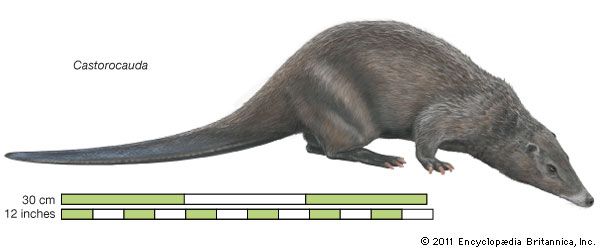
Alongside other Jurassic taxa like the semiaquatic Castorocauda and the digging-specialized Fruitafossor, Ambondro demonstrates that early mammals were a diverse and widespread group, inhabiting both the Northern and Southern hemispheres long before the Cretaceous Period.12
What can Ambondro tell us about the diversity of early mammals in the Southern Hemisphere?
The discovery of Ambondro in the Mahajanga Basin of Madagascar has significantly altered our understanding of early mammalian history in the Southern Hemisphere. Prior to the identification of this Middle Jurassic genus, early tribosphenic mammals were unknown in this region.1
Ambondro provides several key insights into the diversity of early mammals:
- Expanded Geographic Range: Its presence in Madagascar confirms that mammals were widespread across both the Northern and Southern hemispheres during the Jurassic, rather than being limited to northern landmasses as previously thought.1
- Early Complexity: By possessing a complex tribosphenic dentition—a feature previously thought to have originated in the Cretaceous Period—Ambondro pushed the timeline for this evolutionary development back by 25 million years.1
- Evolutionary Diversity: The anatomical and geographic differences between Ambondro and later marsupial and placental mammals suggest that the tribosphenic-type of interlocking dentition may have evolved independently more than once.1
Together with other fossil finds, Ambondro demonstrates that early mammals were a diverse group, even if their fossil record remains poorly sampled.1
How has the discovery of Ambondro influenced our understanding of mammalian tooth evolution?
The discovery of Ambondro has fundamentally reshaped our understanding of mammalian dental evolution by pushing the origin of the complex tribosphenic dentition back by 25 million years. Previously, this dental pattern—which features interlocking molar cusps and a basined heel for crushing insects—was thought to have first appeared during the Cretaceous Period1.1
By identifying this trait in Ambondro fossils dating to the Middle Jurassic, researchers have gained several critical insights:
- Independent Evolution: Because Ambondro exhibits significant anatomical and geographic differences from the earliest known marsupial and placental mammals, scientists now hypothesize that the tribosphenic-type of interlocking dentition may have evolved independently more than once.1
- Expanded Timeline and Range: The find extended the known history of this sophisticated chewing mechanism and established that early tribosphenic mammals were present in the Southern Hemisphere, where they were previously unknown.1
- Early Diversity: Ambondro serves as evidence that early mammals were a diverse and widespread group, occupying various ecological niches alongside other specialized taxa like the semiaquatic Castorocauda.15
How do scientists determine the age of Ambondro fossils?
Scientists determine the age of fossils like Ambondro primarily through biostratigraphy, a method that involves identifying and analyzing the fossils found within specific sedimentary rock strata to establish their relative geologic age.1
In the case of the Ambondro specimen found in the Mahajanga Basin of Madagascar, researchers have dated the fossil to approximately 167 million years before the present, placing it within the Middle Jurassic epoch. The Jurassic Period itself is subdivided into stages that are often established by using index fossils—such as ammonites, bivalves, and protozoans—which help geologists correlate rock layers globally. Because the Mahajanga Basin site contains a variety of other fossils, including those of crocodilians, plesiosaurs, sauropod dinosaurs, and near-shore marine invertebrates, these associated remains provide the necessary context to refine the dating of the Ambondro jaw.67
Sources
- Ambondro — Encyclopædia Britannica
- Castorocauda — Encyclopædia Britannica
- mammal - Diversity — Encyclopædia Britannica
- Tertiary Period - The rise of mammals — Encyclopædia Britannica
- mammal - Teeth — Encyclopædia Britannica
- Jurassic Period - Major subdivisions of the Jurassic System — Encyclopædia Britannica
- Jurassic Period - Ocean basins — Encyclopædia Britannica
- biostratigraphy — Merriam-Webster
Published on · 3 min read