Cave Bear
Early humans interacted with cave bears primarily through sporadic hunting and by sharing the same cave environments, though the bears often used these…
How did early humans interact with cave bears, and is there any evidence of cave bear worship?
Early humans interacted with cave bears primarily through sporadic hunting and by sharing the same cave environments, though the bears often used these spaces for hibernation. Evidence of these interactions is found in archaeological sites like Chauvet–Pont d’Arc, where humans encountered bear remains and footprints.12
Regarding the possibility of cave bear worship, archaeologists have debated the significance of specific bone arrangements found in caves. At some sites, researchers discovered bear skulls and long bones placed in deliberate, non-profane configurations, such as a skull resting on a stone or humeri stuck into the ground. These findings have led some scholars to suggest that early humans practiced a form of “bear ceremonialism” or cultic veneration, potentially to placate the spirits of the animals or ensure the continuation of the species. While these practices are difficult to confirm definitively, they are often interpreted as evidence of a magical or religious relationship between Paleolithic humans and the wild animals they encountered.234
How have scientists used fossil evidence to study cave bears?
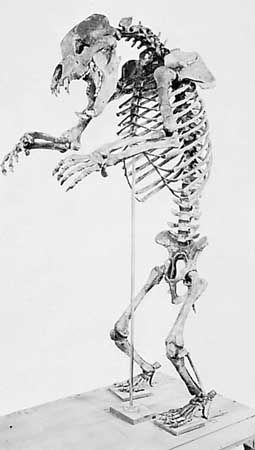
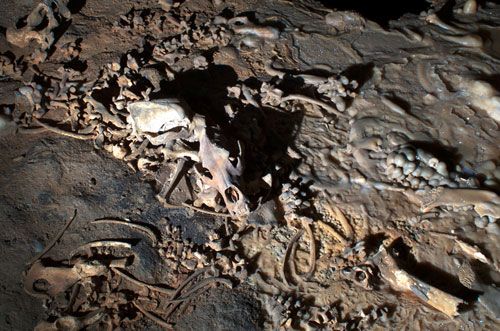
Scientists have utilized fossil evidence from cave deposits to gain significant insights into the biology, behavior, and eventual extinction of the cave bear. Because these animals frequently inhabited caves for hibernation, their remains are exceptionally well-preserved, with over 100,000 specimens recovered from European sites alone.1
Key methods and findings include:
- Genetic Analysis: In 2013, researchers successfully reconstructed a mitochondrial DNA sequence from a bone fragment found in the Sima de los Huesos cave in Spain. Dated to over 300,000 years ago, this provided one of the oldest reconstructed genomes ever obtained outside of permafrost environments.1
- Morphological Studies: By examining skeletal remains, scientists have identified evolutionary changes in the skull. Evidence suggests that enlarged sinuses evolved to help the bears survive dormancy, but this adaptation resulted in a thinner skull, reduced biting force, and a diet restricted to softer, low-value foods.1
- Paleoecological Context: Excavations at sites like Kent’s Cavern have allowed scientists to stratify remains within cave layers, helping to date the bears to the Late Pleistocene Epoch and understand their coexistence with other extinct megafauna.16
How did the cave bear differ from modern bear species in terms of size and appearance?
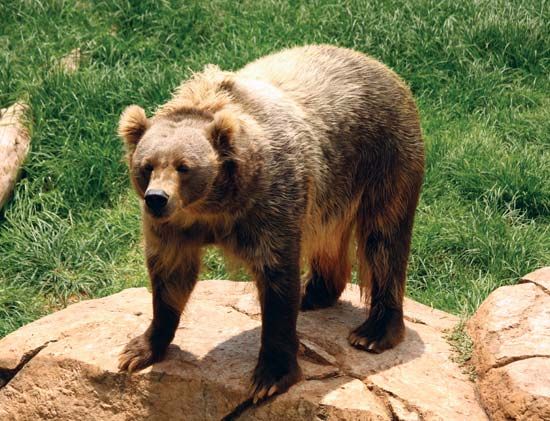
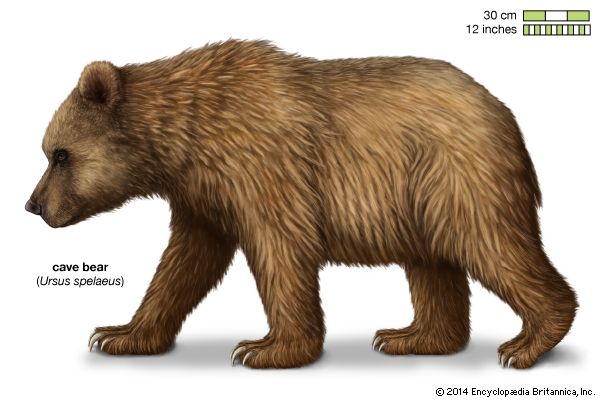
The cave bear (Ursus spelaeus) was a massive animal, with weights ranging from 400 to 1,000 kg (approximately 880 to 2,200 pounds). In terms of size, the largest cave bears were comparable to modern Kodiak bears and polar bears.1
Regarding their appearance, the cave bear possessed a very large head and distinctive teeth. These dental features suggest that, unlike some modern omnivorous bears, the cave bear was largely vegetarian. Additionally, evolutionary changes in the skull led to the development of enlarged sinuses. While these sinuses likely assisted the bears in surviving long periods of dormancy during severe glacial winters, the adaptation resulted in a thinner skull and a reduced biting force, which ultimately limited the animal to a diet of softer, low-value foods.1
Are there any notable cave bear fossils or skeletons on display in museums?
While the provided search results do not list specific museums that house individual cave bear skeletons, they confirm that cave bear remains are frequently preserved in Pleistocene cave deposits, with over 100,000 specimens recovered across Europe.1
Because many of these sites are protected for scientific study—such as the Chauvet–Pont d’Arc cave in France, which contains thousands of bones and 195 skulls—they are often closed to the public to preserve the integrity of the findings. However, to provide public access to such discoveries, institutions sometimes create replicas. For example, a faithful replica of the Chauvet cave, known as La Caverne du Pont-d’Arc, was opened in 2015 to allow visitors to experience the site’s Paleolithic art and bear remains without damaging the original environment.7
Sources
- cave bear — Encyclopædia Britannica
- Chauvet–Pont d’Arc — Encyclopædia Britannica
- prehistoric religion - Hunting rites and animal cults — Encyclopædia Britannica
- Kent’s Cavern — Encyclopædia Britannica
- prehistoric religion - Sacrifices — Encyclopædia Britannica
- Denisova Cave — Encyclopædia Britannica
- cave bear — Merriam-Webster
Published on · 3 min read