Cephalaspis
Cephalaspis does not provide direct evidence for the development of jaws, as it belongs to the ostracoderms, a group of primitive, jawless vertebrates…
What can Cephalaspis tell us about the development of jaws in vertebrates?
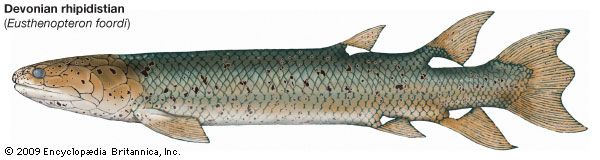
Cephalaspis does not provide direct evidence for the development of jaws, as it belongs to the ostracoderms, a group of primitive, jawless vertebrates (Agnatha). Instead, Cephalaspis serves as a representative of the specialized, armored jawless fishes that existed alongside early jawed vertebrates during the Devonian Period.12
Rather than showing the transition to jaws, Cephalaspis illustrates the evolutionary state of jawless vertebrates, which relied on filter feeding which relied on filter feeding. In these organisms, the gill apparatus functioned as both a respiratory and feeding structure, straining organic matter from water. The evolution of true jaws—which allowed for biting and more efficient food handling—represented a major shift that eventually led to the dominance of placoderms, sharks, and bony fishes. While the exact ancestors of jawed vertebrates remain unknown, the fossil record shows that by the end of the Silurian, both jawed and jawless forms were already well established.1234
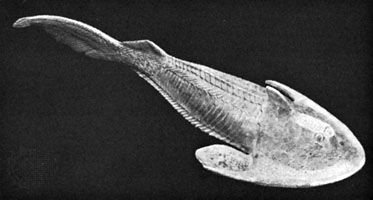
What did Cephalaspis eat and how did it obtain its food?
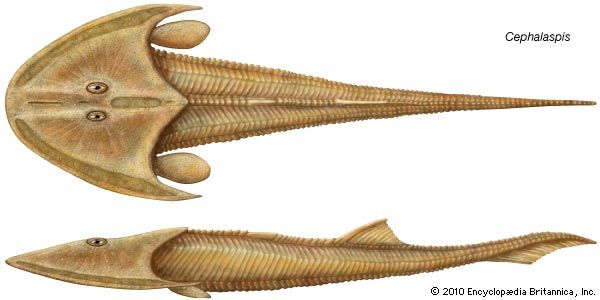
Cephalaspis was a bottom-feeding animal that inhabited freshwater streams during the Devonian Period. Its mouth was positioned ventrally on the underside of its flat head, an anatomical feature that indicates it fed along the bottom of its environment.1
Regarding its diet and feeding mechanism, Cephalaspis likely subsisted on organic matter found within bottom sediments. It obtained this food through a process of filter feeding, a method inherited from its ancestors. In this process, the animal used its gill apparatus to strain small food particles from the water. Water and organic debris were drawn into the mouth—likely through a sucking or nibbling action—and passed into the gill cavity, where the gill structures filtered out the nutrients before directing them to the food canal.126
How does Cephalaspis fit into the evolutionary history of early vertebrates?
Cephalaspis represents a significant genus of ostracoderms, which were primitive, jawless, fishlike vertebrates that thrived during the Devonian Period. As part of the class Cephalaspida, these organisms provide insight into the specialized adaptations of early Agnatha, the group of jawless fishes that preceded the rise of jawed vertebrates.148
In the context of vertebrate evolution, Cephalaspis demonstrates several key advancements:
- Mobility: Unlike its predecessors, Cephalaspis possessed a head shield that was distinct from the rest of its body, allowing for greater movement.1
- Locomotion: It featured paired pectoral fins, which were an important development for stability and swimming control.1
- Sensory Adaptation: The presence of sensory structures along the margins of its head shield suggests the early development of specialized systems, possibly including electric organs.1
While Cephalaspis was a specialized bottom-feeder, it illustrates the evolutionary reliance on filter feeding and dermal armor that characterized early vertebrate history before the emergence of more efficient, jawed groups like placoderms and bony fishes.18
What is Cephalaspis and during which geological period did it live?
Cephalaspis is an extinct genus of primitive, jawless, fishlike vertebrates belonging to the group known as ostracoderms.1 These creatures were characterized by a flattened, bony head shield and the presence of paired pectoral fins, which provided them with greater mobility than their predecessors.1
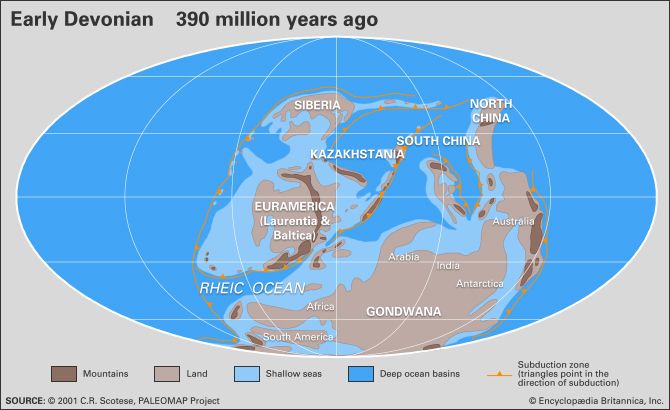
Cephalaspis lived during the Devonian Period, which spanned from approximately 419.2 million to 359 million years ago. Fossils of this genus have been discovered in Lower Devonian rock formations across Europe and North America.19
Sources
- Cephalaspis — Encyclopædia Britannica
- fish - Agnatha: early jawless fishes — Encyclopædia Britannica
- fish - Acanthodii: early jawed fishes — Encyclopædia Britannica
- Cephalaspis — Merriam-Webster
- jaw — Encyclopædia Britannica
- Chordate - Digestion and nutrition — Encyclopædia Britannica
- bivalve - Food and feeding — Encyclopædia Britannica
- Cephalaspida — Merriam-Webster
- A Journey Through Time Since the Precambrian - Devonian Period: 419.2 million to about 359 million years ago — Encyclopædia Britannica
Published on · 3 min read