Ceratophyllales
The order Ceratophyllales consists of a single family, Ceratophyllaceae, which contains the cosmopolitan genus Ceratophyllum. These plants, commonly known as…
What is the evolutionary history and taxonomic classification of Ceratophyllales?
The order Ceratophyllales consists of a single family, Ceratophyllaceae, which contains the cosmopolitan genus Ceratophyllum. These plants, commonly known as hornworts, are submerged aquatic species characterized by their lack of true roots and their unique method of underwater pollination.1
Taxonomic Classification and Evolutionary History
In modern botanical classification, such as the Angiosperm Phylogeny Group III (APG III) system, Ceratophyllales is recognized as a member of the basal angiosperms. While the order was previously hypothesized to be the most basal group of flowering plants, that position is now attributed to Amborellales. Current research suggests that Ceratophyllales represents an isolated lineage, potentially serving as a sister group to the remaining flowering plants known as eudicots. Historically, some classifications have included the family within the order Ranales, though this is less common in contemporary phylogenetic frameworks.12
What adaptations do Ceratophyllales plants have for their aquatic lifestyle?
The order Ceratophyllales, which includes the genus Ceratophyllum (commonly known as hornworts), exhibits several specialized adaptations for its fully submerged, aquatic lifestyle:
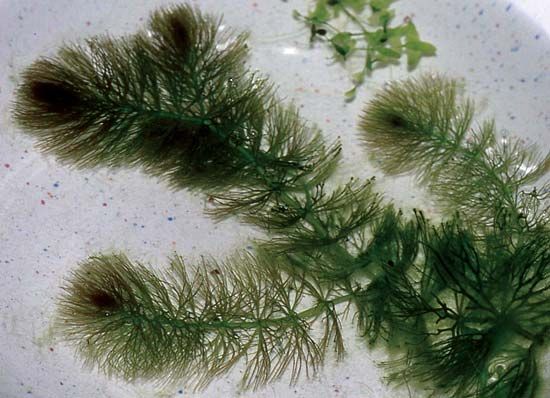
- Absence of True Roots: Unlike most land plants, Ceratophyllum lacks true roots. This adaptation is consistent with its existence as a free-floating or submerged aquatic plant that does not require soil anchorage for nutrient uptake in the same manner as terrestrial species.1
- Morphological Structure: These plants possess dissected, whorled leaves with toothed margins, which provide a high surface area for gas and nutrient exchange directly from the surrounding water.1
- Underwater Pollination: Perhaps the most distinct adaptation is the plant’s ability to undergo underwater pollination. Because the plants are submerged, they have evolved a mechanism where mature male anthers break off and drift through the water column. These anthers eventually settle into a specific groove near the stigma of a female flower, facilitating fertilization without the need for air or insect vectors.1
- Habitat Colonization: Their ability to thrive in freshwater lakes, ponds, and slow-moving water allows them to rapidly colonize and potentially choke waterways, creating complex environments that serve as breeding sites for various aquatic invertebrates and insects.1
In what types of habitats are Ceratophyllales plants typically found?
Ceratophyllales plants, specifically those within the genus Ceratophyllum, are cosmopolitan, submerged aquatic herbs that thrive in various freshwater environments.13
They are typically found in the following habitats:
- Quiet Freshwaters: These plants prefer still or slow-moving water, such as ponds and lakes.13
- Waterways: Due to their rapid growth, they can become dense enough to choke waterways.1
Because they lack true roots, these plants are mostly free-floating, relying on their submerged structure to occupy these aquatic niches. Their presence often creates complex environments that serve as essential breeding sites for various aquatic invertebrates and insects, including mosquitoes. Additionally, several species are commonly utilized as aquarium plants.13
How many species are included in the Ceratophyllales order, and what are some examples?
The order Ceratophyllales is a small, specialized group of flowering plants consisting of only one family, Ceratophyllaceae, which contains a single cosmopolitan genus known as Ceratophyllum.1
Within this genus, there are 10 recognized species. These plants are commonly referred to as hornworts, a name derived from the spiny, horn-like appearance of their fruits. While the order is taxonomically isolated and considered part of the basal angiosperms, it remains a distinct lineage that has adapted uniquely to life in freshwater environments.1
Sources
- Ceratophyllales — Encyclopædia Britannica
- Caryophyllales - Characteristic morphological features — Encyclopædia Britannica
- Ceratophyllaceae — Merriam-Webster
- root — Encyclopædia Britannica
- bryophyte - Form and function — Encyclopædia Britannica
- Ceratophyllum — Merriam-Webster
Published on · 3 min read