Cheetah
Cheetahs are the fastest land animals, capable of reaching speeds up to 114 km (71 miles) per hour. Their remarkable sprinting ability is the result of…
What are the unique physical characteristics of cheetahs that make them the fastest land animals?
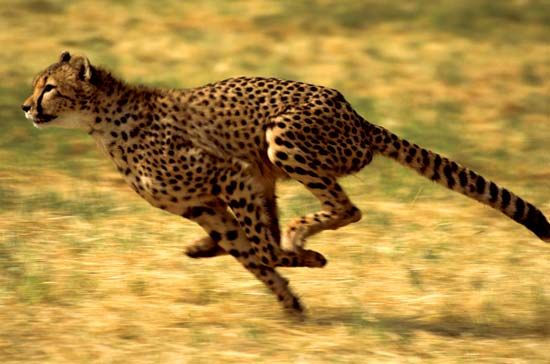
Cheetahs are the fastest land animals, capable of reaching speeds up to 114 km (71 miles) per hour. Their remarkable sprinting ability is the result of several specialized physical adaptations:12
- Skeletal Structure: Cheetahs possess elongated spines that increase their stride length, and their legs are proportionally longer than those of other big cats.12
- Traction: Unlike other felids, cheetahs have nonretractable claws and hard foot pads that function similarly to athletic cleats, providing essential traction during high-speed maneuvers.123
- Balance: A long, muscular tail acts as a rudder, allowing the animal to maintain balance during intense, high-speed chases.12
- Physiological Support: Internally, they are equipped with large hearts, lungs, bronchi, nasal passages, and livers to support the extreme oxygen and energy demands of sprinting.12
These adaptations allow for rapid acceleration—reaching 96.5 km (60 miles) per hour in under three seconds—though these bursts are limited to short distances of 200–300 meters due to the rapid buildup of body heat.12
In which regions of the world are cheetahs found, and what are their preferred habitats?
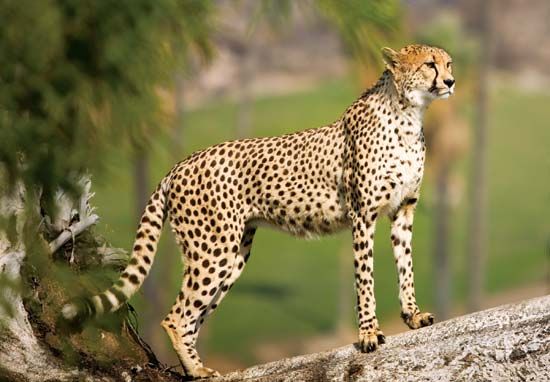
In the 21st century, cheetahs are found almost exclusively in Africa, with the largest populations residing in Namibia, Botswana, Zimbabwe, Kenya, and Tanzania. A tiny, nearly extinct population of a few dozen individuals also persists in northeastern Iran.4562
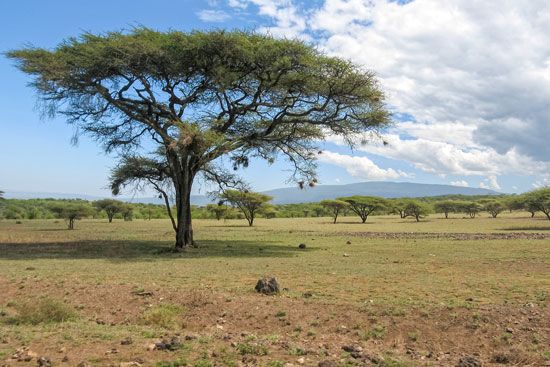
Regarding their preferred environment, cheetahs are primarily associated with dry, open country, savannas, and grasslands, where these landscapes allow them to utilize their high-speed hunting strategy. However, they are also found in areas featuring denser vegetation and rocky upland terrain. While they once ranged across much of the Middle East and Asia, their current distribution is significantly restricted due to habitat loss, poaching, and competition with other large predators.452
What are the main threats to cheetah populations, and what conservation efforts are in place?
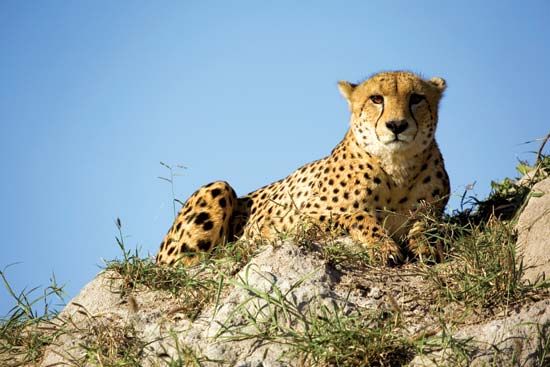
Cheetah populations face significant threats that have led to a drastic decline in their numbers, dropping from an estimated 100,000 in 1900 to between 9,000 and 12,000 today.2
Main Threats
- Habitat Loss: The conversion of land for human use has significantly reduced the open spaces necessary for cheetahs to hunt and thrive.26
- Human-Wildlife Conflict: Outside of protected reserves, cheetahs are frequently trapped or shot by humans seeking to protect their livestock.2
- Competition and Predation: Even within protected areas, cheetahs struggle against larger predators, such as lions and hyenas, which compete for prey and often kill cheetah cubs.2
- Genetic Vulnerability: Modern cheetahs exhibit low genetic diversity due to historical population bottlenecks. This inbreeding is linked to increased susceptibility to infectious diseases, such as feline infectious peritonitis, and higher rates of infant mortality.2
- Historical Exploitation: Centuries of capture for sport and royal companionship, combined with hunting, contributed to their near-extinction in Asia and complete disappearance from India by the 1950s.26
Conservation efforts focus on managing these threats, though all remaining populations are considered vulnerable.2
How do cheetahs differ from other big cats in terms of behavior and adaptations?
Cheetahs (Acinonyx jubatus) are distinct from other big cats due to a unique combination of physiological adaptations and behavioral traits evolved primarily for high-speed hunting.125
Physical Adaptations
- Speed and Sprinting: Cheetahs are the world’s fastest land animals, capable of reaching speeds up to 114 km (71 miles) per hour. Their bodies are highly specialized for this: they possess elongated spines for increased stride length, proportionally longer legs than other big cats, and a long tail that acts as a rudder for balance during sharp turns.12
- Claws and Paws: Unlike most other cats, which have fully retractable claws, cheetahs have nonretractable (or only partly retractable) claws. These function like cleats on an athlete’s shoe, providing essential traction during high-speed chases.182
- Internal Physiology: To support the intense physiological demands of sprinting, cheetahs have evolved larger-than-average hearts, lungs, nasal passages, and adrenal glands. Because they generate heat rapidly during a chase, their high-speed pursuits are typically limited to short distances of less than 300 meters.12
Behavioral Differences
- Activity Patterns: While many other large carnivores are nocturnal, cheetahs are primarily diurnal, typically hunting in the early morning or late afternoon.24
- Vocalizations: A notable behavioral distinction is that cheetahs purr rather than roar, a trait more commonly associated with smaller cat species.8
- Social Structure: Cheetah social behavior is unique among big cats. While females are generally solitary (except when raising cubs), males often form stable, lifelong coalitions—frequently consisting of brothers—to hunt and defend territory.24
- Hunting Strategy: Unlike the stealthy, ambush-based approach of cats like leopards, which rely on strength and climbing ability to overpower and hide prey, cheetahs rely on explosive bursts of speed to chase down prey in open environments.24
Sources
- How fast are cheetahs? — Encyclopædia Britannica
- cheetah — Encyclopædia Britannica
- cat - Claws — Encyclopædia Britannica
- Did you know? — Merriam-Webster
- What’s the difference between a cheetah and a leopard? — Encyclopædia Britannica
- cheetah: Top Questions — Encyclopædia Britannica
- List of English Words from India - Cheetah — Encyclopædia Britannica
- Are Cheetahs Cats or Dogs? — Encyclopædia Britannica
Published on · 4 min read