Cheviot Hills
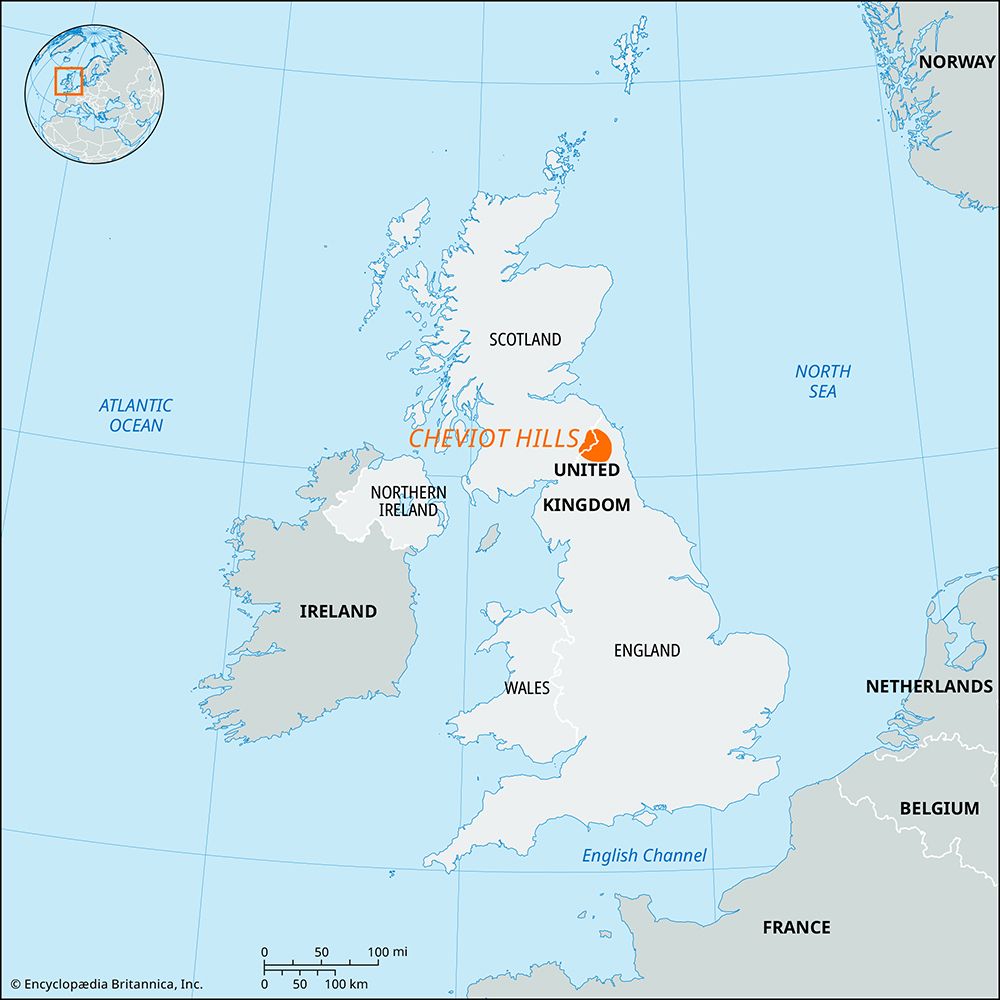
The Cheviot Hills are a highland range extending over 30 miles (50 km) that serve as the boundary between England and Scotland. The range features steep…
What is Cheviot Hills?
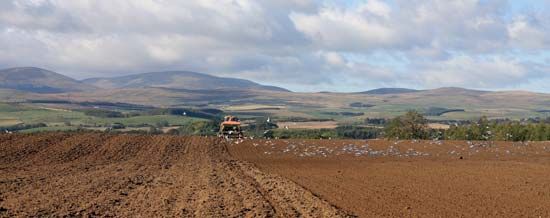
The Cheviot Hills are a highland range extending over 30 miles (50 km) that serve as the boundary between England and Scotland. The range features steep, smoothly rounded hills, with its highest peak, the Cheviot, reaching an elevation of 2,676 feet (816 meters).12
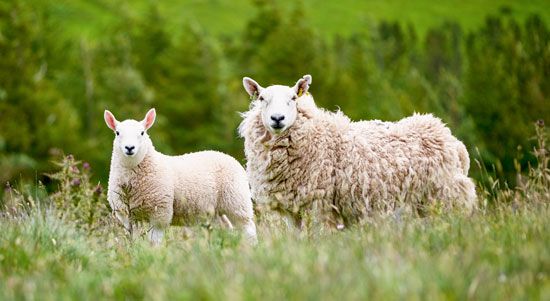
The landscape varies from ancient volcanic rocks in the east to shale and sandstone moorlands in the west, much of which is now protected within Northumberland National Park and a National Forest Park. The region is also historically significant as the origin of the Cheviot, a hardy, white-faced breed of sheep known for its high-quality wool, which was once a staple of the tweed industry. Evidence of prehistoric human occupation is widespread throughout the area.13
What is the history of the Cheviot sheep breed?
The Cheviot sheep breed, originating in the Cheviot Hills on the border of Scotland and England, has a history dating back to at least the 1370s. Early records refer to these animals as “long hill sheep” or “longfaces” due to their distinct appearance.43
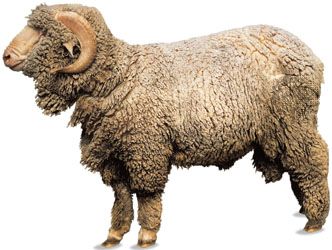
In the late 15th century, local monks attempted to improve the breed’s wool quality by crossing them with Merino sheep, though this initially resulted in weaker, disease-prone stock. Significant improvements occurred in the mid-18th century when breeder James Robson crossed long hill ewes with Leicester-type rams to enhance carcass quality.3
The breed gained prominence around 1791 when Scottish reformer Sir John Sinclair introduced 500 sheep to Caithness. They thrived in the hilly terrain, leading Sinclair to name them “Cheviot” after their place of origin. Subsequent crossbreeding created the North Country and South Country types. By the 19th century, the breed was exported globally to Canada, Australia, the United States, and New Zealand.43
How do national parks protect the Cheviot Hills?
National parks and forest commissions protect the Cheviot Hills by managing land use and conservation across the range’s diverse terrain. The region is safeguarded through two primary designations:
- Northumberland National Park: A significant portion of the hills is included within this national park, which provides a framework for preserving the landscape’s natural beauty and historical integrity.1
- National Forest Park: Areas of the western hills, characterized by shale and sandstone moorlands, are managed by the Forestry Commission as a National Forest Park. This designation has facilitated extensive afforestation efforts in the region since World War II.1
These protections help maintain the environment of the hills, which are otherwise sparsely populated and marked by steep, rounded slopes and deep glens.1
What are some other famous mountain ranges in the United Kingdom?
The United Kingdom features several prominent mountain ranges, each defined by unique geological histories and landscapes:
- Grampian Mountains: Located in the Scottish Highlands, this range contains the highest peaks in the British Isles, including Ben Nevis, which reaches 4,406 feet (1,343 metres).78
- Cairngorm Mountains: Also situated in Scotland, these mountains are known for their granitic masses and elevations exceeding 4,000 feet (1,200 metres).78
- Pennines: Often called the “backbone” of northern England, this upland system stretches from Northumberland to Derbyshire. It is characterized by limestone dales, moorlands, and significant underground water systems.79
- Cumbrian Mountains: Home to the famous Lake District, this compact group includes England’s highest point, Scafell Pike.7
- Cambrian Mountains: Forming the core of Wales, these mountains include the rugged peaks of Snowdonia in the north and the Brecon Beacons in the south.710
- Mourne Mountains: Located in Northern Ireland, this cluster of granite summits includes Slieve Donard, the highest point in the region.7
Sources
- Cheviot Hills — Encyclopædia Britannica
- Cheviot Hills — Merriam-Webster
- Cheviot — Encyclopædia Britannica
- Cheviot: Top Questions — Encyclopædia Britannica
- Scottish Borders — Encyclopædia Britannica
- Peeblesshire — Encyclopædia Britannica
- United Kingdom - The highland zone — Encyclopædia Britannica
- Pennines — Encyclopædia Britannica
- Scotland - Relief of Scotland — Encyclopædia Britannica
- Wales - Relief — Encyclopædia Britannica
- Brecon (brecknock) Beacons — Encyclopædia Britannica
- Brecon Beacons — Merriam-Webster
Published on · 3 min read