Crab Spider
The provided search results do not contain specific information detailing the differences in appearance between male and female crab spiders. While the crab…
How do male and female crab spiders differ in appearance and behavior?
The provided search results do not contain specific information detailing the differences in appearance between male and female crab spiders. While the crab spider family (Thomisidae) is characterized by a crablike shape and the ability to walk sideways or backward, the available data focuses on general family traits and the color-changing abilities of specific species like Misumena vatia rather than sexual dimorphism.1
Regarding behavior, male crab spiders are known to engage in specific mating rituals. Unlike many other spiders that use elaborate web-plucking or visual displays, a male crab spider typically approaches his mate and expertly wraps her in silk. Although the female is capable of escaping, she generally remains until the mating process is complete. Males of many spider species also tend to wander more extensively than females to locate mates, often utilizing pheromones to identify receptive females.2
How do crab spiders hunt and capture their prey?
Crab spiders (family Thomisidae) are ambush predators that do not construct webs to snare their prey. Instead, they rely on a strategy of concealment and patience, often waiting for unsuspecting insects to approach them while they remain hidden on surfaces such as plants, flowers, or fences.35
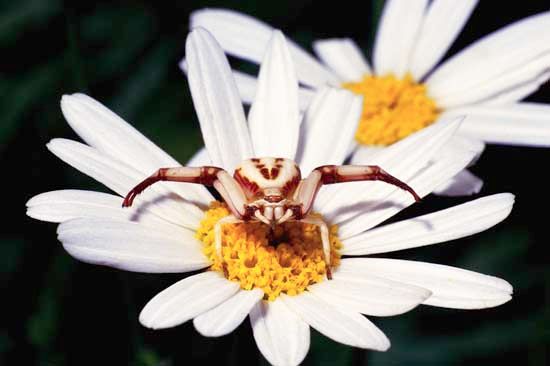
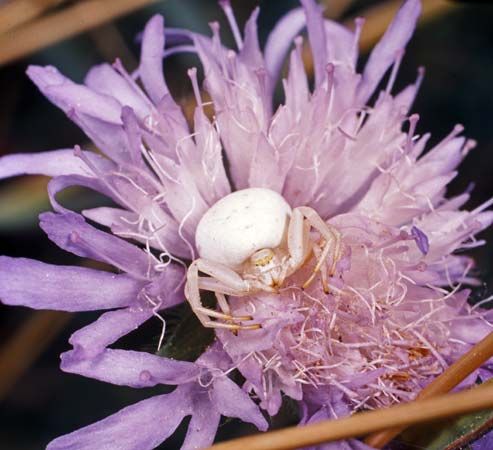
To increase their success as ambushers, many crab spiders utilize background matching. They frequently position themselves on flowers that share a color similar to their own, making them difficult for prey to detect. Some species, such as Misumena vatia, possess the remarkable ability to change their body color over several days to match the specific flower upon which they are resting.53
When a potential victim comes within range, the crab spider uses its legs to grasp the insect firmly. Once the prey is secured, the spider delivers a lethal bite to complete the capture.5
What habitats do crab spiders typically inhabit?
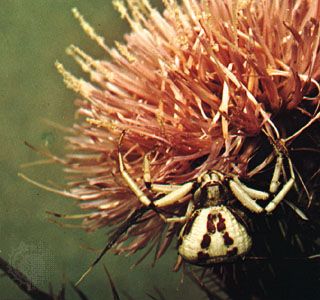
Crab spiders (family Thomisidae) are found worldwide and occupy a variety of environments. Because they do not construct webs to capture prey, they rely on their surroundings for concealment and ambush opportunities.36
Common habitats for these spiders include:
- Vegetation and Flowers: Many species are frequently found in open spaces, resting on plants or flowers where they wait for visiting insects.36
- Ground and Soil: A significant number of species live directly on the soil surface or within leaf litter.3
- Bark: Some crab spiders are adapted to live on or under the bark of trees.36
- Man-made Structures: It is common to find certain species, such as those in the genera Misumena and Misumenoides, on fences and other structures in open areas.3
While the term “crab spider” is sometimes applied to other groups—such as the wall crab spiders (family Selenopidae) or the giant crab spider (family Sparassidae)—the members of the family Thomisidae are the ones most commonly associated with these diverse terrestrial habitats.3
What are the unique physical characteristics of crab spiders?
Crab spiders (family Thomisidae) are distinguished by several unique physical characteristics that aid their lifestyle as ambush predators:
- Crablike Morphology: They are named for their crablike shape and their tendency to walk sideways or backward, similar to many crabs.3
- Size: Most species are relatively small, typically measuring about 12 mm (0.5 inch) in length.3
- Coloration and Camouflage: Their bodies are commonly gray or brown, though some species exhibit specialized coloration to blend into their environment. For instance, the flower-dwelling Misumena vatia is white or yellow with a distinctive red stripe on the side of its abdomen.3
- Color-Changing Ability: A notable physical adaptation in some species, such as Misumena vatia, is the ability to change body color over several days to match the specific flower on which they are resting, which enhances their concealment from prey.36
Sources
- spider - Courtship — Encyclopædia Britannica
- arachnid - Reproduction and life cycle — Encyclopædia Britannica
- crab spider — Encyclopædia Britannica
- Did you know? — Merriam-Webster
- spider - Stalking prey — Encyclopædia Britannica
- spider crab — Encyclopædia Britannica
- coloration - Background matching — Encyclopædia Britannica
- spider - Annotated classification — Encyclopædia Britannica
- Photoreception - Optics of superposition eyes — Encyclopædia Britannica
- Photoreception - Image formation — Encyclopædia Britannica
Published on · 3 min read