Crab
The primary difference between "true crabs" and hermit crabs lies in their anatomy and protective strategies.
What is the difference between true crabs and hermit crabs?
The primary difference between “true crabs” and hermit crabs lies in their anatomy and protective strategies.
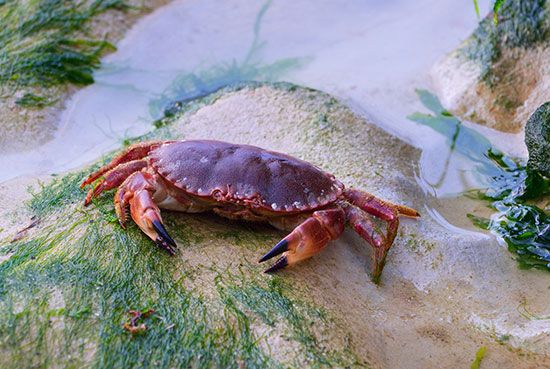
True Crabs (Brachyura) True crabs belong to the infraorder Brachyura. They are characterized by a broad, hard carapace (upper body shield) and a small abdomen that is folded tightly underneath the thorax. Because they possess this protective exoskeleton, they do not require external housing to survive.12
Hermit Crabs (Anomura) Hermit crabs are classified as anomurans rather than true crabs. Unlike their brachyuran counterparts, hermit crabs have soft, vulnerable abdomens that lack a hard protective covering. To compensate for this, they occupy empty gastropod shells or other hollow objects for protection, carrying these “homes” on their backs as they grow. Their bodies are often asymmetrical to accommodate the shape of the shells they inhabit. While most hermit crabs rely on these portable dwellings, some species, such as the robber crab, have evolved to discard this habit, developing hardened abdominal plates instead.134
What roles do crabs play in their ecosystems and food webs?
Crabs play diverse and vital roles within their ecosystems, functioning as key components of complex food webs across marine, freshwater, and terrestrial environments.2
Ecological Roles and Food Web Dynamics
- Predators and Scavengers: Many crabs are active predators, while others serve as omnivorous scavengers. As predators, they exert significant evolutionary pressure on their prey; for example, the development of thick, ornamented shells in many marine mollusks is considered a defensive response to the powerful pincers of crabs.26
- Prey Species: Crabs themselves are an essential food source for a wide variety of animals, including fish, seabirds, and various mammals.6
- Ecosystem Engineers: By burrowing into sediment or navigating rocky crevices, crabs help shape their physical environments. However, some species can negatively impact their surroundings; for instance, burrowing crabs in rice paddies can undermine embankments, leading to water drainage and potential saltwater intrusion that threatens crops.789
- Commensal Relationships: Some crabs live in close association with other organisms. The pea crab, for example, lives inside the shells of mollusks, sharing the host’s food, while others may live within worm tubes or echinoderms.2
While not true crabs, horseshoe crabs are also critical to their ecosystems, particularly in estuaries like Delaware Bay, where their eggs serve as a vital food source for migrating birds such as the American red knot.10
How many species of crabs exist, and in what habitats can they be found?
There are approximately 10,000 described species of crabs, which belong to the order Decapoda.9
Crabs are highly adaptable and occupy a vast range of habitats across the globe:
- Marine Environments: The majority of crab species live in the sea, inhabiting diverse areas such as rocky shores, sandy or muddy bottoms, and even deep-sea oceanic trenches.29
- Freshwater: Many species thrive in rivers, lakes, and streams, particularly in warmer regions of the world.9
- Terrestrial and Amphibious: Some crabs are amphibious, scavenging on land while remaining tied to the water for reproduction. True land crabs (family Gecarcinidae) can live significant distances from the ocean in fields, swamps, and mangrove thickets, though they must return to the sea to release their larvae.2911
Whether in the ocean or on land, these crustaceans have evolved to fill almost every conceivable niche within their respective environments.2
What are some of the largest and smallest crab species?
Crab species exhibit a remarkable range in size, from massive marine giants to tiny creatures measuring only a centimeter or two in adulthood.12
Largest Crab Species
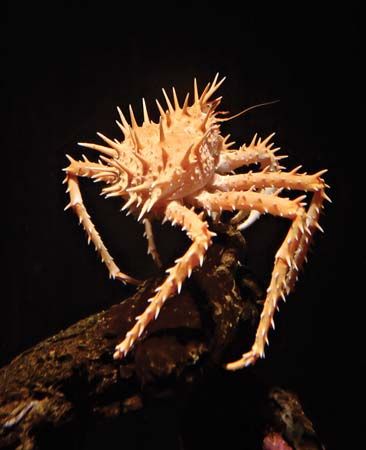
The giant crab (Macrocheira kaempferi) of Japan is widely considered the largest known arthropod. These impressive crustaceans can span nearly 4 meters (13 feet) from the tip of one outstretched claw to the other, with a body measuring approximately 37 cm (15 inches) across and weighing over 18 kg (40 pounds).131412
Another notable giant is the Tasmanian crab (Pseudocarcinus gigas), which is known for its stout build. While its leg span is not as expansive as the giant spider crab, it can weigh well over 9 kg (20 pounds), with a carapace that may measure 46 cm (18 inches) across.12
Smallest Crab Species
At the other end of the spectrum are various small species, many of which are only about 1 to 2 cm (less than 1 inch) in length as adults. Examples include:1312
- Long-beaked spider crab (Macropodia rostrata): Found in European coastal waters, this species has a body diameter of about 1 cm.13
- Kelp crab (Pugettia producta): This species typically measures about 1.25 cm wide and 2.5 cm long.13
- Pea crab (Pinnotheres): These small, commensal crabs live inside the shells of mollusks and other hosts; females generally measure up to 2 cm across.1512
Sources
- hermit crab — Encyclopædia Britannica
- crab — Encyclopædia Britannica
- 14 Questions About Aquatic Animals Answered - Which animals live inside empty seashells? — Encyclopædia Britannica
- Brachyura — Merriam-Webster
- branchiopod - Size range and diversity of structure — Encyclopædia Britannica
- crustacean - Ecology — Encyclopædia Britannica
- Horseshoe Crab: A Key Player in Ecology, Medicine, and More — Encyclopædia Britannica
- crustacean - Importance to humans — Encyclopædia Britannica
- crustacean - Distribution and abundance — Encyclopædia Britannica
- Why do crabs walk sideways? — Encyclopædia Britannica
- land crab — Encyclopædia Britannica
- spider crab — Encyclopædia Britannica
- giant crab — Encyclopædia Britannica
- pea crab — Encyclopædia Britannica
- malacostracan - Size range and diversity of structure — Encyclopædia Britannica
Published on · 4 min read