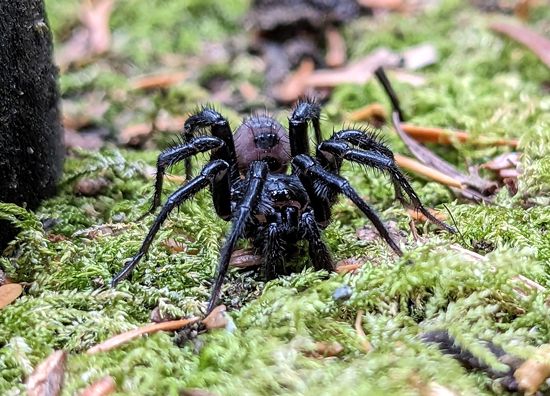
Curtain-web Spider
Australian funnel-web spiders (family Atracidae) possess several distinct physical characteristics:
What are the distinguishing physical characteristics of funnel-web spiders?
Australian funnel-web spiders (family Atracidae) possess several distinct physical characteristics:
- Size and Color: They are medium to large spiders, generally reaching up to 5 cm (about 2 inches) in length, and are typically black or brown in color.12
- Body Structure: Like all spiders, they have a body consisting of a fused head and thorax (cephalothorax) and an abdomen. Their eight hairy legs are attached to a glossy, deeply grooved cephalothorax.1
- Spinnerets: The abdomen is tipped with four spinnerets, which the spiders use for building their characteristic funnel-shaped webs.1
- Mouthparts: As mygalomorphs, their jaws move forward and down. They possess two pairs of appendages near the mouth:
It is important to note that Australian funnel-web spiders are unrelated to the funnel weavers of the family Agelenidae.13
What is the typical behavior and lifestyle of funnel-web spiders?
Australian funnel-web spiders (family Atracidae) are primarily burrowing, solitary predators native to southern and eastern Australia. Their lifestyle is defined by their specialized hunting technique and habitat preferences:3
- Habitat: These spiders construct underground burrows, typically located in crevices, under rocks, or within rotting logs. Some species are arboreal and inhabit holes in trees. Unlike the burrows of trap-door spiders, these tunnels do not feature doors.3
- Hunting Behavior: They are ambush predators named for their funnel-shaped webs, which open wide at the mouth of their burrow. The spider remains within the narrow, protected end of the funnel, waiting for prey to contact trip lines extending from the web. Once a vibration signals that an insect or small animal has touched the web, the spider rushes out to capture its prey at the funnel’s mouth.315
- Aggression and Defense: Certain species, such as the Sydney funnel-web spider (Atrax robustus), are known for their aggressive nature. Their bites are medically significant to humans, capable of causing severe symptoms like tachycardia, muscle spasms, and pulmonary edema within minutes.31
How do funnel-web spiders construct their distinctive webs?
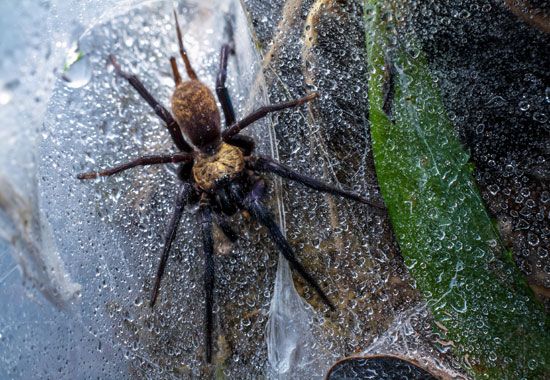
Funnel-web spiders construct their webs as a combination of a protective retreat and a hunting snare. Unlike the complex, geometric patterns of orb weavers, the funnel web is designed to facilitate an ambush-style hunting strategy.73
The construction process typically involves the following features:
- Tubular Retreat: The spider creates a silk-lined tube that serves as its home. This retreat is often built within existing crevices, under rocks, or inside rotting logs, providing the spider with a secure place to hide.89
- Funnel-Shaped Snare: At the entrance of the burrow, the spider expands the silk into a wide, sheet-like funnel. This structure serves as the primary trap for prey.89
- Trip Lines: Many of these spiders extend silk trip threads around the mouth of the tube. These threads are highly sensitive to movement; when an insect walks across the sheet or touches the trip lines, the resulting vibrations alert the spider to the presence of prey.9
- Ambush Execution: The spider remains within the narrow, protected end of the funnel. Once it detects a vibration, it rushes out to capture the prey at the mouth of the web.58
How venomous are funnel-web spiders, and what makes their venom particularly dangerous?
Australian funnel-web spiders (family Atracidae) are among the most venomous spiders in the world, with several species posing a significant medical threat to humans. Their danger stems from potent toxins that specifically target the nervous systems of primates and other vertebrates.4110
When a person is bitten, symptoms can manifest rapidly—often within 15 to 20 minutes—due to the fast-acting nature of the venom. Clinical signs of envenomation include:41
- Tachycardia (rapid heart rate)
- Severe muscle spasms
- Nausea and vomiting
- Pulmonary edema (fluid accumulation in the lungs)
The aggressive nature of species like the Sydney funnel-web spider (Atrax robustus) increases the risk of human encounters. Historically, these bites have resulted in human fatalities; however, the development of an effective antivenom has significantly improved outcomes, provided it is administered promptly after a bite.41
Sources
- Australian funnel-web spider — Encyclopædia Britannica
- homopteran - Annotated classification — Encyclopædia Britannica
- funnel weaver — Encyclopædia Britannica
- 9 of the World’s Deadliest Spiders - Australian Funnel-web Spiders (family Atracidae) — Encyclopædia Britannica
- spider - Stalking prey — Encyclopædia Britannica
- arachnid - Reproduction and life cycle — Encyclopædia Britannica
- How do spiders make circular webs? — Encyclopædia Britannica
- Types of Spiderwebs — Encyclopædia Britannica
- curtain-web spider: Top Questions — Encyclopædia Britannica
- spider - Venom — Encyclopædia Britannica
Published on · 3 min read