Crown-of-thorns Starfish
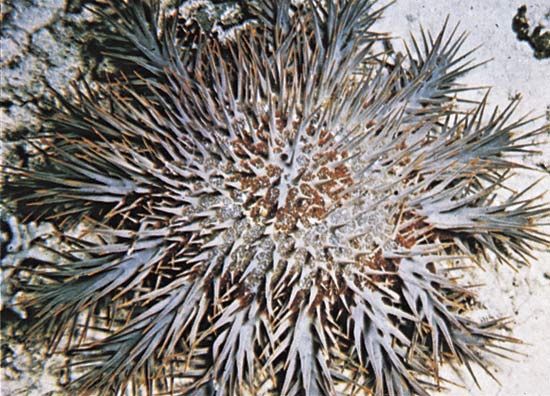
The crown-of-thorns starfish (Acanthaster planci) differs from many other starfish species in several distinct ways:
How does the crown-of-thorns starfish differ from other species of starfish?
The crown-of-thorns starfish (Acanthaster planci) differs from many other starfish species in several distinct ways:
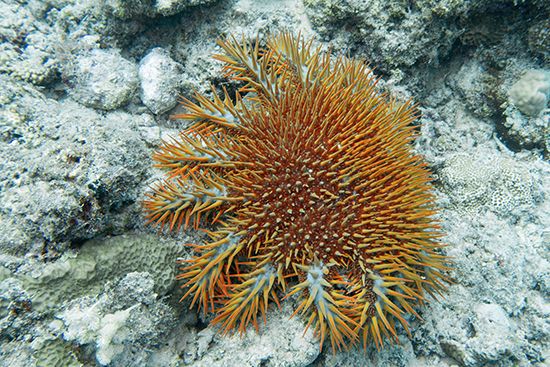
- Physical Appearance: Unlike common starfish that typically have five arms, the adult crown-of-thorns starfish possesses between 12 and 19 arms and is covered in long, heavy spines.1
- Feeding Habits: This species is a specialized predator that feeds on coral polyps. It consumes them by everting its stomach to liquefy and absorb the coral tissue.21
- Venomous Nature: It is a venomous animal; its spines can inflict painful wounds that may cause redness, swelling, vomiting, numbness, and paralysis in humans.3
- Ecological Impact: The species is known for dramatic, periodic population explosions, or “blooms,” which can lead to the widespread destruction of coral reefs. While these events were once thought to be solely the result of human interference, research suggests they are also part of the organism’s natural life cycle, with reefs often capable of regenerating afterward.21
How do crown-of-thorns starfish reproduce and what factors contribute to population outbreaks?
The provided search results do not contain specific information regarding the reproductive process of the crown-of-thorns starfish (Acanthaster planci).
Regarding population outbreaks, while the exact causes remain unknown, researchers hypothesize that several factors may contribute to these dramatic “blooms”:
- Natural Life Cycle: Evidence suggests that population explosions are a phase in the organism’s natural life cycle, with reefs often capable of regenerating after an infestation.45
- Nutrient Loads: Periodic input of high-nutrient loads from land sources is considered a potential trigger for these outbreaks.4
- Predator Removal: The decline of natural predators, such as the Pacific triton snail, may allow starfish populations to multiply unchecked. Additionally, the removal of other species that prey on adult starfish is hypothesized to be a contributing factor.4
Outbreaks typically last one to two years, though some have been known to persist for up to five years.4
What are the main characteristics of crown-of-thorns starfish?
The crown-of-thorns starfish (Acanthaster planci) is a distinct species within the phylum Echinodermata characterized by several notable features:
- Physical Appearance: Unlike many common starfish that typically have five arms, the adult crown-of-thorns starfish possesses between 12 and 19 arms. It is a reddish, heavy-spined species that typically measures about 45 centimeters (18 inches) across.4
- Feeding Habits: This species is a specialized predator that feeds on coral polyps. It consumes its prey by everting its stomach to liquefy and absorb the coral tissue.42
- Venomous Nature: It is a venomous animal. Its spines can inflict painful wounds on humans, which may result in redness, swelling, vomiting, numbness, and paralysis.3
- Population Dynamics: The species is known for periodic “blooms,” or population explosions, which can cause significant damage to coral reefs. While these events were once attributed solely to human interference—such as the removal of its primary predator, the Pacific triton snail—research suggests these outbreaks may also be a phase in the organism’s natural life cycle.42
What are the unique features of echinoderms, and how does the crown-of-thorns starfish exemplify them?
Echinoderms are a diverse phylum of marine invertebrates defined by several fundamental biological characteristics. Their name, derived from the Greek words for “spiny skin,” reflects their most recognizable feature: a hard, calcified internal skeleton that often supports external spines.789
Key Characteristics of Echinoderms
- Pentamerous Symmetry: While they begin life with bilateral symmetry, adult echinoderms typically exhibit five-part (pentamerous) radial symmetry, which organizes their skeletal structures, nervous systems, and organ systems.710
- Water-Vascular System: This unique hydraulic apparatus, derived from the coelom, is essential for locomotion, respiration, and feeding. It operates through a series of fluid-filled canals and tube feet that use suction to grip surfaces.119
- Internal Skeleton: Unlike many other invertebrates, echinoderms possess a mesodermal skeleton that grows alongside the animal, providing structural support similar to the vertebrae in vertebrates.9
The Crown-of-Thorns Starfish as an Exemplar
The crown-of-thorns starfish (Acanthaster planci) serves as a prime example of these traits, though it displays them with specific adaptations:
- Skeletal Structure: It features a heavily armored body covered in prominent, venomous spines, which exemplify the “spiny skin” characteristic of the phylum.78
- Radial Organization: While many sea stars have five arms, the crown-of-thorns starfish exhibits a variation of the phylum’s radial pattern by possessing between 12 and 19 arms, all radiating from a central disk.106
- Feeding Mechanism: Like other advanced sea stars, it utilizes its water-vascular system and tube feet to move across coral reefs. It exemplifies the group’s predatory nature by everting its stomach to digest coral polyps externally.116
Sources
- crown of thorns — Merriam-Webster
- coral reef - Crown-of-thorns starfish — Encyclopædia Britannica
- poison - Animal poisons ( zootoxins ) — Encyclopædia Britannica
- crown-of-thorns starfish — Encyclopædia Britannica
- cnidarian - Ecology and habitats — Encyclopædia Britannica
- sea star — Encyclopædia Britannica
- echinoderm - Size range and diversity of structure — Encyclopædia Britannica
- Circulatory system - Echinodermata — Encyclopædia Britannica
- echinoderm — Encyclopædia Britannica
- echinoderm - Symmetry and body form — Encyclopædia Britannica
- skeleton - Skeleton of echinoderms — Encyclopædia Britannica
- List of echinoderms — Encyclopædia Britannica
Published on · 4 min read