Feather Star
A feather star is any of the approximately 550 living species of crinoid marine invertebrates belonging to the phylum Echinodermata that lack a stalk. Unlike…
What is feather star?
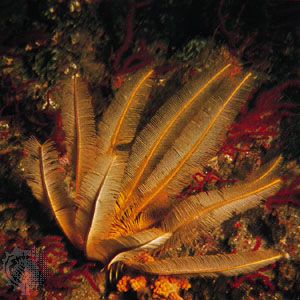
A feather star is any of the approximately 550 living species of crinoid marine invertebrates belonging to the phylum Echinodermata that lack a stalk. Unlike their stalked relatives, the sea lily, feather stars are free-swimming and stalkless.123
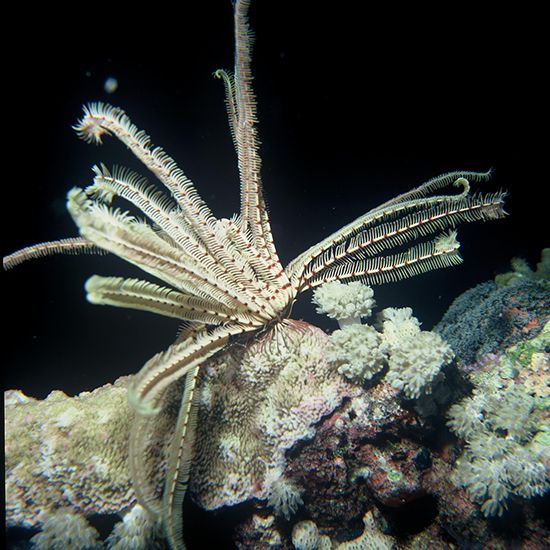
These animals typically possess five arms featuring feathery fringes, which they use for swimming. They anchor themselves to surfaces like corals or sponges using grasping appendages known as cirri. To feed, they trap drifting microorganisms in sticky grooves located along their arms.1
Feather stars are primarily found in shallow, rocky environments, with the highest abundance occurring in regions from the Indian Ocean to Japan. While they are traditionally classified under the order Comatulida, some scientific authorities categorize them into several distinct orders.12
How do feather stars differ from sea lilies?
While both feather stars and sea lilies belong to the class Crinoidea, they are distinguished primarily by their mobility and physical structure.
- Attachment: The most significant difference is that sea lilies are permanently fixed to the sea floor by a stalk, which is composed of limy disks and anchored by a holdfast. In contrast, feather stars are stalkless and free-moving.43
- Locomotion: Because they lack a stalk, feather stars can move from place to place. They typically swim by coordinating the thrashing of their arms or by pulling themselves across surfaces. While most sea lilies remain fixed, some species are capable of releasing their holdfasts to relocate.43
- Habitat: Sea lilies are found primarily in deep waters, whereas feather stars are often found in shallower, rocky environments.45
Both animals share a similar body plan, featuring a cup-shaped body and flexible arms lined with feathery pinnules that capture food particles from the water.45
What other animals belong to the phylum Echinodermata?
The phylum Echinodermata encompasses a diverse group of marine invertebrates characterized by a hard, spiny skin and a water-vascular system. While many classes are known only from the fossil record, there are several living groups of echinoderms:
- Crinoidea: Includes sea lilies and feather stars, which are typically characterized by a cup-shaped body and feathery feeding arms.67
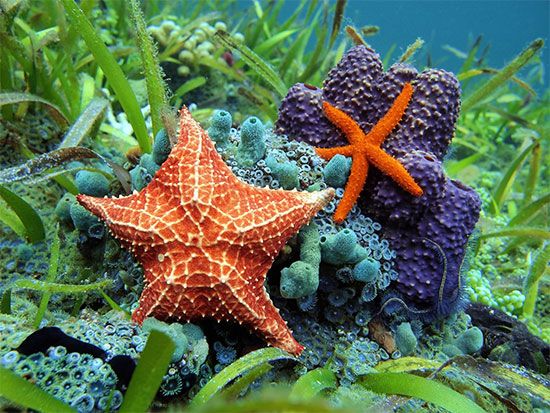
- Asteroidea: Commonly known as sea stars or starfishes, these animals typically have five arms and tube feet used for movement and feeding.67
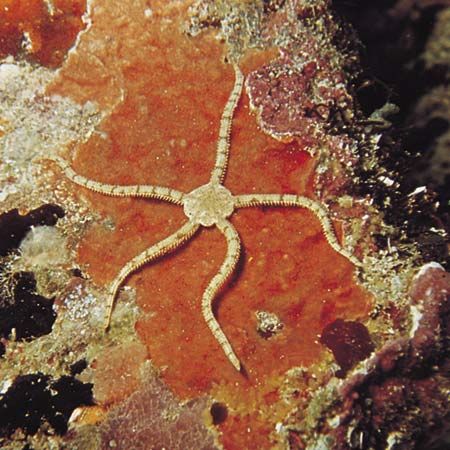
- Ophiuroidea: Includes brittle stars, basket stars, and serpent stars. They are distinguished by a small, central disk and long, slender, flexible arms.678
- Echinoidea: This group includes sea urchins, heart urchins, and sand dollars, which possess a rigid skeleton (test) covered in movable spines.67
- Holothuroidea: Known as sea cucumbers, these animals have elongated, cylindrical bodies and a ring of feeding tentacles around the mouth.67
- Concentricycloidea: Known as sea daisies, these are small, disk-shaped animals without obvious arms, discovered relatively recently in the 1980s.67
How do feather stars use their cirri to move?
Feather stars do not use their cirri for locomotion. Instead, these grasping structures, often referred to as “legs,” are used to perch on sponges, corals, or other substrata, allowing the animal to remain stationary while it feeds on drifting microorganisms.1
When feather stars need to move, they rely on their arms rather than their cirri. They typically swim by coordinating the thrashing of their arms in an up-and-down motion, or they pull themselves across surfaces using their arms if they are not swimming.5
Sources
- feather star — Encyclopædia Britannica
- feather star — Merriam-Webster
- crinoid — Encyclopædia Britannica
- sea lily — Encyclopædia Britannica
- echinoderm - Locomotion — Encyclopædia Britannica
- echinoderm - Annotated classification — Encyclopædia Britannica
- echinoderm — Encyclopædia Britannica
- brittle star — Encyclopædia Britannica
- malacostracan - Locomotion — Encyclopædia Britannica
- cirripede - The digestive system — Encyclopædia Britannica
Published on · 3 min read