Cystoid
The term "cystoid" refers to an extinct class of primitive echinoderms known as Cystoidea. These marine animals, which are related to modern starfish and sea…
What is cystoid?
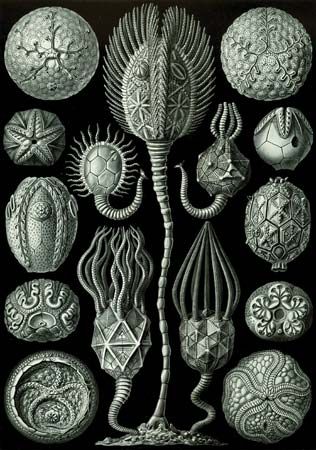
The term “cystoid” refers to an extinct class of primitive echinoderms known as Cystoidea. These marine animals, which are related to modern starfish and sea lilies, first appeared during the Middle Ordovician Epoch and persisted until the Late Devonian Epoch.1
Cystoids were characterized by saclike bodies covered in numerous calcareous plates and were typically attached to the seafloor by a stem. Because they were once diverse and widespread, their remains serve as important index fossils, helping geologists correlate rock units across different regions.1
It is important to distinguish this biological classification from a cyst, which is an enclosed, membrane-bound sac found within body tissues that may contain liquid or other materials.2
What are other examples of extinct echinoderms?
Beyond the cystoid, the fossil record reveals several other extinct classes of echinoderms that exhibited diverse and often bizarre body forms as the phylum evolved. Notable examples include:3
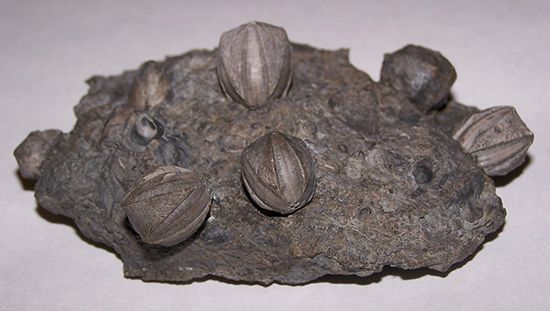
- Blastoid (class Blastoidea): Sedentary, stalked animals that existed from the Middle Ordovician to the Late Permian. They are distinguished by a highly regular structure consisting of 13 calcium carbonate plates arranged in three circles.4
- Carpoid (class Carpoidea): Unusual, generally flat-bodied echinoderms that lacked the radial symmetry typical of the phylum. Because they possessed features such as gill slits, some scientists have theorized they may be related to primitive chordates.5
- Edrioasteroid (class Edrioasteroidea): Stationary, saclike echinoderms with flexible, plated bodies. They are often cited in studies of early echinoderm evolution due to their potential link to the development of pentamerous (five-part) symmetry.36
These groups represent the “experimental” phase of early echinoderm history, during which many unique body plans and feeding mechanisms emerged.3
How do index fossils help scientists date rock layers?
Index fossils are essential tools for dating rock layers and defining boundaries in the geologic time scale. They function based on the law of faunal succession, which observes that fossilized plants and animals appear in rock strata in a predictable, nonrepetitive order over time.1011
To be an effective index fossil, a species must meet several criteria:
- Short temporal range: The species existed for a relatively brief period, allowing for precise dating of the strata in which it is found.1012
- Wide geographic distribution: Being “cosmopolitan” allows geologists to correlate rock layers across different regions.1012
- Abundance and distinctiveness: They must be easily recognizable and common enough to be found reliably.1012
By identifying these specific fossils within separated outcrops, scientists can determine that the rocks were formed during the same interval of geologic history. This process, known as stratigraphic correlation, allows researchers to piece together Earth’s history even when physical rock layers are geographically distant.1211
What are the main differences between cystoids and modern starfish?
Cystoids and modern starfish (asteroids) represent two very different evolutionary strategies within the phylum Echinodermata. The primary differences between these extinct organisms and their modern counterparts are summarized below:
Body Plan and Lifestyle
- Cystoids: These were primitive, sedentary animals that lived attached to the seafloor by a stem or stalk. Their bodies were saclike and covered in numerous calcareous plates. As an extinct class, they represent an early stage of echinoderm evolution.2
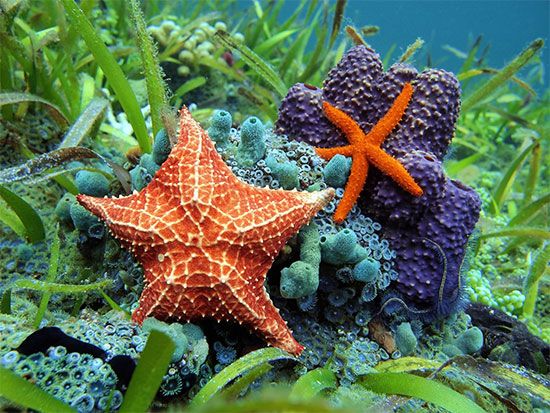
- Starfish: Modern starfish are generally mobile, free-living organisms. They possess a large central disk from which five or more hollow arms radiate, a structure that allows for active movement and predation.13
Symmetry
- Cystoids: While echinoderms eventually developed radial symmetry, early forms like the cystoids were more primitive in their organization.213
- Starfish: Starfish exhibit a highly developed pentamerous (five-part) radial symmetry. This pattern is reflected in their skeletal structure, nervous system, and the arrangement of their tube feet, which radiate from the mouth along the arms in specialized grooves called ambulacral furrows.13
Feeding Mechanisms
- Cystoids: As stationary organisms, they were limited to feeding methods appropriate for a fixed position on the seafloor.2
- Starfish: Starfish are active, selective predators. Many species use their tube feet to exert a relentless pull on the shells of prey, such as bivalve mollusks, and then evert their stomachs through their mouths to digest the prey externally.1415
Sources
- cyst — Encyclopædia Britannica
- cystoid — Encyclopædia Britannica
- echinoderm - Extinct echinoderms — Encyclopædia Britannica
- List of echinoderms — Encyclopædia Britannica
- echinoderm - Extant echinoderms — Encyclopædia Britannica
- edrioasteroid — Merriam-Webster
- Edrioasteroidea — Merriam-Webster
- blastoid — Encyclopædia Britannica
- carpoid — Encyclopædia Britannica
- index fossil — Encyclopædia Britannica
- law of faunal succession — Encyclopædia Britannica
- dating - Principles and techniques — Encyclopædia Britannica
- Morphology - Body plan and symmetry — Encyclopædia Britannica
- echinoderm - Food and feeding habits — Encyclopædia Britannica
- echinoderm - Symmetry and body form — Encyclopædia Britannica
- Feeding behaviour - Types of food procurement — Encyclopædia Britannica
Published on · 3 min read