Cusk Eel
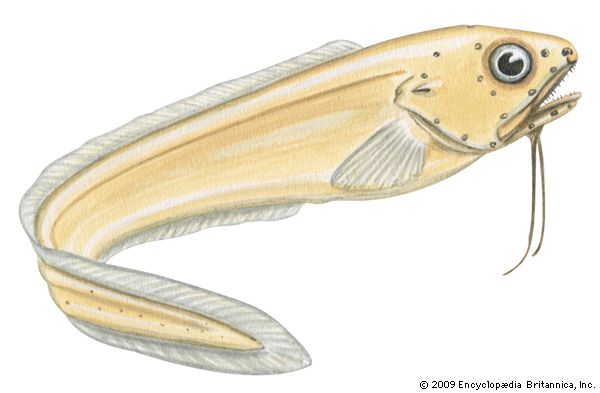
A cusk eel is any of approximately 30 species of slim, eel-like marine fish belonging to the family Ophidiidae. These fish are found globally in warm and…
What is cusk eel?
A cusk eel is any of approximately 30 species of slim, eel-like marine fish belonging to the family Ophidiidae. These fish are found globally in warm and temperate waters, primarily inhabiting deep-sea environments, though some species reside in shallow water.1
Key characteristics include:
- Fins: The dorsal, anal, and tail fins are joined into a single, continuous fin.1
- Sensory Organs: They possess feeler-like pelvic fins located on the throat, which function as sensory devices to locate food along the ocean floor.1
- Size: Most species grow to a maximum length of 0.6 meters (2 feet), though two specific species can exceed 1.5 meters (5 feet).1
One notable species is the kingklip (Genypterus capensis), a South African fish that is highly valued as a food source.1
How do cusk eels use their throat fins to find food?
Cusk eels utilize their pelvic fins, which are positioned on the throat, as specialized sensory devices to locate food. As the fish swims just above the ocean floor, it keeps these feeler-like fins in a continuous probing motion to detect potential prey.13
Are cusk eels actually related to true eels?
Despite their name and superficial physical resemblance, cusk eels are not true eels. While they share an elongated, eel-like profile, they belong to the family Ophidiidae, whereas true eels are classified within the order Anguilliformes.19
The primary biological differences include:
- Classification: True eels belong to the order Anguilliformes, which is characterized by the absence of pelvic fins and a specific larval stage known as a leptocephalus.9
- Anatomy: Cusk eels possess feeler-like pelvic fins located on their throats, which they use as sensory organs to locate food along the ocean floor. In contrast, true eels lack pelvic fins entirely.19
- Fin Structure: Cusk eels have dorsal, anal, and tail fins that are joined into a single, continuous fin. While true eels also have a continuous median fin, their internal skeletal and cranial structures differ significantly from those of the Ophidiidae family.19
What makes the kingklip a popular food source?
The kingklip (Genypterus capensis), a type of cusk eel found in the waters of southern Africa, is highly esteemed as a food source primarily due to its exceptional flavor and culinary versatility.10
Beyond its firm, white flesh, the fish is particularly prized for its liver, which is considered a delicacy with a flavor profile often compared favorably to that of chicken liver. As a large fish that can reach lengths of up to five feet, it provides a substantial and high-quality yield for commercial and recreational fisheries in the region.10
Sources
- cusk eel — Encyclopædia Britannica
- cusk eel — Merriam-Webster
- Senses - Electric sense — Encyclopædia Britannica
- Animal communication - Signal reception — Encyclopædia Britannica
- eel - Form and function — Encyclopædia Britannica
- Mechanoreception - The sense of touch — Encyclopædia Britannica
- fish - Locomotion — Encyclopædia Britannica
- paracanthopterygian - Form and function — Encyclopædia Britannica
- eel - Annotated classification — Encyclopædia Britannica
- kingklip — Merriam-Webster
Published on · 2 min read