Cypress Pine
Cypress pine refers to any of the 15 species of coniferous trees and shrubs belonging to the genus Callitris within the cypress family (Cupressaceae). Native…
What is Cypress pine?
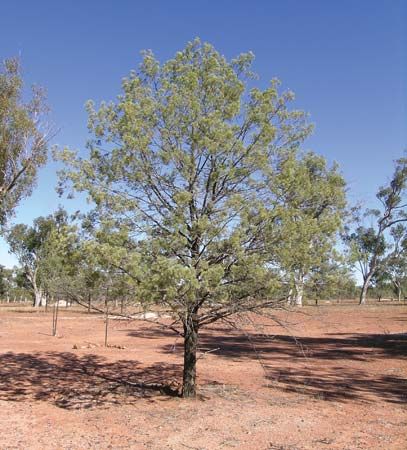
Cypress pine refers to any of the 15 species of coniferous trees and shrubs belonging to the genus Callitris within the cypress family (Cupressaceae). Native to Australasia, these evergreen plants are well-adapted to arid environments.1
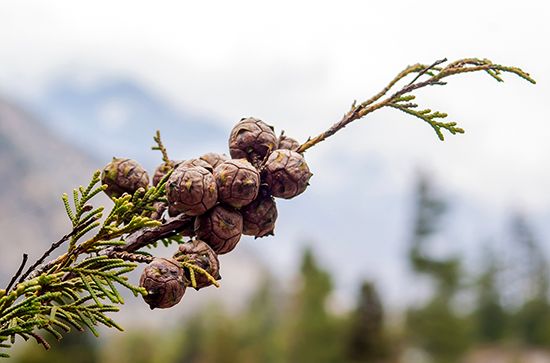
Physically, cypress pines are characterized by scalelike leaves arranged in whorls of three, with tips that often curve inward. Their female cones are typically round and feature six woody scales. Many species are fire-adapted, releasing their seeds specifically after a wildfire.1
Economically, the wood of the cypress pine is valued for being attractively marked and resistant to termite attack. Various products, including tannin, sandarac resin, and fragrant oils, can be extracted from the trees. While some species are cultivated as ornamentals, others, such as the Murray River pine, serve as important timber sources.1
How do cypress pines survive in arid environments?
Cypress pines (genus Callitris) are well-adapted to thrive in arid environments, where they are native to Australasia. Their survival in these challenging conditions is supported by specific biological and reproductive strategies:1
- Fire Adaptation: Many cypress pine species are fire-dependent, meaning they rely on wildfire as an ecological disturbance to regenerate. In these woodlands, fires clear the understory to bare soil, which stimulates the germination and establishment of seeds.14
- Seed Protection: These trees produce cones that protect their seeds from the intense heat of a fire. Following a conflagration, the cones open to scatter seeds onto an ash-fertilized seed bed, ensuring the next generation can take root in the cleared environment.4
- Physical Structure: As evergreens, they possess small, scalelike leaves arranged in whorls of three, with tips that often curve inward. This structure is typical of many conifers and helps the plant manage water loss and survive in dry, arid localities.1
Why is cypress pine wood resistant to termites?
Cypress pine wood is naturally resistant to termite attack, a characteristic that makes it a valued timber for construction. While the specific chemical mechanism is not detailed in the provided text, this resistance is a recognized property of the genus Callitris.2
In general forestry, trees often develop natural defenses against pests, and foresters may select or breed specific trees for such inherent resistances to avoid the need for expensive direct control measures. The wood of the cypress pine is also noted for being attractively marked and capable of yielding tannin, sandarac resin, and fragrant oils, which may contribute to its durability.12
What are the main differences between conifers and other types of trees?
Conifers, which belong to the division Pinophyta, are a distinct group of gymnosperms that differ significantly from angiosperms (flowering plants) in their reproductive structures, internal anatomy, and life cycles.
Reproductive Differences
The most fundamental distinction lies in how these plants reproduce:
- Seeds: Conifers produce “naked seeds” that are typically formed in cones (strobili) and are exposed to the air at the time of pollination. In contrast, angiosperms enclose their seeds within an ovary, which develops into a protective fruit.69
- Flowers: Conifers lack flowers, whereas angiosperms utilize flowers to facilitate reproduction, often employing diverse pollination strategies.9
- Fertilization: Angiosperms undergo double fertilization, a process that creates a unique food-storage tissue called endosperm. Conifers do not perform double fertilization; their seeds rely on a multicellular female gametophyte for food storage.6
Structural and Anatomical Differences
- Conducting Tissues: Conifer wood is generally simpler than that of angiosperms. It consists primarily of tracheids for water transport and support. Angiosperms typically possess a more complex system that includes specialized vessels and fibers, which is why conifer wood is often referred to as “softwood” and angiosperm wood as “hardwood.”10611
- Leaves: While some conifers have broad blades, most possess simple, small, needlelike or scalelike leaves that are often evergreen, allowing them to persist through various seasons.10
Sources
- cypress pine — Encyclopædia Britannica
- cypress — Encyclopædia Britannica
- conifer - Economic importance — Encyclopædia Britannica
- conifer - Sporophyte phase — Encyclopædia Britannica
- Tree - Tree roots — Encyclopædia Britannica
- gymnosperm - Pinophyta — Encyclopædia Britannica
- forestry - Insect and disease control — Encyclopædia Britannica
- pine - Physical description and natural history — Encyclopædia Britannica
- Angiosperm - General characteristics — Encyclopædia Britannica
- What’s the Difference Between Angiosperms and Gymnosperms? — Encyclopædia Britannica
- conifer - Strobili — Encyclopædia Britannica
- conifer - Stem — Encyclopædia Britannica
Published on · 3 min read