Date Palm
Date palms typically begin to bear fruit 4 to 5 years after planting. They reach their full fruit-bearing capacity between 10 and 15 years of age, at which…
How long does it take for a date palm to produce fruit, and what is its lifespan?
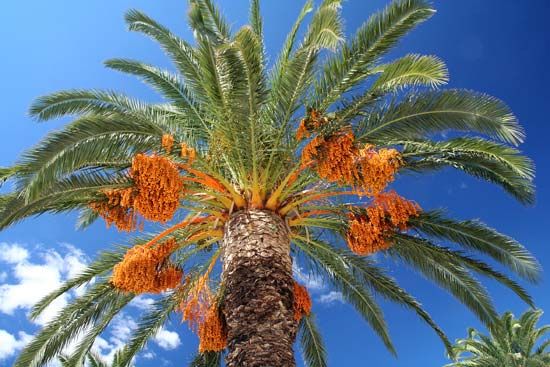
Date palms typically begin to bear fruit 4 to 5 years after planting. They reach their full fruit-bearing capacity between 10 and 15 years of age, at which point a single tree can yield 40 to 80 kg (90 to 180 pounds) or more of fruit.
Regarding their longevity, date palms are known to live as long as 150 years. However, because fruit production naturally declines as the tree ages, they are often replaced at an earlier age in commercial cultivation.
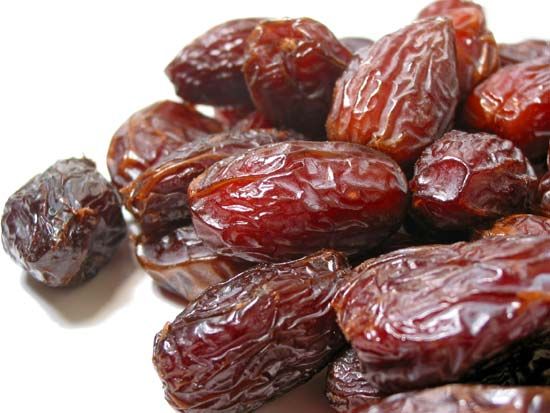
How have date palms influenced the culture and economy of regions where they are grown?
The date palm (Phoenix dactylifera) has been a cornerstone of life in the arid regions of North Africa and the Middle East since antiquity. Its influence spans both essential economic utility and deep cultural significance.1
Economic Impact
The date palm is often described as a tree of life because nearly every part provides economic value:
- Food and Trade: The fruit serves as a staple food and a primary source of wealth in irrigable desert regions. Because dates have a long shelf life, they are a vital article of commerce, with countries like Egypt, Iran, Saudi Arabia, and Iraq leading global production.1
- Versatile Materials: Beyond the fruit, the trunk provides timber, while leaves and leaf bases are used for furniture, basketry, fuel, and rope. The sap is consumed as a beverage, and seeds are repurposed as stock feed.1
- Local Livelihoods: For centuries, palms have provided the necessities of life for tropical and desert communities, supporting local economies through the production of syrup, vinegar, and various fibers.13
Cultural Significance
The tree holds a prominent place in religious and social traditions:
- Religious Observance: Its leaves are used in the celebration of Palm Sunday by Christians and for the Sukkoth (Feast of Tabernacles) by Jewish communities.1
- Ornamental Use: Due to its graceful appearance, the date palm is widely cultivated as an ornamental tree in warm climates worldwide.1
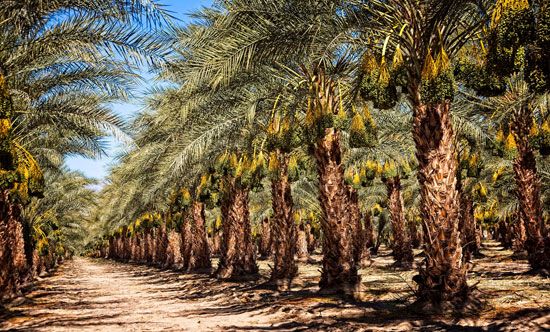
What are some traditional and modern uses of date palms beyond fruit production?
The date palm (Phoenix dactylifera) is often referred to as a “tree of life” because nearly every part of the plant serves a practical purpose beyond its fruit. These uses have been essential to local economies and domestic life for centuries.1
Traditional and Structural Uses
- Construction and Furniture: The trunk provides durable timber for building, while the midribs of the leaves are used to craft furniture and crates.1
- Crafts and Textiles: The leaflets are woven into baskets, and the tree’s fiber is utilized for cordage and packing materials. Fruit stalks are traditionally repurposed as rope or fuel.1
- Fuel: Both the leaf bases and fruit stalks are commonly used as a source of fuel.1
- Culinary Derivatives: Beyond the fruit itself, the sap can be consumed as a beverage, either fresh or fermented. When a tree is cut down, the tender terminal bud is harvested and eaten as a salad.1
Modern and Ornamental Applications
- Commercial Processing: The fruit is processed into various products, including syrup, vinegar, alcohol, and strong liquor.1
- Ornamental Cultivation: Due to its graceful appearance, the date palm is widely planted as an ornamental tree in warm climates globally.1
- Religious Significance: The leaves hold cultural and religious importance, notably in the celebration of Palm Sunday and the Jewish festival of Sukkoth.1
How are date palms cultivated and harvested?
The cultivation and harvesting of date palms (Phoenix dactylifera) involve specific horticultural practices to ensure high-quality yields.
Cultivation
- Propagation: While palms can be grown from seeds, commercial plantings rely on offshoots (suckers) that emerge near the base of the stem. These are removed when they are three to six years old and have developed their own root systems.1
- Pollination: Because male and female flowers are borne on separate plants, artificial pollination is a standard practice in commercial cultivation to ensure successful fruit set. This involves collecting and applying pollen directly to the female flowers.14
- Growth Cycle: Palms typically begin bearing fruit within 4 to 5 years and reach full production between 10 and 15 years. A single tree can yield 40 to 80 kg (90 to 180 pounds) or more of fruit annually.1
Harvesting
Dates grow in large bunches, with more than 1,000 fruits appearing on a single cluster that can weigh 8 kg (18 pounds) or more. The fruit is harvested once it reaches maturity, after which it is either sold as fresh produce or processed and dried for long-term storage.1
Sources
- Date palm — Encyclopædia Britannica
- Palm - Ecology — Encyclopædia Britannica
- Palm - Economic importance — Encyclopædia Britannica
- Fruit farming - Pollination — Encyclopædia Britannica
Published on · 4 min read