Helwingia
Helwingia is a genus consisting of three species of shrubs that make up the family Helwingiaceae within the order Aquifoliales. These plants are native to…
What is Helwingia?
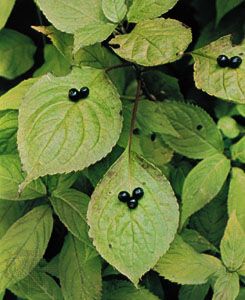
Helwingia is a genus consisting of three species of shrubs that make up the family Helwingiaceae within the order Aquifoliales. These plants are native to the Himalayas and eastern Asia.1
The genus is notable for its unique reproductive characteristics. The plants are dioecious, meaning male and female flowers grow on separate individual plants. Most distinctively, the flowers appear to emerge directly from the leaves, as their stems are fused to the midribs of the foliage. Male flowers typically grow in clusters, while female flowers are found either singly or in small groups.1
What does it mean for a plant to be dioecious?
A plant is considered dioecious when it is unisexual, meaning that male and female reproductive structures are produced on separate individual plants. In these species, some individuals produce only pollen-bearing (staminate) flowers or cones, while others produce only ovule-bearing (pistillate) flowers or cones.234
This reproductive strategy is distinct from monoecious plants, which possess both male and female structures on the same individual, or plants with bisexual (hermaphroditic) flowers. By separating the sexes, dioecious plants ensure genetic outcrossing, which promotes genetic variability within a population. This variability is an evolutionary advantage, as it allows offspring to combine hereditary traits from two different parents, potentially increasing the species’ ability to adapt to changing environments. Examples of dioecious plants include ginkgo, willows, kiwi, and date palms.234
How do plants benefit from having flowers grow on their leaves?
While the phenomenon of flowers growing from leaves—a condition known as being epiphyllous—is a striking botanical feature of the genus Helwingia, the provided search results do not specify a particular evolutionary or functional benefit for this growth pattern.15
In general, plant reproductive strategies are often shaped by the need to optimize pollination. For instance, many plants position their flowers to maximize exposure to wind or to attract specific pollinators, such as insects. While wind-pollinated plants often bloom before leaves emerge to avoid obstruction, or place flowers high on the plant to catch breezes, the specific advantage of the fused stems found in Helwingia remains a subject of botanical study rather than a confirmed evolutionary adaptation for pollination efficiency.61
What other plants are in the order Aquifoliales?
The order Aquifoliales comprises five distinct families of flowering plants. While the Aquifoliaceae family (the holly family) is the most prominent, the order also includes the following four families:78
- Helwingiaceae: This family consists of the genus Helwingia, which includes three species of shrubs native to eastern Asia known for their unique flowers that emerge directly from the leaf surface.71
- Phyllonomaceae: This family contains the single woody genus Phyllonoma, which includes four species ranging from Mexico to Bolivia. Like Helwingia, these plants produce flowers that emerge from their leaves.7
- Stemonuraceae: This family includes 12 genera and 95 species found in tropical regions from Southeast Asia to Australia. The largest genera in this group are Gomphandra and Stemonurus.7
- Cardiopteridaceae: This family comprises five genera and approximately 45 species. Its largest genus is Citronella, which contains 21 species.7
Sources
- Helwingia — Encyclopædia Britannica
- Do Plants Have Sexes? — Encyclopædia Britannica
- sexual reproduction — Encyclopædia Britannica
- cross-pollination — Encyclopædia Britannica
- epiphyllous — Merriam-Webster
- pollination - Wind — Encyclopædia Britannica
- Aquifoliales — Encyclopædia Britannica
- angiosperm - Annotated classification — Encyclopædia Britannica
Published on · 2 min read