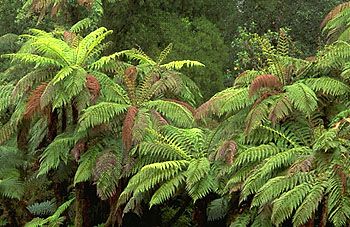
Dicksoniaceae
The Dicksoniaceae family, a group of tree ferns, possesses a significant and diverse fossil record that dates back to the Triassic Period (approximately 251…
What is the evolutionary history of the Dicksoniaceae family?
The Dicksoniaceae family, a group of tree ferns, possesses a significant and diverse fossil record that dates back to the Triassic Period (approximately 251 to 199.6 million years ago).12
During the subsequent Jurassic and Cretaceous periods, members of the family were both diverse and relatively common. However, the evolutionary trajectory of these plants was impacted by the mass extinction event that occurred at the end of the Cretaceous Period. This event is believed to have opened new ecological niches, which facilitated a subsequent period of diversification.2
While the family’s history is ancient, the modern genera associated with Dicksoniaceae only became evident during the early Cenozoic era (65.5 to 2.6 million years ago). Today, the family comprises about three genera and approximately 30 species, which are widely distributed as components of humid tropical forests.21
What are some of the most well-known species within the Dicksoniaceae family?
The Dicksoniaceae family contains approximately 30 species across three genera, though classification can sometimes vary between botanical sources. It is important to note that while some older or alternative classifications may group certain genera with the Cyatheaceae family, the genus Dicksonia is a primary representative of the Dicksoniaceae family.13
Notable species include:
- Dicksonia antarctica: This is perhaps the most well-known species within the genus. It is a large tree fern frequently cultivated for its ornamental value and is recognized for its robust, trunklike stem.3
- Lophosoria quadripinnata: Formerly classified within its own family (Lophosoriaceae), this species is now assigned to Dicksoniaceae. It is a widespread small tree fern found in Neotropical mountains, ranging from southern Mexico to Bolivia and Brazil, as well as on islands such as Cuba and the Juan Fernández Islands.1
These plants are characterized by their vertical rhizomes and highly divided leaves, which often feature conspicuous multicellular hairs.1
What is the ecological importance of Dicksoniaceae in their native habitats?
Members of the Dicksoniaceae family are integral components of humid tropical forests worldwide, where they contribute to the structural complexity of these ecosystems. As tree ferns, they possess arborescent habits with vertical rhizomes that can reach significant heights, providing a unique vertical dimension to the forest understory and canopy layers.12
Ecologically, these plants serve as vital habitats for other organisms. Their trunks are often covered in a dense mantle of adventitious roots, which can support epiphytic plants and other small organisms that rely on this fibrous, nonrotting substrate. Furthermore, as part of the broader group of tree ferns, they play roles in successional habitats; some species act as early colonizers in disturbed areas, helping to stabilize soil and facilitate the development of more mature forest communities.2
It is important to note that these plants face significant conservation threats due to human activity, including overcollection for use as horticultural substrates and decorative crafts, which has necessitated their protection under international trade regulations.2
How have Dicksoniaceae plants adapted to their environments over time?
The Dicksoniaceae family has demonstrated remarkable evolutionary resilience, with a fossil record extending back to the Triassic Period (251 million to 199.6 million years ago). Their survival through significant geological shifts, including the mass extinction at the end of the Cretaceous Period, allowed for subsequent diversification during the early Cenozoic.12
Key adaptations include:
- Structural Growth: Unlike seed plants, their trunks are rhizomes modified for vertical growth. These are embedded in a dense mantle of adventitious roots, which provides stability and support for their arborescent habit.12
- Reproductive Protection: The sori are strategically located along the edges of leaf segments. They are protected by a combination of curled leaf margins and a membranous indusium, creating a cuplike structure that shields the sporangia from environmental stressors.1
- Morphological Defense: Instead of scales, these ferns utilize conspicuous multicellular hairs, particularly on the petioles, which serve as a distinct evolutionary trait compared to other tree fern families.12
We could dive deeper into how these specific reproductive strategies compare to those of the Cyatheaceae family.
Sources
- Dicksoniaceae — Encyclopædia Britannica
- tree fern — Encyclopædia Britannica
- Dicksonia — Merriam-Webster
Published on · 3 min read