Hypsilophodon
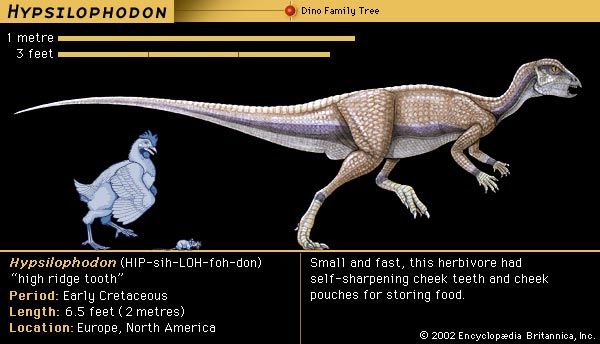
Hypsilophodon was a small to medium-sized herbivorous dinosaur that lived during the Early Cretaceous Period. Contrary to older theories suggesting it was…
What role did Hypsilophodon play in its ecosystem?
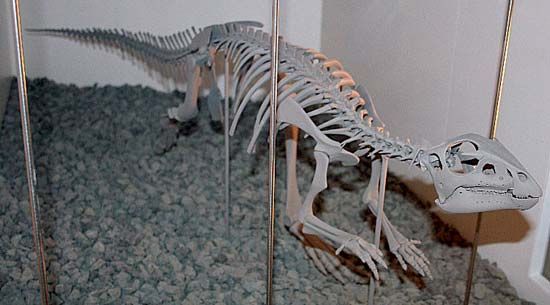
Hypsilophodon was a small to medium-sized herbivorous dinosaur that lived during the Early Cretaceous Period. Contrary to older theories suggesting it was arboreal, it is now understood to have been a ground-dwelling animal.1
In its ecosystem, Hypsilophodon functioned as a primary consumer. It was well-adapted for a herbivorous diet, utilizing incisor-like teeth in its horny beak to nip off vegetation, while its high, grooved, self-sharpening cheek teeth were specialized for grinding plant matter. As a member of the ornithopod group, it shared its environment with other herbivores, including early iguanodontids.1
How do paleontologists determine the age of Hypsilophodon fossils?
Paleontologists determine the age of Hypsilophodon fossils and the rocks in which they are found by using a combination of relative and absolute dating methods.
Relative Dating
The primary method for correlating Cretaceous rocks is through the use of fossils. By identifying specific index fossils—such as ammonites, belemnites, or inoceramid bivalves—researchers can place the fossil within a specific biozone or stage of the Cretaceous Period. This allows scientists to establish the relative age of the specimen based on its position within the stratigraphic record.21
Absolute Dating
To assign a specific numerical age to these geological layers, paleontologists utilize radiometric dating. This technique measures the decay of radioactive isotopes within minerals found in the surrounding rock, such as volcanic ash beds. By calculating the ratio of parent isotopes to daughter isotopes (e.g., uranium-238 to lead-206 or potassium-40 to argon-40), scientists can determine the age of the formation in millions of years.342
How has our understanding of Hypsilophodon changed since its initial discovery?
Our understanding of Hypsilophodon has evolved significantly since its initial discovery, particularly regarding its lifestyle and habitat.
For many decades, paleontologists operated under the assumption that Hypsilophodon was an arboreal (tree-dwelling) animal. This theory was based on an early, incorrect reconstruction of the dinosaur’s foot, which led researchers to believe the creature possessed the ability to grasp branches and perch in trees.
Modern scientific consensus has corrected this view. Hypsilophodon is now recognized as a ground-dwelling animal with a conventional ornithopod foot. This shift in understanding aligns it more accurately with its classification as a member of the Hypsilophodontidae, a widespread and enduring family of dinosaurs that flourished from the Late Jurassic to the Late Cretaceous Period. Rather than climbing, these dinosaurs are now understood to have been speedy runners that occupied a terrestrial niche, using their specialized teeth to grind vegetation while moving across the landscape.
How big was Hypsilophodon compared to modern animals?
Hypsilophodon was a small to medium-sized herbivorous dinosaur that reached lengths of up to 2 meters (6.5 feet) and weighed approximately 60 kg (130 pounds).1
To put this size into perspective compared to modern animals:
- Weight: At 60 kg, Hypsilophodon was roughly the size and weight of a large adult human or a medium-sized dog, such as a Labrador Retriever or a Boxer.
- Length: Its 2-meter length is comparable to the total length of a large adult kangaroo or a medium-sized shark, though its bipedal, ground-dwelling posture would have made it appear quite different in profile.1
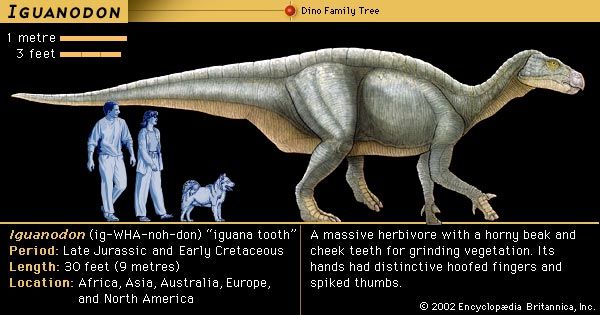
While Hypsilophodon was relatively small, it was part of the ornithopod group, which included much larger relatives like the iguanodontids (reaching about 9 meters) and the massive duck-billed hadrosaurs.17
Sources
- Hypsilophodon — Encyclopædia Britannica
- Did you know? — Merriam-Webster
- geology - Isotopic geochemistry — Encyclopædia Britannica
- Cretaceous Period - Correlation — Encyclopædia Britannica
- Cretaceous Period - Major subdivisions of the Cretaceous System — Encyclopædia Britannica
- ornithopod — Encyclopædia Britannica
- Hypsilophodon — Merriam-Webster
- dinosaur - Ornithopoda — Encyclopædia Britannica
Published on · 3 min read