Do Camels Store Water in Their Humps?
It is a common misconception that camels store water in their humps. In reality, a camel's hump is composed of fatty tissue, which serves as a vital energy…
Do Camels Store Water in Their Humps?
It is a common misconception that camels store water in their humps. In reality, a camel’s hump is composed of fatty tissue, which serves as a vital energy reserve when food is scarce.1
When a camel cannot find food, its body metabolizes this stored fat for nourishment. As the fat is depleted, the hump may deflate or droop, only to return to an upright position once the animal is able to refuel. Beyond providing nutrition, the concentration of fat in the hump helps the camel regulate its body temperature by minimizing heat insulation across the rest of its body, allowing excess heat to dissipate more effectively.12
Camels are able to survive in arid environments not because of water storage in their humps, but because of their remarkable ability to conserve water and tolerate dehydration. This efficiency is supported by their unique, oval-shaped red blood cells, which allow them to consume large volumes of water rapidly without bursting under osmotic stress.12
How do oval-shaped blood cells help camels survive?
The oval shape of a camel’s red blood cells is a critical adaptation for survival in arid environments, providing two primary physiological advantages:
- Rapid Rehydration: Because these cells are more elastic and flexible than the circular blood cells found in most other mammals, they can change shape more easily. This allows a camel to consume and process massive quantities of water—up to 30 gallons in a single sitting—without the cells bursting under the resulting osmotic stress.1
- Improved Circulation: When water is scarce and the animal becomes dehydrated, the blood can become thicker and more difficult to pump. The oval shape of the cells helps the blood flow more easily through the circulatory system, ensuring the camel remains functional even during prolonged periods without access to water.1
These specialized cells are a key reason why camels can endure harsh desert conditions, allowing them to maintain hydration levels that would be fatal to many other species.1
What are the main differences between dromedary and Bactrian camels?
The primary differences between dromedary (Arabian) camels and Bactrian camels are rooted in their physical anatomy and environmental adaptations.
Key Physical Differences
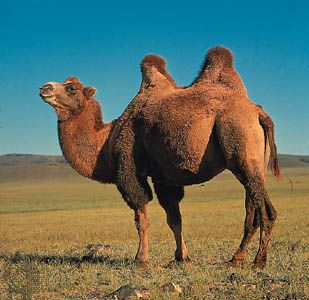
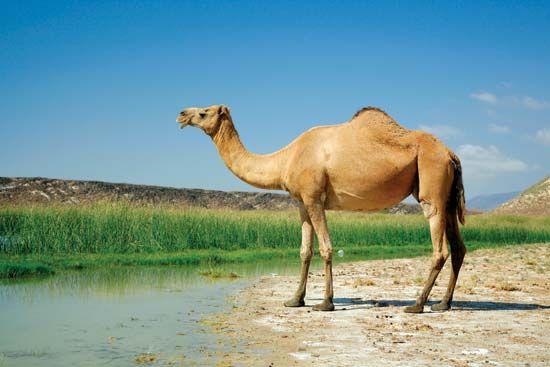
- Humps: The most distinct difference is the number of humps. Dromedaries have one hump, while Bactrian camels have two.23
- Stature and Build: Bactrian camels are generally stockier, heavier, and have longer hair compared to the more lightly built dromedaries.23
- Protective Callosities: Dromedaries possess horny pads on their chest and knees to protect them from searing desert sand when they lie down; Bactrian camels lack these callosities.2
- Foot Structure: Dromedaries have soft, wide-spreading pads specifically adapted for walking on sand, whereas Bactrian camels have firmer feet.2
Habitat and Adaptation
- Climate: Dromedaries are primarily found in the arid regions of North Africa and the Middle East. Bactrian camels are adapted to the harsh, cold winters of the Eurasian steppes, growing long, woolly coats in the summer that are shed in large tufts during the spring.3
- Load Capacity: Bactrian camels are generally stronger, capable of carrying loads up to 270 kg (595 pounds), while dromedaries typically carry up to 100 kg (220 pounds).23
How do camels regulate their body temperature in extreme heat?
Camels employ several sophisticated physiological adaptations to regulate their body temperature and survive in extreme desert heat:
- Fluctuating Body Temperature: Unlike many mammals that maintain a constant internal temperature, camels can allow their body temperature to rise as high as 41 °C (106 °F) before they begin to sweat. By permitting this increase, they reduce the temperature gradient between their bodies and the environment, which significantly lowers heat gain and conserves water.1
- Insulating Coat: Their fine, woolly coat acts as an insulator, which helps reduce heat gain from the environment during the day.1
- Concentrated Fat Storage: By storing fat in their humps rather than distributing it throughout their bodies, camels minimize heat insulation across the rest of their frame. This allows excess body heat to dissipate more efficiently through the skin during the cooler nighttime hours.21
- Minimizing Sweating: These combined strategies allow the camel to minimize sweating, which is a critical water-saving mechanism in arid climates.1
Sources
- Do Camels Store Water in Their Humps? — Encyclopædia Britannica
- camel - Natural history — Encyclopædia Britannica
- Bactrian camel — Encyclopædia Britannica
- Livestock farming - Camels — Encyclopædia Britannica
Published on · 3 min read