Camel
Camels typically have a lifespan of 30 to 40 years.
How long do camels typically live, and how does their lifespan compare to other large mammals?
Camels typically have a lifespan of 30 to 40 years.12
When compared to other large mammals, their longevity is notable but generally shorter than that of some other iconic species. For instance, elephants can live to be approximately 60 years old in the wild and may reach 80 years or more in captivity. While camels are well-adapted to survive in harsh, arid environments where other livestock might perish, their maximum lifespan remains significantly lower than that of the elephant, which holds one of the longest lifespans among terrestrial mammals.312
What are the different species of camels, and where are they found in the world?
There are three distinct species of camels within the genus Camelus. They are primarily distinguished by the number of humps on their backs and their geographic distribution.5
The Three Species of Camels
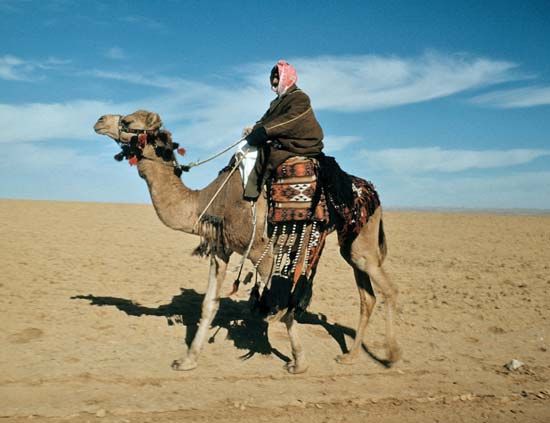
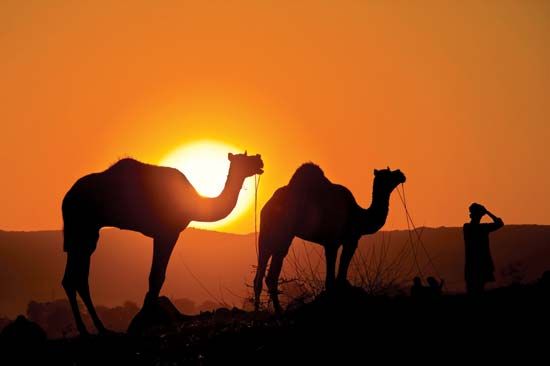
- Arabian Camel (Dromedary): Known scientifically as Camelus dromedarius, this species is characterized by a single back hump. While wild dromedaries are now extinct, there is a significant feral population in the interior of Australia, descended from animals imported in the 19th century. Today, approximately 13 million domesticated dromedaries are found primarily in India and the Horn of Africa.5
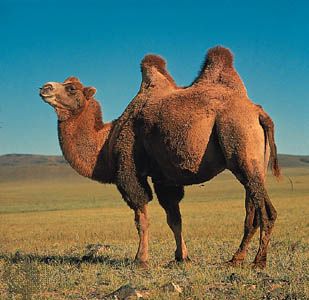
- Domesticated Bactrian Camel: (Camelus bactrianus) This species possesses two humps and is found across a wide range, extending from southern Ukraine through the Middle East and into the steppes of Mongolia and China. There are roughly one million domesticated Bactrian camels globally.56
- Wild Bactrian Camel: (Camelus ferus) Also featuring two humps, this species is distinct from its domesticated relative. It is classified as a critically endangered species and is limited to small, isolated pockets within China and Mongolia, with the largest population residing in the Gobi Desert.56
How have camels adapted to survive in harsh desert environments?
Camels have evolved remarkable physiological and behavioral adaptations that allow them to thrive in harsh, arid environments where other mammals would struggle to survive.
Water Conservation and Tolerance
Contrary to popular belief, a camel’s hump does not store water; it stores fatty tissue. This fat serves as a vital energy reserve when food is scarce. By concentrating fat in one location, the camel minimizes heat insulation across the rest of its body, allowing heat to dissipate more efficiently. Furthermore, camels possess unique oval-shaped erythrocytes that are highly elastic, enabling them to consume massive amounts of water—up to 100 liters in minutes—without the cells bursting from osmotic stress. They also conserve water by producing highly concentrated urine and dry feces.71
Thermoregulation and Physical Traits
Camels minimize water loss by reducing sweating. They can allow their body temperature to rise significantly during the day, which reduces the temperature gradient between the animal and the environment, thereby slowing heat gain. Physically, they are well-equipped for the desert:
- Feet: Their wide-spreading toes prevent them from sinking into soft sand.1
- Protection: Heavy eyelashes and closable nostrils shield them from blowing sand.1
- Diet: They can endure protein deficiency and consume tough vegetation like thorns and saltbush that other livestock avoid.1
What is unique about a camel’s digestive system compared to other mammals?
Camels are classified as pseudoruminants because their digestive system, while similar to that of true ruminants, exhibits distinct evolutionary differences.
Key Digestive Features
- Three-Chambered Stomach: Unlike the four-chambered stomach found in most ruminants (such as cattle or deer), the camel’s stomach is divided into three chambers. It lacks the clear separation between the omasum and abomasum seen in other species.89
- Glandular Pockets: The rumen and reticulum of a camel are equipped with specialized glandular pockets. These are separated by muscular walls containing sphincters, which help manage the breakdown of tough plant material.9
- Independent Evolution: Evidence suggests that camels evolved the habit of rumination—the process of regurgitating and re-chewing cud—independently of true ruminants. This is supported by the fact that the esophagus opens directly into the rumen, rather than into the area between the rumen and reticulum.9
Like other ruminants, camels rely on microorganisms within their stomach to ferment and break down cellulose, as mammalian digestive juices alone cannot digest plant cell walls.89
Sources
- camel - Natural history — Encyclopædia Britannica
- Livestock farming - Camels — Encyclopædia Britannica
- How long do elephants live? — Encyclopædia Britannica
- elephant - Reproduction and life cycle — Encyclopædia Britannica
- camel — Encyclopædia Britannica
- Bactrian camel — Encyclopædia Britannica
- Do Camels Store Water in Their Humps? — Encyclopædia Britannica
- ruminant — Encyclopædia Britannica
- artiodactyl - Digestive system — Encyclopædia Britannica
Published on · 3 min read