Do Emperor Penguins Mate for Life?
Emperor penguins do not mate for life. Instead, they are considered serially monogamous, meaning they typically form an exclusive pair bond for only a single…
Do emperor penguins mate for life?
Emperor penguins do not mate for life. Instead, they are considered serially monogamous, meaning they typically form an exclusive pair bond for only a single breeding season.1
While these birds often return to the same colony each year, the partnership rarely continues beyond one season. Research indicates that only about 15 percent of pairs reunite in successive years. If a previous mate does not return to the breeding grounds in time, the penguin will simply pair with a new partner. This behavior is likely an adaptation to the harsh Antarctic environment, where the short breeding season requires efficient cooperation to successfully raise a chick.1
During the season, the pair works together to ensure the survival of their offspring. The female lays a single egg, which the male incubates throughout the winter while fasting, before both parents eventually alternate between foraging at sea and caring for the chick.12
How do emperor penguins find their mates in a large colony?
Because emperor penguins do not build nests, they cannot rely on a fixed location to find their mates within the massive, crowded colonies where every individual looks nearly identical. Instead, they rely on a sophisticated vocal identification system.34
Emperor penguins possess a specialized vocal organ called the syrinx, which splits into two branches. This allows them to produce two different frequencies simultaneously, creating a unique “two-voiced” call with a specific beating amplitude pattern. These patterns carry enough individual information for penguins to recognize their specific mates amidst the intense background noise of the colony. Research has shown that when these birds are prevented from vocalizing, they struggle to identify each other using visual cues alone.3
This vocal recognition system is highly effective for navigating the dense, noisy environment of an Antarctic colony, allowing partners to locate one another even after long periods of separation.32
What is the purpose of the huddling behavior in emperor penguins?
The primary purpose of huddling behavior in emperor penguins is to provide mutual protection against the extreme cold and gale-force winds of the Antarctic winter.54
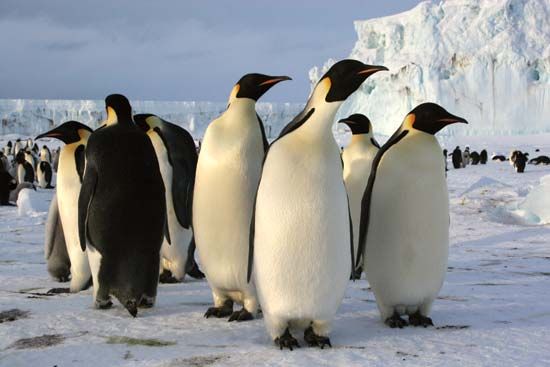
By gathering into tightly packed crowds, the penguins are able to share body heat, which is essential for survival during the harsh incubation period when temperatures can drop below –50 °C (–58 °F). This communal behavior acts as a critical survival strategy, allowing the birds to conserve energy and maintain a stable body temperature while they endure the winter without access to food.425
How do emperor penguin chicks survive the Antarctic winter?
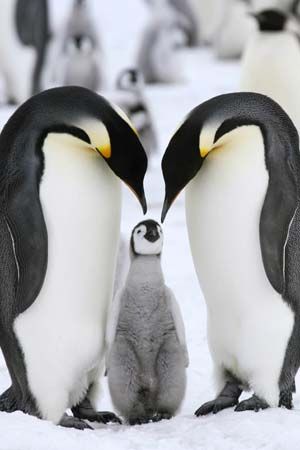
Emperor penguin chicks survive the harsh Antarctic winter through a combination of parental care and communal behavior. After hatching in August, chicks are initially kept warm by standing on the feet of one of their parents, who drapes a layer of skin over them to provide insulation. As they grow, chicks remain close to their parents’ sides to minimize exposure to the elements.542
Once the chicks are large enough, they join a nursery group known as a crèche. In these groups, many young penguins huddle together for protection against the cold and predators while both parents forage at sea. During this stage, the chicks’ initial silver-gray down is replaced by a coat of short, stiff feathers that provide better insulation.54
Throughout this period, parents continue to provide food by regurgitating a “soup” of crustaceans or fish. When a parent returns from a foraging trip, it uses vocal calls to locate and distinguish its specific chick from the others in the crèche, ensuring the young bird receives the necessary nutrition to survive until it is fully fledged.4
Sources
- Do emperor penguins mate for life? — Encyclopædia Britannica
- penguin - Reproduction — Encyclopædia Britannica
- How Do Penguins Tell Each Other Apart? — Encyclopædia Britannica
- Emperor penguin — Encyclopædia Britannica
- How do penguins stay warm? — Encyclopædia Britannica
- penguin - Form and function — Encyclopædia Britannica
Published on · 3 min read