Bird-watching
Bird-watching is a rewarding and accessible pastime that relies on a few key tools to help you observe and identify birds in their natural habitats without…
What are the essential tools and equipment needed for bird-watching?
Bird-watching is a rewarding and accessible pastime that relies on a few key tools to help you observe and identify birds in their natural habitats without causing them harm.1
The essential equipment for any bird-watcher includes:
- Binoculars: These are the most critical optical aids, allowing you to study birds from a distance with clarity.1
- Field Guide: A reliable field guide is necessary for identifying species based on their field marks.1
- Notebook: A simple notebook is used to record the time, place, and details of your sightings, which can contribute to valuable scientific data regarding migration and habitat patterns.1
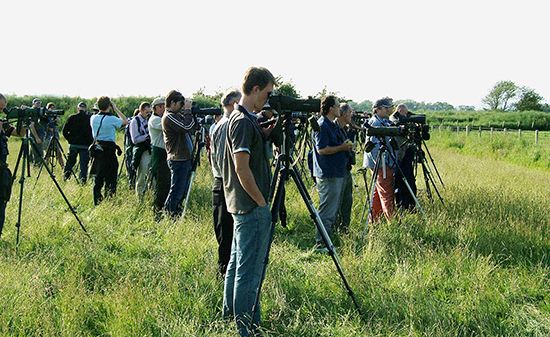
- Spotting Scope: For more advanced observation, a spotting scope—a portable telescope typically mounted on a tripod—is often used to view wildlife at greater distances.2
Beyond these tools, many enthusiasts also set up feeding stations to attract birds to their own surroundings.1
What are some popular bird-watching locations around the world?
While the provided search results detail the migratory patterns and ecological distribution of birds across regions like North America and Africa, they do not explicitly list specific, popular bird-watching locations or “hotspots” for enthusiasts to visit.
Bird-watching, or birding, is a global activity that has evolved from 19th-century collection practices into a modern pursuit focused on observation, identification, and the study of bird behavior, ecology, and migration. Because birds are found in nearly every environment—from the tundras of the north to the swampy regions of South America—popular locations are often defined by their role as critical stopovers along major migratory flyways or as high-density wintering grounds.345
If you are looking for specific destinations, birders often prioritize areas with high biodiversity or those that serve as bottlenecks for migratory species, such as coastal regions, river systems, or protected wetlands.5
How does bird-watching contribute to conservation efforts?
Bird-watching plays a vital role in conservation by transforming recreational observation into a powerful tool for scientific research and environmental advocacy.
The contributions of bird-watchers to conservation include:
- Data Collection: Amateur bird-watchers compile extensive lists of observations that provide scientists with essential data on bird dispersal, habitat usage, and migration patterns.1
- Community Science Programs: Large-scale initiatives like the Christmas Bird Count—the world’s longest-running community science program—enlist thousands of volunteers to conduct annual censuses. This data helps researchers monitor population health, range variations, and the impacts of climate change on various species.7
- Coordinated Surveys: Organizations such as the British Trust for Ornithology and the National Audubon Society coordinate amateur efforts with professional studies, enabling comprehensive monitoring of species that would be impossible for scientists to track alone.15
- Informing Policy: Statistical models derived from bird-watching data allow scientists to identify population declines and propose actionable conservation strategies to protect endangered species and their habitats.7
How do binoculars differ from spotting scopes?
Binoculars and spotting scopes are both optical instruments used for magnification, but they differ significantly in design, usage, and functionality.
Binoculars
Binoculars consist of two identical telescopes mounted on a single frame, designed for handheld use. Because they utilize both eyes, they provide a stereoscopic view that offers depth perception and improved visual acuity. They are typically characterized by two numbers (e.g., 7×50), representing magnification and the diameter of the objective lens, which dictates light-gathering power. Due to their design, they are comfortable for nature study and sports, though higher-magnification models often require a tripod to remain steady.10
Spotting Scopes
A spotting scope is essentially a portable, single-tube telescope. Unlike standard binoculars, spotting scopes are almost always mounted on a tripod because they are designed for high-magnification viewing of terrestrial objects and wildlife. While they lack the stereoscopic depth perception provided by binoculars, they are superior for observing fine details at much greater distances.2
Sources
- Bird-watching — Encyclopædia Britannica
- spotting scope — Merriam-Webster
- Bird — Encyclopædia Britannica
- Migration - In North America — Encyclopædia Britannica
- Migration - Modes of migration — Encyclopædia Britannica
- Africa - Birds of Africa — Encyclopædia Britannica
- What Is the Christmas Bird Count? — Encyclopædia Britannica
- Migration - In coastal and pelagic regions — Encyclopædia Britannica
- conservation - Fire control — Encyclopædia Britannica
- Binoculars — Encyclopædia Britannica
Published on · 3 min read