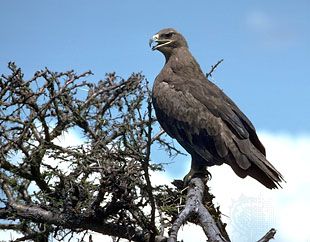
How Fast Can Eagles Fly?
Eagles typically soar at speeds of approximately 50 km (30 miles) per hour when flying at high altitudes. However, they are capable of significantly higher…
How fast can eagles fly?
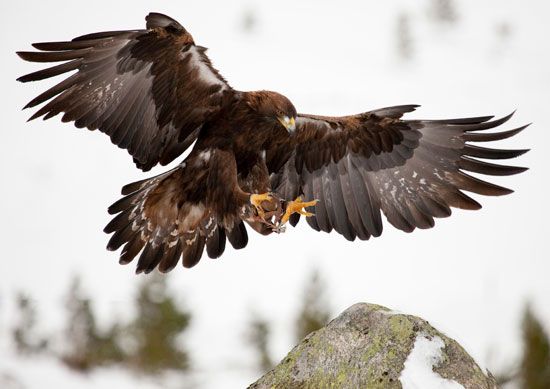
Eagles typically soar at speeds of approximately 50 km (30 miles) per hour when flying at high altitudes. However, they are capable of significantly higher speeds when diving to capture prey.1
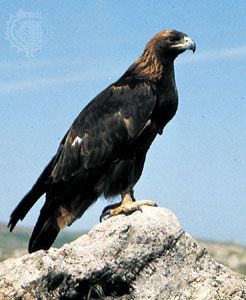
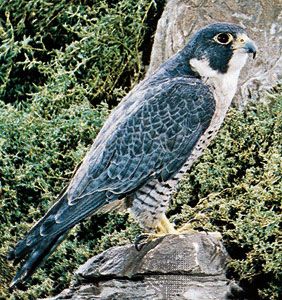
For instance, the golden eagle can reach speeds of 240 to 320 km (150 to 200 miles) per hour during a hunting swoop. While many eagles combine strong soaring and gliding abilities with agility during attacks, they generally do not match the extreme diving speeds of peregrine falcons, which are considered the fastest members of the animal kingdom.123
How do eagles use thermals to soar for long periods?
Eagles and other soaring birds utilize thermals—vertical columns of rising hot air—to gain elevation while expending minimal energy. As the ground heats up, it creates these updrafts, which often form into “thermal bubbles” at the top of the column.21
To navigate these currents, eagles employ a specific flight pattern characterized by alternating between circling and straight gliding. Because a thermal bubble rises faster than a bird descends, the eagle spirals within the updraft to be carried upward. Once the bird reaches the bottom of a bubble or finishes its ascent, it transitions into a straight gravitational glide to travel toward the next thermal.2
The ability to effectively ride these currents is influenced by the bird’s wing loading, which is the ratio of its body weight to its wing area. Eagles possess broad wings with slotted tips that reduce turbulence and increase lift, allowing them to catch and maintain their position within these air currents. Smaller species with lower wing loading can utilize smaller thermals, whereas heavier birds require larger thermal bubbles to gain height.51
What physical adaptations help eagles spot prey from high altitudes?
Eagles, like other falconiforms, possess extraordinary visual capabilities that allow them to spot prey from great heights. Their eyes are highly specialized, featuring two areas of high visual acuity known as foveae, whereas the human eye has only one. One fovea is directed laterally for monocular vision, while the other is directed forward for binocular vision, providing resolving power up to eight times greater than that of humans.7
This high resolving power is achieved by focusing a large image onto the retina and maintaining a dense concentration of rods and cones. Additionally, these birds have a screenlike structure called a pecten, which may cast a lattice-like shadow on the retina to enhance the perception of moving objects. Because their eyes move very little within their sockets, eagles must rotate their heads to track prey or scan their surroundings.7
How does wing loading affect the flight style of different bird species?
Wing loading, defined as the ratio of a bird’s body weight to its wing area, is a primary factor in determining how a species navigates the air and utilizes thermal updrafts.8
The relationship between weight and wing area dictates specific flight characteristics:
- Soaring and Thermal Use: The ability to circle in thermals is directly controlled by wing loading. Species with higher wing loading require larger thermal “bubbles” to gain height and typically have larger turning circles. Conversely, smaller species with lower wing loading can effectively utilize smaller, weaker thermals.8
- Flight Efficiency: Birds with lower wing loading generally exhibit more buoyant and easier flight. While wing loading increases proportionately with weight as the cube of body size—whereas wing area increases only as the square—some species have evolved specific adaptations to maintain lower wing loading for their size, resulting in more efficient soaring.8
- Speed and Maneuverability: High wing loading is often associated with high-speed flight and rapid diving. For example, falcons utilize their heavy, bullet-shaped bodies and high wing loading to achieve significant speeds during dives, allowing them to overtake prey that might otherwise evade them.8
Sources
- How fast can eagles fly? — Encyclopædia Britannica
- Falconiform - Flapping, soaring , and diving — Encyclopædia Britannica
- The Fastest Animals on Earth — Encyclopædia Britannica
- 11 Questions About Birds Answered — Encyclopædia Britannica
- Locomotion - Soaring — Encyclopædia Britannica
- How high do birds fly? — Encyclopædia Britannica
- Falconiform - Vision, hearing, and smell — Encyclopædia Britannica
- wing loading — Merriam-Webster
- airplane - Aerodynamics — Encyclopædia Britannica
Published on · 3 min read